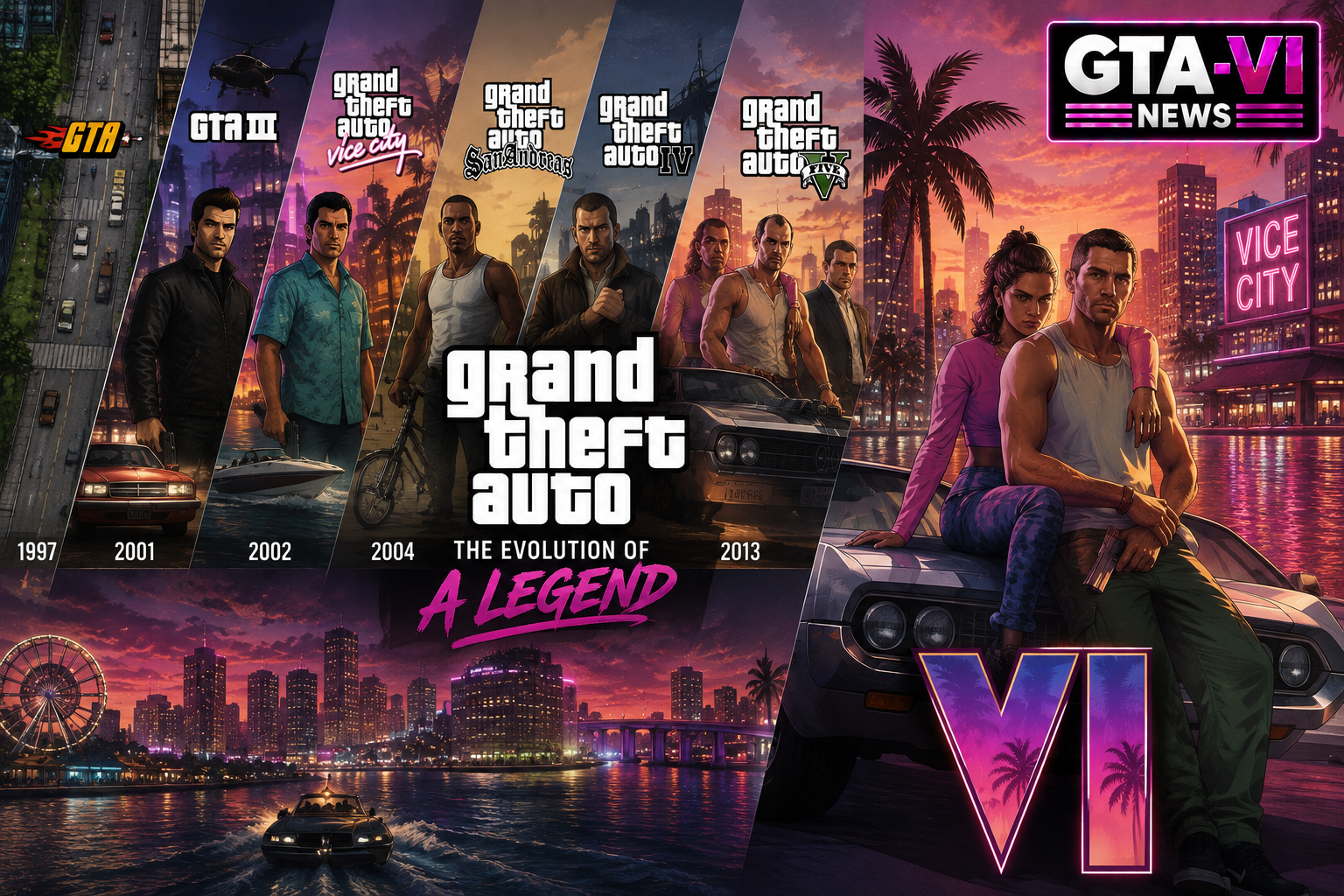
Few video game franchises have changed as dramatically as Grand Theft Auto. What began in 1997 as a chaotic top-down crime game has grown into a global entertainment phenomenon, with each major installment raising expectations for what an open world can deliver.
Now, nearly three decades later, GTA 6 is preparing to take the series back to Vice City as part of the larger state of Leonida.
The technology is almost unrecognizable compared with the original. The underlying appeal, however, remains remarkably familiar. Grand Theft Auto gives players a city, a collection of vehicles and enough freedom to create stories Rockstar never explicitly scripted.
That simple formula has survived every generation.
Grand Theft Auto Started With a Very Different Perspective
The original Grand Theft Auto arrived in 1997 and looked nothing like the modern series.
Players viewed the action from above while navigating urban streets, stealing cars and completing criminal assignments. Its presentation was basic by current standards, yet the freedom at its center was unusual.
Instead of restricting players to a tightly controlled sequence of levels, GTA encouraged experimentation.
You could follow the objectives or cause trouble simply because the game allowed it.
The early titles established several ideas that would remain fundamental to the franchise: open cities, stolen vehicles, escalating police attention and satire built around crime and popular culture.
Rockstar had the foundation. It just needed another dimension.
GTA 3 Changed Open-World Gaming
Grand Theft Auto III provided that transformation in 2001.
The move into a fully three-dimensional Liberty City changed the scale of the experience. Players could drive through streets at ground level, leave their vehicles, explore neighborhoods and encounter missions throughout the city.
Today, those features sound ordinary. In 2001, the combination felt remarkably different.
Liberty City was not simply a collection of levels connected by menus. It was one continuous playground.
GTA 3’s influence spread rapidly. Open-world design became a major part of the industry, while other developers began exploring their own versions of urban freedom.
Grand Theft Auto had moved from cult success toward mainstream dominance.
Vice City Gave GTA a Stronger Identity
Rockstar followed GTA 3 with Grand Theft Auto: Vice City in 2002.
Rather than merely expanding the technology, Vice City focused heavily on atmosphere. Its fictional interpretation of Miami embraced the music, fashion, cars and excess associated with the 1980s.
Tommy Vercetti also gave the series a more distinctive protagonist.
The result demonstrated that a GTA map could be memorable for more than its size. Radio stations, architecture and visual style could give an open world a recognizable personality.
That legacy is particularly relevant today because GTA 6 returns to Vice City, although Rockstar’s modern version is vastly larger and set in the present day.
San Andreas Expanded the Meaning of a GTA World
Then came GTA: San Andreas in 2004.
Rockstar moved beyond one central city and created a state containing Los Santos, San Fierro and Las Venturas, connected by countryside, mountains and desert.
CJ’s journey also became more personal.
Players could alter his appearance, improve skills, exercise, eat and customize vehicles. Aircraft became a larger part of exploration, while the sheer variety of environments made road trips feel like genuine journeys.
San Andreas established an expectation that Grand Theft Auto should offer more than missions.
The world itself became the attraction.
GTA 4 Chose Detail and Story Over Sheer Scale
With Grand Theft Auto IV in 2008, Rockstar changed priorities again.
Niko Bellic’s Liberty City was physically less varied than San Andreas, but it offered denser streets, improved physics and a more grounded atmosphere.
Niko also remains one of Rockstar’s most complex protagonists.
His pursuit of opportunity in America sits alongside memories of violence and disappointment. The story retained GTA’s crude humor and satire, but it also explored themes with greater seriousness than earlier installments.
Vehicle physics became heavier. Pedestrian reactions became more convincing. Liberty City felt less like a theme park and more like a place that happened to contain a crime story.
GTA 5 Turned Grand Theft Auto Into a Long-Term Platform
GTA 5 arrived in 2013 and transformed the franchise again.
Rockstar introduced three playable protagonists: Michael, Franklin and Trevor. Players could switch between them during free roam and, in certain missions, during major action sequences.
Los Santos and Blaine County also combined urban density with countryside, mountains and desert.
Yet GTA 5’s biggest legacy may ultimately be GTA Online.
The multiplayer component developed into a long-running service filled with businesses, vehicles, robberies and updates. It helped GTA 5 remain commercially relevant across three console generations.
The numbers reflect that longevity. GTA 5 has sold hundreds of millions of copies, putting it among the most successful entertainment products ever released.
That success also explains why expectations surrounding its successor are so unusual.
Red Dead Redemption 2 Raised Expectations for GTA 6
Although it belongs to another franchise, Red Dead Redemption 2 is crucial to understanding GTA 6.
Rockstar’s 2018 western pushed environmental interaction and character detail much further. NPCs appeared to follow routines. Wildlife interacted with the environment. Small encounters could develop naturally while Arthur Morgan traveled through the world.
The game also delivered one of Rockstar’s most character-focused stories.
GTA 6 now has to follow that achievement while operating in a much faster modern environment filled with cars, crowds, smartphones and dense urban activity.
That may be a harder technical challenge than simply building a larger map.
GTA 6 Brings the Series Back to Vice City
Grand Theft Auto VI returns to Vice City, but Rockstar is no longer restricting the setting to a single urban area.
The game takes place across Leonida, a fictional state inspired by Florida. Official material has shown beaches, wetlands, highways, islands and communities beyond the central city.
Rockstar has also introduced Jason and Lucia as the game’s central protagonists.
Their relationship appears to form the foundation of the story, giving GTA 6 a noticeably different setup from GTA 5’s three-character structure.
Lucia is also the first woman to lead a mainline modern Grand Theft Auto story in this way, marking another important change for the franchise.
GTA 6 Faces Expectations No Previous Entry Had to Meet
Every major GTA game has arrived with pressure, but GTA 6 occupies a different category.
Players have spent more than a decade with GTA 5. During that period, the industry changed substantially. Open-world games became common, graphics advanced dramatically and player expectations for interactive environments increased.
Simply making Leonida bigger will not be enough.
Fans will expect better NPC behavior, deeper interactions, improved physics and missions that take greater advantage of open-world freedom.
They will also expect Rockstar’s familiar attention to detail.
That is an extraordinary standard for any game.
Nearly 30 Years Later, GTA’s Core Idea Still Works
Fans may be surprised by how recognizable the original Grand Theft Auto remains beneath GTA 6’s modern technology.
The camera changed. Cities became larger. Stories grew more sophisticated. Vehicles gained detailed interiors, characters developed complex personalities and online multiplayer transformed the commercial model.
Yet the basic promise survived.
Rockstar gives players a city and asks what they want to do inside it.
From the overhead streets of 1997 to GTA 6’s Leonida, that freedom has been the franchise’s defining quality.
Rockstar’s challenge now is not reinventing Grand Theft Auto completely. It is making that familiar freedom feel surprising again after nearly 30 years.
If GTA 6 succeeds, it will continue a pattern that began with a tiny top-down crime game long before anyone imagined Vice City could look like this.