
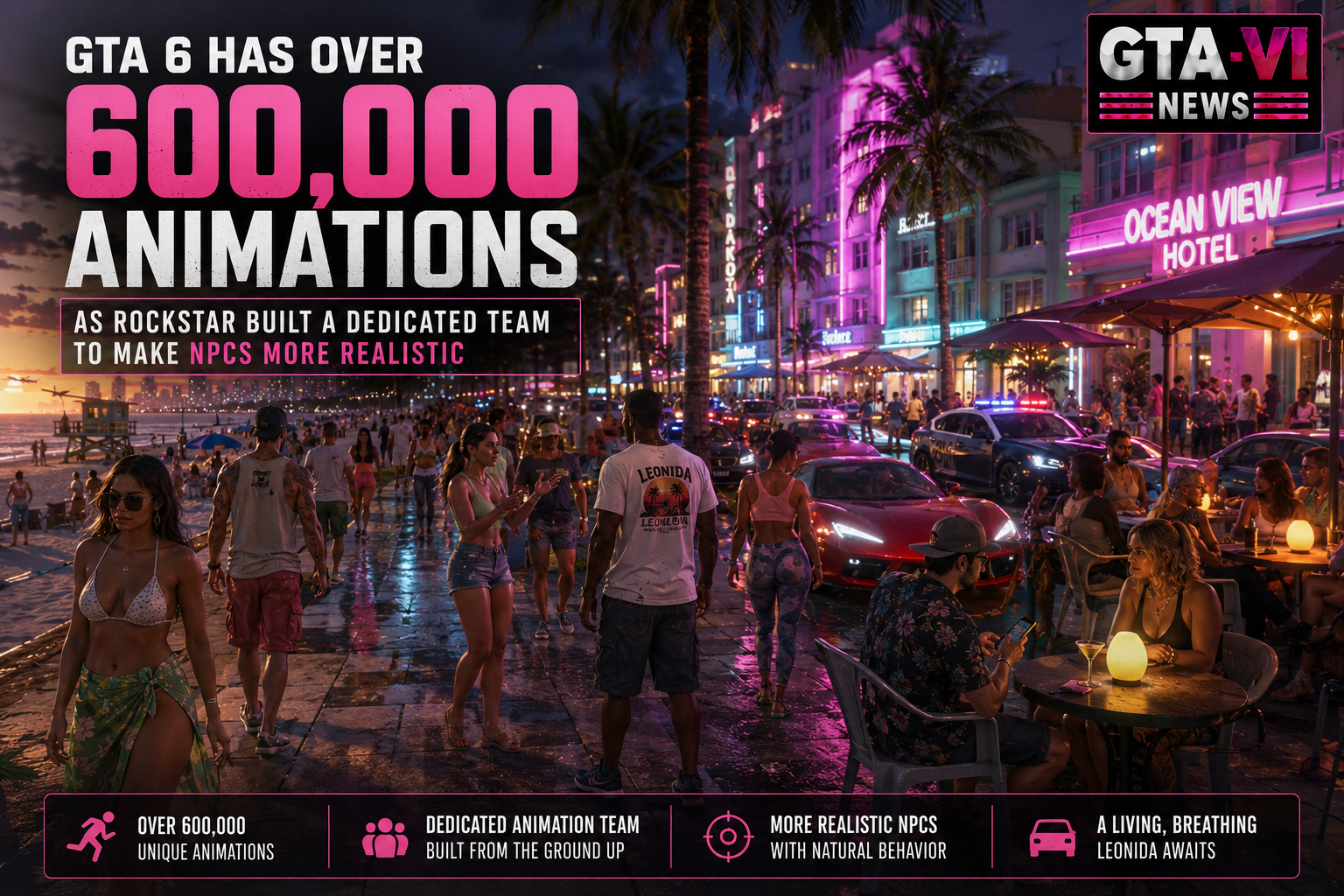
Rockstar Games has revealed another reason why GTA 6 has taken so long to build. The studio created a development team focused specifically on making the people of Leonida more believable, contributing to a game that reportedly contains more than 600,000 animations.
The figure offers a remarkable glimpse at the scale behind Grand Theft Auto VI. Rockstar is not simply increasing visual fidelity or expanding the map. It has invested heavily in how characters walk, react, socialize and interact with the world around Jason Duval and Lucia Caminos.
For comparison, Rockstar says Red Dead Redemption 2 contained around 300,000 animations. GTA 6 therefore has roughly twice as many.
GTA V reportedly had around 55,000.
The difference is enormous. More importantly, much of that work appears designed for characters players may never meet twice.
GTA 6 Contains More Than 600,000 Animations
Rockstar North co-studio head Aaron Garbut discussed the scale of the animation work following the recent GTA 6 Extended Look.
According to Garbut, Grand Theft Auto VI contains more than 600,000 animations across its enormous open world.
That number should not be interpreted as 600,000 completely unique character actions that every player will consciously notice. Large animation libraries contain variations, transitions and contextual movements required to make actions connect naturally.
Even so, the scale is striking.
A character getting into a vehicle may require different animations depending on the door, seating position and circumstances. NPCs need reactions for conversations, collisions, threats and crimes. Characters also behave differently while sitting, walking, shopping or socializing.
Multiply those situations across an entire fictional state and the workload grows rapidly.
Rockstar Created a Dedicated Team for GTA 6 NPCs
Perhaps more revealing than the raw number is how Rockstar organized development.
The studio reportedly assembled a team whose focus was improving GTA 6 NPCs.
That decision reflects a fundamental challenge facing modern open-world games. Buildings can look convincing and cars can have realistic reflections, but a city quickly feels artificial when its population behaves like scenery.
Rockstar wants to reduce that effect.
Leonida’s pedestrians are designed to display greater variety in their movement and behavior. Crowds should feel like collections of individuals rather than repeated character models following identical routines.
The Extended Look already provides evidence of that philosophy.
Beaches are filled with people exercising, talking, using phones and relaxing. Clubs contain crowds dancing and socializing. Streets remain active while Jason and Lucia move through them.
Many of those actions exist purely to make the world believable.
Red Dead Redemption 2 Provided the Foundation
Rockstar is not beginning from zero.
Red Dead Redemption 2 established many of the ideas now being expanded in GTA 6. Arthur Morgan could greet or antagonize strangers, while NPCs responded according to his actions and the surrounding situation.
Characters also followed routines that helped towns feel occupied even when no mission was taking place.
GTA 6 brings that philosophy into a much denser environment.
That is considerably harder.
Red Dead Redemption 2 often placed Arthur in wilderness or relatively small settlements. Vice City can place dozens of pedestrians and vehicles around the player simultaneously.
Rockstar therefore needs more animations while also managing more characters at once.
GTA 6 NPCs Can Respond to Jason and Lucia
The improvement goes beyond visual variety.
Rockstar has said its GTA 6 NPC interaction system expands substantially on Red Dead Redemption 2.
Jason can target nearby characters and receive contextual interaction options. Animals can also be interacted with, suggesting the system applies beyond human pedestrians.
Characters can respond to the protagonists and events occurring around them.
This creates opportunities for unscripted situations.
An NPC witnessing a crime could behave differently from someone who arrives afterward. A confrontation might escalate because of how Jason responds. Nearby characters can react to violence instead of continuing their original animations as though nothing happened.
That is the kind of detail that can make an open world feel less predictable.
NPC Technology Could Transform GTA 6’s Police System
The same philosophy appears to extend into law enforcement.
The GTA 6 police system reportedly pays greater attention to information about suspects. Clothing, physical appearance and vehicles can potentially become relevant after a crime.
CCTV may provide another source of evidence.
That creates a connection between animation, NPC behavior and gameplay systems.
A witness is no longer necessarily a decorative pedestrian who runs away when gunfire begins. That character could become part of the consequences surrounding a crime.
Rockstar has not yet explained every rule governing witnesses and police identification.
However, the broader direction is clear. The population of Leonida is meant to participate in events rather than simply surround them.
600,000 Animations Help Explain GTA 6’s Long Development
The animation figure also provides context for GTA 6’s unusually long production cycle.
Creating an animation is only one stage of implementation.
Developers must determine when it plays, how it transitions into another movement and what happens if the player interrupts it. Animations must work across different environments and interact correctly with objects.
They also need extensive testing.
In an open-world game, players regularly create situations developers cannot perfectly predict. A character might begin an animation just as a vehicle hits an object, police arrive or the player starts a confrontation.
Every system needs to recover convincingly.
Fans may never see most of that work directly. They will notice when it fails.
Rockstar Is Increasing Variety Across Leonida’s Population
The animation work is accompanied by noticeably greater visual diversity.
Official GTA 6 gameplay footage shows pedestrians with different builds, clothing, hairstyles and appearances.
This is especially obvious in crowded locations.
A beach containing dozens of people can expose repetition quickly if the same models appear several times within one camera view. Rockstar appears to be working aggressively to reduce that problem.
Greater model variety combined with a larger animation library can make two similar NPCs behave differently enough that repetition becomes less obvious.
That may sound like a minor technical achievement.
Across an 80-hour playthrough, it matters.
Leonida’s Scale Makes NPC Density Even More Important
The challenge becomes larger when considering the reported size of the GTA 6 map.
Rockstar North leadership has indicated that Leonida is roughly twice the size of GTA V’s world. Vice City itself is reportedly around twice as large as Los Santos.
A map that large could easily feel empty.
Rockstar appears determined to avoid that outcome by emphasizing density as well as geographic scale.
Urban streets contain substantial traffic. Public spaces are populated. Interiors include crowds rather than a handful of mission-specific characters.
The 600,000-plus animations help support that density.
Instead of making the world merely larger, Rockstar is trying to make more things happen inside it.
GTA 6’s Most Important Upgrade May Not Be Its Graphics
The Extended Look made GTA 6’s visual advances immediately obvious. Lighting is more sophisticated. Characters contain far more detail. Water, reflections and environments represent a major leap over GTA V.
Those upgrades are easy to advertise.
The NPC work is more subtle.
Players will spend enormous amounts of time surrounded by people they never speak to. If those characters react naturally, move differently and respond to events around them, Leonida becomes more convincing without constantly calling attention to the technology.
That may be why Rockstar dedicated an entire team to the problem.
More than 600,000 animations is an impressive statistic. But the number itself is not really the goal.
The goal is for players to stop noticing that they are animations at all.