
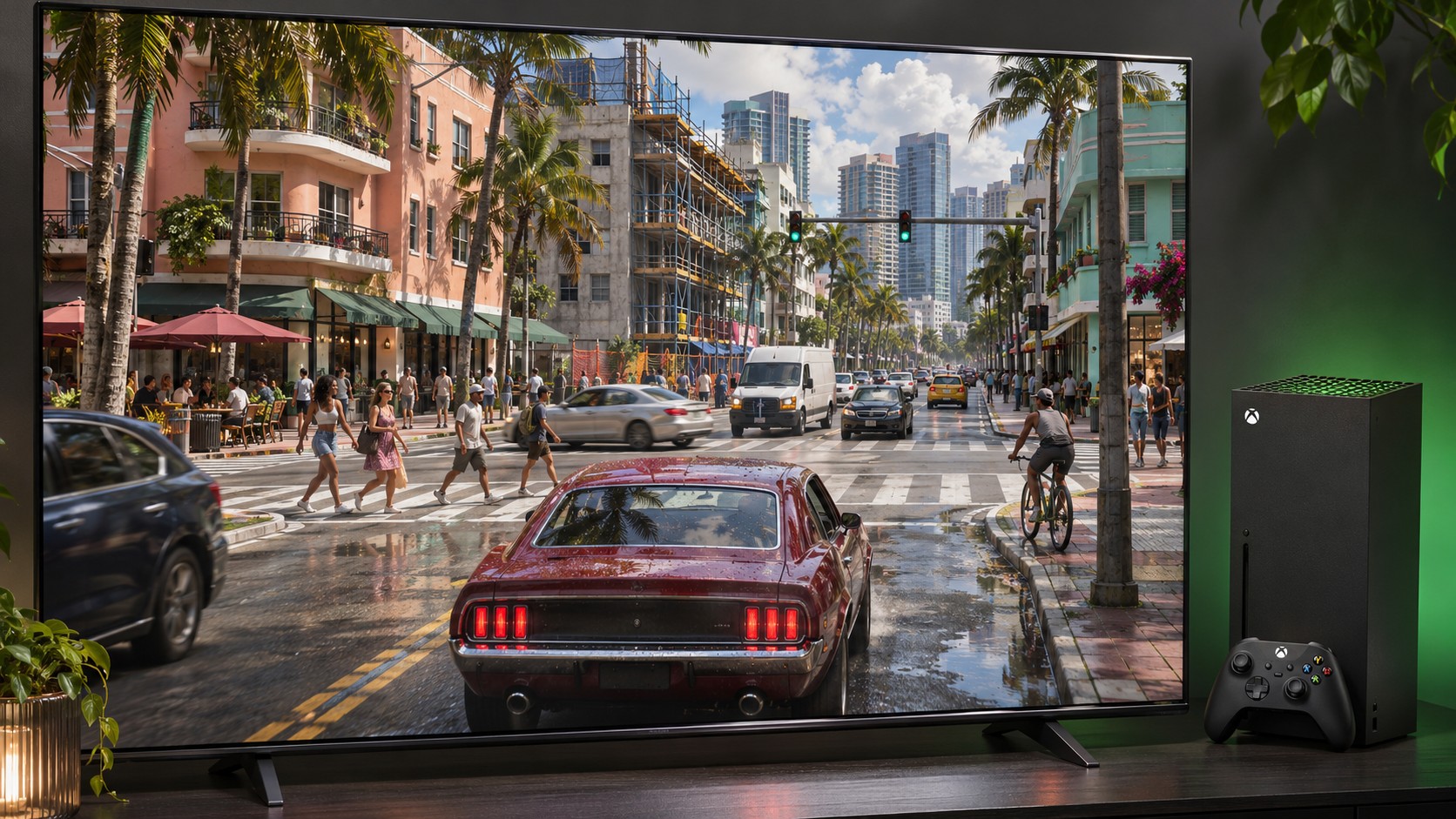
A believable open world depends on systems arriving together, from moving objects to the data behind the next street.
Picture an open-world situation: a vehicle enters a crowded junction while the camera swings towards a side street. The image changes, but so does the work behind it. Objects move, visibility shifts and detail becomes relevant.
This hypothetical scene is a useful way to understand GTA 6 Xbox gameplay. A screenshot records the finished picture. Playing asks the console to keep producing that picture while the world and the player’s decisions keep changing.
Leonida is a setting with technical consequences
Rockstar describes GTA 6 as Jason and Lucia’s story across Leonida, including Vice City. That setting establishes the game’s scope. It does not, by itself, document how many pedestrians are simulated, how traffic is scheduled or which systems run at which frequency.
The technical challenge becomes tangible at the junction. A driver needs to distinguish the opening ahead from surrounding activity. A pedestrian crossing the view matters because it changes the decision. Consistent motion helps make that decision feel understandable.
The world has to behave before it can be drawn
Movement, collisions and game rules require computation. The graphics processor then needs enough prepared information to construct the visible scene. Neither side works in complete isolation; delays at one stage can influence the time available to another.
Nvidia’s profiling documentation describes a CPU bottleneck as a frame limited by CPU work rather than GPU execution. Although that document concerns its analysis tools, the underlying distinction helps explain why beautiful screenshots do not reveal the source of a slowdown.
Imagine reducing the pixel count while leaving a hypothetical simulation unchanged. Drawing the image may become cheaper, but the simulation still needs its processing time. This example shows why visual reductions are not guaranteed to solve every performance problem.
The next street must arrive on time
An installed game contains more data than can remain active in memory at once. Useful material must be brought into the working set as circumstances change. That includes more than textures: geometry, animation and audio can all be part of an environment.
Microsoft’s Velocity Architecture discussion links storage and memory movement to larger, denser worlds. It describes hardware decompression and an architecture built around efficient asset access. These are tools available to developers, rather than proof of a specific GTA 6 technique.
Travel changes the streaming problem
Standing still gives an engine different demands from moving quickly through a changing environment. A camera turn can also reveal material that was previously out of view. Good asset streaming aims to prepare what becomes useful before the absence is distracting.
That makes the everyday experience more informative than a stopwatch at startup. Observe whether detail arrives coherently during movement. Separate a brief transition from repeated interruptions, and avoid diagnosing every visible change as a storage fault.
A bigger world does not explain every design choice
Technical limits influence games, but they do not provide an automatic excuse for awkward controls or unclear feedback. A player can reasonably criticise an interaction without knowing which subsystem produced it. The criticism becomes stronger when it describes the action and result precisely.
For example, compare two statements: the game feels wrong, and the camera consistently takes too long to follow a particular turn. The second identifies an experience that another person can attempt to reproduce. It leaves room to examine settings, display behaviour and the game’s own response.
Gameplay quality also includes judgement about pacing, readability and effort. More visible objects are not automatically better if important information becomes difficult to follow. Technical density and good design sometimes support each other, but they remain different achievements.
Look beyond the spectacle
Rockstar’s Extended Look announcement identifies PlayStation 5 as its capture platform. That presentation offers a view of the game, but an Xbox player’s priorities extend beyond admiring a selected shot.
Readable movement supports better decisions
Return to the junction. A clear silhouette helps the driver judge a nearby vehicle’s position. Consistent animation makes its movement easier to anticipate. The lighting should establish the scene without hiding every useful landmark. These are practical benefits of coherent presentation.
Imagine crossing the same space on foot. The priorities change: nearby objects occupy more of the picture, while slower movement allows closer inspection. The console needs to deliver a convincing whole, but the player’s attention asks different questions.
That is why an impressive environment needs more than a high object count. The view must remain understandable at the speed of play. A richly decorated street earns its complexity when its details support navigation, atmosphere and decisions rather than constantly competing for attention.
A useful Xbox gameplay assessment follows an interaction from input to result. Does the camera make a turn easy to read? Does the world respond consistently? Does a technical interruption break the player’s concentration? Those questions connect the machinery to the moment that matters.