
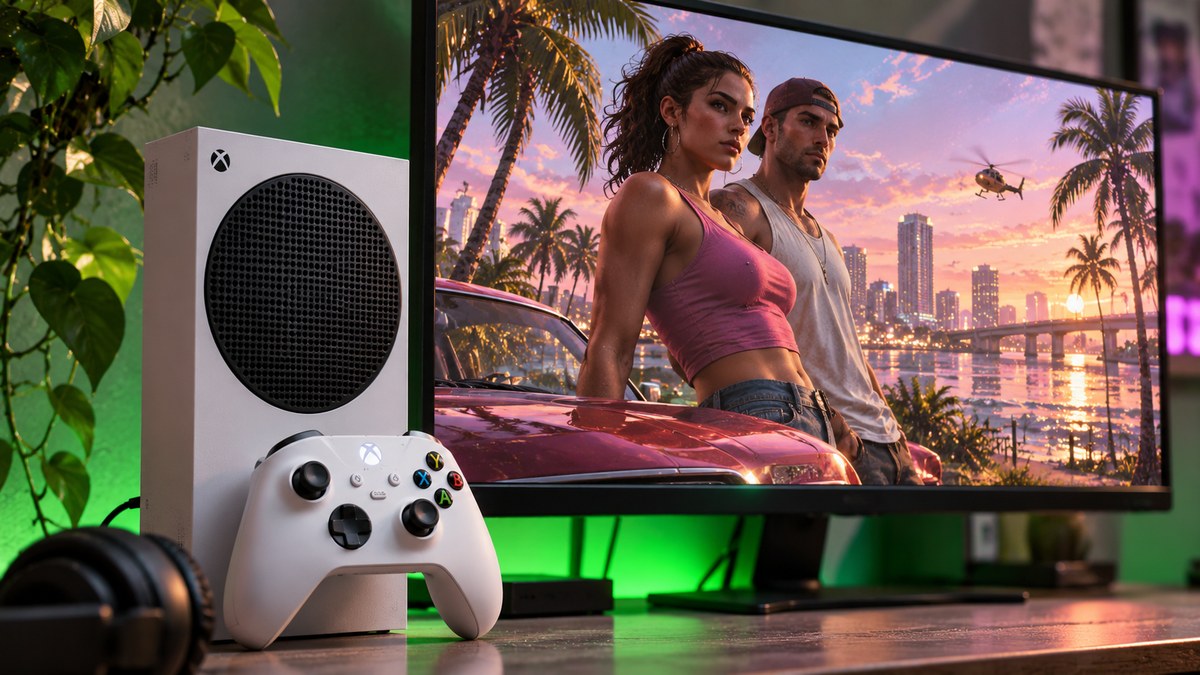
The budget Xbox has the hardest technical job in the current console family. Interest in GTA 6 Xbox Series S reflects a simple concern: can a lower priced machine present Rockstar’s enormous world without sacrificing the experience that makes it worth playing? The sensible answer requires more than a screenshot.
The smallest Xbox faces the same sprawling city
Xbox Series S players are stepping into the same fictional state of Leonida and the same central story as owners of more expensive machines. The difference is the hardware available to display that world. Series S has less graphics capacity and memory bandwidth than Series X, so developers commonly adjust resolution, texture quality, visual effects and draw distance to keep the underlying experience functional.
That does not mean the story is smaller or that an inferior version is automatically unplayable. It means comparisons should focus on what actually changes on the screen and whether the game responds reliably while driving, navigating crowds and entering demanding missions.
Why resolution alone misses the point
A screenshot can make a cleaner image look decisively better, but a still frame is only part of the experience. During rapid movement, dynamic resolution, temporal upscaling and motion reconstruction can affect apparent clarity. Fine lettering, vegetation and distant objects may reveal more than a character portrait.
The wider context
It is also important to distinguish the image sent to a 4K television from the internal rendering resolution. A console can output 4K while the game is rendered at a lower resolution and reconstructed. Claims that a game is simply 4K or not 4K often skip that distinction.
A 30 FPS target requires consistency
Rockstar’s public performance discussion centres on a 30 FPS target across the current consoles. For Series S, the practical question is how often the engine keeps that pace under load. Explosions, busy intersections, rapid travel and weather effects could provide more revealing tests than a quiet street.
Independent performance comparisons are especially useful when they show frame time graphs rather than isolated averages. Brief stalls, uneven pacing and persistent drops feel different in play. The launch build, later patches and the area being tested should all be identified before sweeping claims are made.
Storage and downloads deserve attention
Before installing a large open world game, Series S owners should inspect available internal storage, not just the headline capacity printed on the box. System files and other installed games reduce usable space. Fast travel, asset streaming and updates also make the storage arrangement an important part of the experience.
For expansion, choose storage that the Xbox officially supports for current generation games. A generic USB hard drive may store data but may not run an optimised title directly. Clear space in advance, install the latest console update and allow enough room for future patches.
Who should choose the Series S edition?
If Series S is the console you own, there is no reason to assume that the game’s visual compromises erase the appeal of the campaign. The same world design, dialogue and mission structure can matter more than pixel counts. Owners of larger screens who sit close may be more sensitive to softer details.
The practical reality
A buyer deciding between consoles today should compare measured footage, display requirements and total ownership costs. Avoid treating promotional stills as performance tests. The fairest verdict will come from matched scenes tested on current software, with attention to both image quality and control response.
How to assess the footage fairly
A fair console comparison should start with matching scenes. Daytime traffic, neon lighting after rain and a crowded interior each stress different rendering systems. Watch for legibility of street signs, detail in distant buildings, consistency of motion and responsiveness when the player turns abruptly. Online video compression can erase small advantages or create noise that is absent on a television. A direct capture is more useful than a recording of someone else’s display. If reviewers reveal the patch version and hardware settings, readers can judge whether later updates have changed the situation. Without that context, claims of a decisive winner are often premature.
The practical takeaway
It is also worth remembering that a first impression can be correct about one part of a game and wrong about another. The better assessment is the one that makes room for both strengths and limitations.