
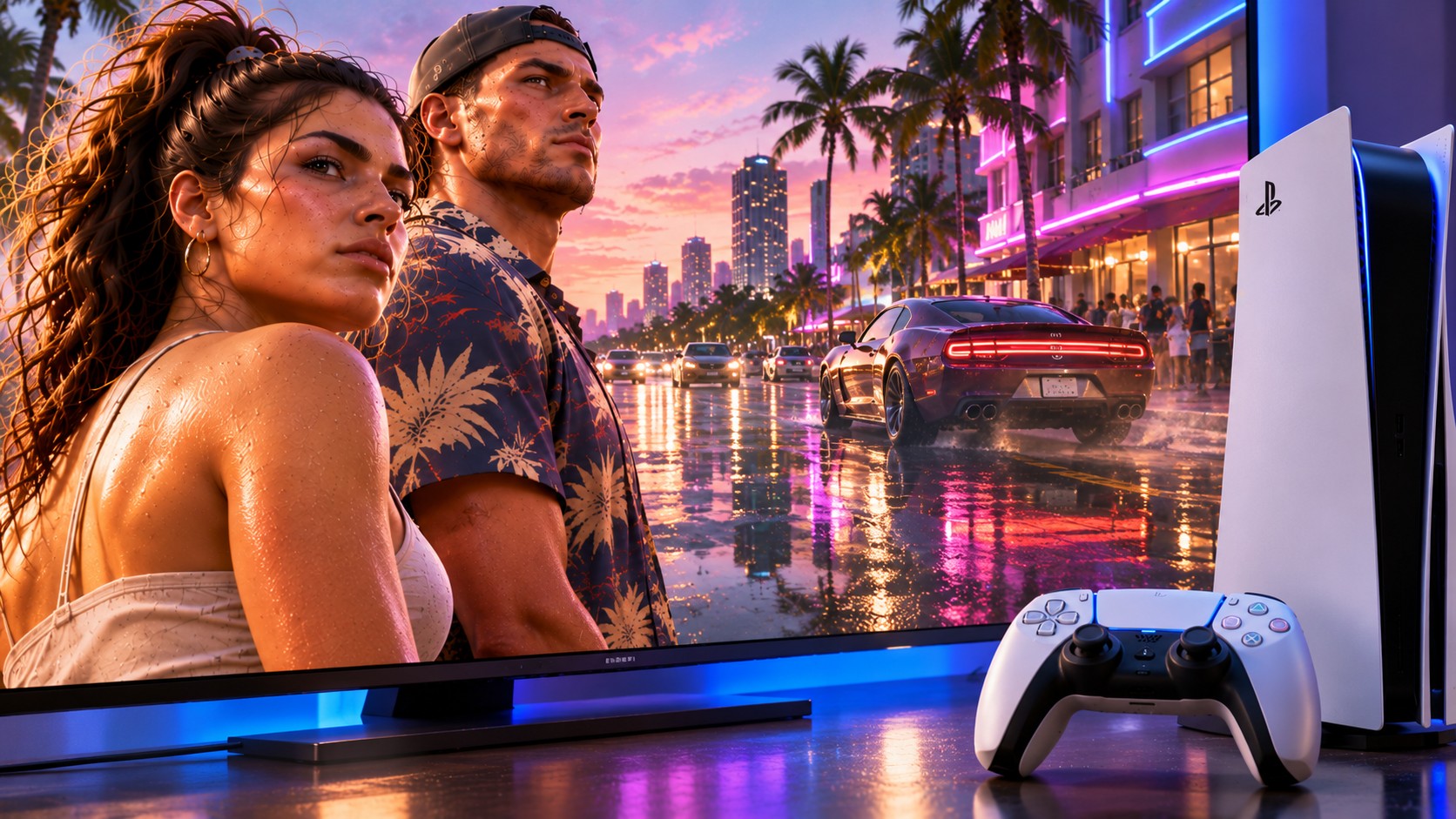
As GTA 6 begins loading onto consoles, some of the most closely watched clues are not screenshots at all. They are technical references embedded in the information surrounding the game. One reported entry, described as “BVH8”, has prompted discussion about more advanced ray tracing on PlayStation 5 Pro. The name sounds precise, and it is relevant to rendering technology. It is not, by itself, a measured comparison between consoles.
Players interested in the best-looking version of Leonida have reason to pay attention. They also have reason to keep expectations grounded until Rockstar explains the actual graphics options.
Why BVH8 attracted attention
Ray tracing simulates aspects of light by following paths through a representation of a scene. Efficiently searching that geometry is computationally expensive. A bounding volume hierarchy, often shortened to BVH, helps graphics hardware find the surfaces most likely to matter without testing every object individually.
The BVH8 terminology seen in reporting has been interpreted as a reference to an eight-way hierarchy or an optimization associated with ray tracing. That makes it a plausible technical clue for how the game handles reflections and lighting. Yet a file label does not reveal where the technique is used, how often it runs or what improvement the player will notice.
A filename is not a performance benchmark
Two games can use related rendering structures and produce very different results. Engine settings, scene complexity, resolution targets and reconstruction methods influence the final image. Even confirmed use of an optimization would not establish that GTA 6 PS5 Pro runs at a particular frame rate.
Three terms in the graphics discussion
- BVH
- A spatial organization technique used to accelerate ray intersection calculations.
- 120Hz
- Display refresh capability, not a guaranteed game frame rate.
- PSSR
- Sony’s reconstruction technology used in supported PS5 Pro software.
The official storefront gives one firmer detail
Sony lists GTA 6 as PS5 Pro Enhanced on its UK store. That confirms there is a platform-specific enhancement designation. It does not provide a complete specification of visual modes or a side-by-side demonstration of the final game.
Some early reports have speculated about sharper ray-traced reflections, more detailed lighting and improved rendering efficiency. These are reasonable subjects for testing once the game is available, but readers should distinguish expected benefits from verified findings.
120Hz and PSSR raise separate questions
Metadata investigators have also discussed 120Hz support and more recent versions of PlayStation Spectral Super Resolution, Sony’s image reconstruction technology. These terms describe different stages of presentation. A console can output to a 120Hz display while rendering the game at a lower frame rate, and image upscaling does not guarantee a specific performance result.
For example, a 40 frames-per-second mode can be displayed cleanly on a 120Hz screen if the developer provides it. That possibility is often cited during technical speculation. It remains a possibility until the game exposes such a mode and analysts can verify its behavior.
What variable refresh rate would change
Variable refresh rate can allow a compatible display to adapt its refresh timing to fluctuations in frame output. Reports about current metadata have questioned whether GTA 6 exposes that feature. A missing or ambiguous storefront reference is not sufficient to describe every final system setting, especially before release updates and hands-on testing.
What a better technical comparison would include
The most informative PS5 Pro analysis will show the same gameplay sequence on both consoles, ideally under repeatable conditions. Reflections on a moving vehicle, light sources at night and dense traffic offer more demanding examples than a static promotional image. Frame-time graphs can reveal stutters that a quoted average frame rate conceals. Native resolution estimates and reconstruction artifacts matter as well, especially when fine details such as overhead wires or palm leaves move across the screen. None of these measurements can be recovered reliably from a backend identifier. They require the final software, suitable capture equipment and careful methodology. That is why the reported ray-tracing clue should prompt questions rather than sweeping claims about visual superiority.
Real comparisons must happen in motion
Still images of a sunny coastline may conceal the compromises required during a busy drive through Vice City. Useful analysis will compare frame pacing, reflection stability, internal resolution and visual detail in the same scenes on PS5 and PS5 Pro. It should also inspect performance in rain, traffic and large crowds rather than relying only on empty scenic views.
That testing can happen after the game’s November 19 release. Before then, players can preload from November 10 and should prepare up to 212 GB of storage. These confirmed details remain more actionable than any alleged technical enhancement.
Rockstar’s new open world could make interesting use of Sony’s additional hardware. The current GTA 6 ray tracing discussion is best treated as an informed question, not a finished verdict on image quality.