
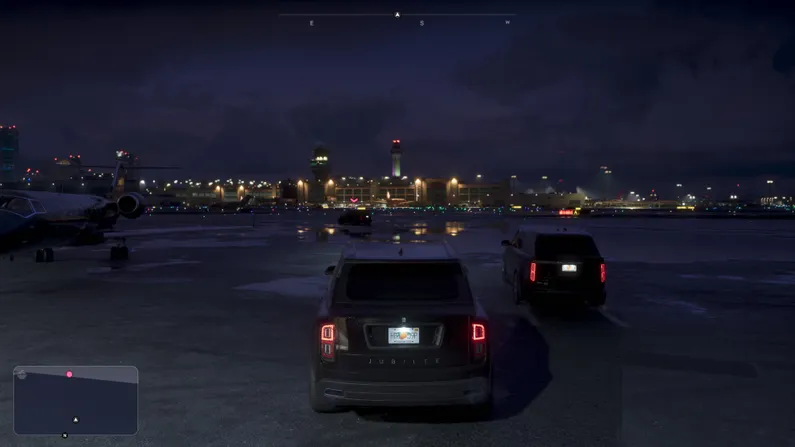
GTA 6 Party Hard begins with the unglamorous side of celebrity work: collecting a client and accommodating a detour. It ends with a helicopter rescue. The distance between those two jobs defines the mission. Jason and Lucia are hired to keep someone comfortable, then become responsible for keeping him alive. The escalation is action fiction, but the division of responsibilities gives it a dramatic shape.
The security assignment, explained
After Lawyer Up, Valentina offers work protecting telenovela actor Andrés de León. Meet her at Vice City International Airport and escort him to the opening of Megamundo’s headquarters. Gunmen interrupt the event and abduct Andrés. Jason pursues the kidnappers while Lucia deals with the endangered guests. The assignment ends after Andrés is recovered and the helicopter returns to the building.
Before the party breaks apart
The early drive includes a stop in Little Cuba for Andrés’s drink order. That detail does more than fill the route. It defines the employment relationship: the client’s preferences set the schedule, and the protagonists accommodate them. Later, when danger takes over, the same client becomes dependent on their judgement.
The shift works because the opening allows service work to establish a baseline. An immediate attack would deliver urgency faster, but it would leave less contrast between the evening everyone expects and the one they actually experience. The detour establishes the client’s demands before the protagonists take charge of his survival.
Two protagonists, different rescue problems
- The first break: Andrés is taken from the conference room. Disarm the remaining attacker, clear the route and collect the marked radio.
- The divided response: Lucia reaches the stairwell, survives an assault and makes her way through the building. Jason continues toward the kidnappers.
- The separate priorities: Lucia clears the party floor and checks on the hostages. Jason reaches the helicopter carrying Andrés.
Switching changes the question
The character changes are most effective when they alter the immediate problem. A pursuit asks for forward movement. A room containing hostages asks for restraint and identification. Those demands pull in different directions, giving the player a reason to reset their attention each time control moves.
That structure also makes cooperation visible without requiring both protagonists to occupy the same corridor. Their contributions remain connected by the incident, while their actions solve different parts of it. The sequence can therefore support a large rescue without turning one character into an observer waiting for the other to finish.
The building gives the unfolding incident a readable direction. Offices, stairs, the party floor and the roof suggest different responsibilities without needing a separate location for every escalation. That spatial continuity helps the rescue remain one event rather than a string of unrelated encounters. The helicopter extends the crisis beyond the building only after the interior has established what is at stake.
Lucia’s section rewards deliberate aim
The party floor deserves particular care. Lucia’s silenced pistol has no spare ammunition available at this stage. Avoid speculative shots, identify targets and remember that hostages occupy the space below. Focus can highlight nearby enemies when activated without aiming. A loud weapon or being spotted draws hostile attention.
The resulting tension is more interesting than a simple enemy count. Accuracy protects a limited resource, but it also supports the fiction of a rescue. The point is to remove threats without treating every visible person as one. This is a useful example of an action mission making caution part of competence.
The rooftop trades caution for spectacle
Jason’s finish changes the rhythm again. Reach the departing helicopter, follow the combat prompts against the kidnappers and bring Andrés back inside. Once control of the aircraft passes to Jason, fly to the Megamundo helipad and land to complete the job. The rescue is not finished merely because the fight aboard the helicopter is over.
The finale shifts into spectacle, with prescribed prompts that expose the sequence’s limits. This section offers participation in a staged escape rather than broad tactical freedom. Its success depends on whether the preceding complications have earned that spectacle. The rooftop fits the expanding scope of a rescue that has divided the protagonists across the building.
A favour becomes an obligation
Party Hard is strongest when it shows how little control the couple has over the size of the jobs they accept. A legal connection produces security work; security work produces a hostage crisis. The transaction expands while the protagonists are already committed. The connection between favour and crisis gives the spectacle a motive beyond the celebrity’s misfortune.
The quieter opening and heavily directed finish may frustrate players who want uninterrupted freedom. Even so, the middle supplies a clear reason for its alternating viewpoints. Jason follows the person being taken away. Lucia protects the people left behind. Those two responsibilities give the mission an identity beyond its helicopter finale.