
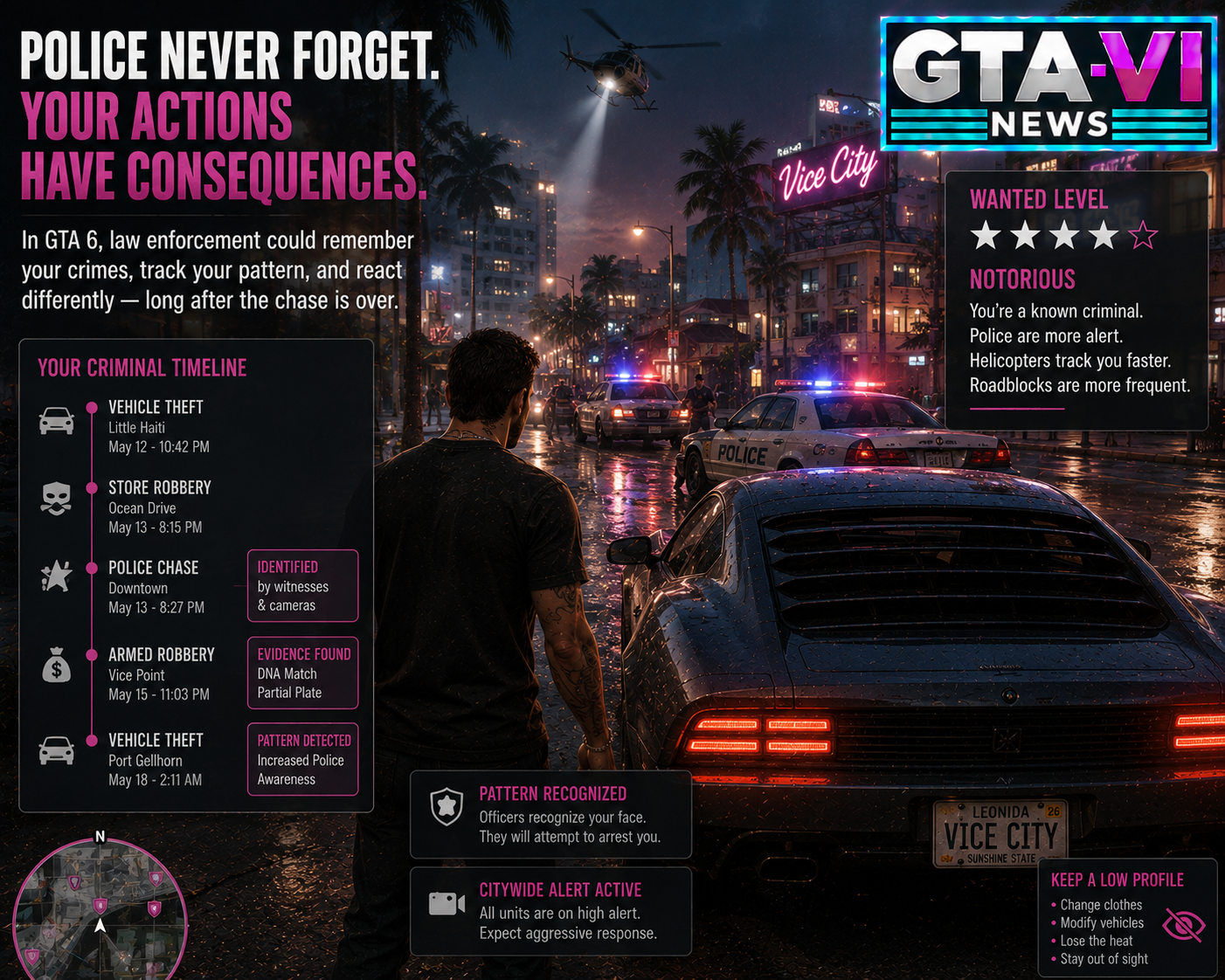
GTA 6 could fundamentally change what it means to escape the police. Instead of simply hiding until the stars disappear, players may have to deal with the consequences of major crimes long after the immediate pursuit has ended.
Rumors surrounding Grand Theft Auto VI suggest Rockstar Games may be developing a more persistent law enforcement system. Police could potentially continue investigating Jason or Lucia after losing sight of them, while vehicles and crime locations may remain connected to previous incidents.
If accurate, the familiar GTA strategy of disappearing down an alley for a few minutes could become far less reliable.
There is an important distinction, however. Rockstar has not officially confirmed a persistent wanted system that remembers crimes for several in-game days. Specific claims about police recognition, investigations and long-term criminal records remain speculation.
The concept itself would represent a logical evolution of GTA’s police mechanics.
Losing the GTA 6 Police Might Not End the Search
Grand Theft Auto traditionally separates a police pursuit into a relatively simple cycle.
Commit a crime, attract a wanted level, escape the search area and wait. Once the wanted stars disappear, the world largely returns to normal.
A more advanced GTA 6 wanted system could separate escaping from being forgotten.
Jason or Lucia might successfully lose pursuing officers while remaining a person of interest. Police could stop actively chasing the player but continue searching the surrounding area.
That would create two distinct objectives.
First, survive the immediate pursuit. Then avoid doing anything that allows authorities to find you again.
Such a system could make high-level wanted encounters considerably more tense without simply adding more police vehicles or stronger weapons.
Returning to a Crime Scene Could Become Dangerous
A persistent system could also make locations remember what happened there.
Imagine robbing a business in Vice City and escaping after a major shootout. Returning ten minutes later to the same street and finding everything completely normal can weaken the illusion that the world reacts to the player’s actions.
GTA 6 police patrols could potentially remain heavier around major crime scenes.
Officers might block roads while investigators remain nearby. Businesses could temporarily close. Police vehicles could patrol surrounding streets while NPCs react to the aftermath.
For the player, returning too quickly could create additional risk.
This would not require every crime to permanently alter the map. Even temporary consequences lasting part of an in-game day could make Leonida feel more responsive.
Police Could Potentially Remember Your Vehicle
Vehicle recognition could make the system even more interesting.
Cars are central to Grand Theft Auto escapes, yet changing the player’s physical location has traditionally mattered more than changing the vehicle itself.
A deeper GTA 6 police system could potentially track identifying details associated with a getaway car.
Suppose Jason uses the same personal vehicle during a heavily armed robbery. Even after escaping, driving that recognizable car back through the neighborhood could attract attention.
Players might need to abandon the vehicle, change its appearance or use a different car until police interest declines.
That would give garages and vehicle customization a practical role beyond appearance.
A new paint job or replacement license plate could theoretically become part of escaping an investigation rather than simply another customization option.
Witnesses Could Make Crimes Harder to Hide
Rockstar has already experimented with more detailed witness mechanics.
Red Dead Redemption 2 allowed NPCs to report crimes to law enforcement. Players could sometimes intervene before a witness reached the authorities, while masks and identity played a role in the broader wanted system.
GTA 6 could expand those ideas for a modern setting.
Vice City contains technology that Red Dead’s frontier obviously did not. Security cameras, smartphones, vehicle records and surveillance systems could all theoretically influence how police identify suspects.
A robbery committed in front of numerous witnesses should create different consequences from a crime carried out quietly in an isolated location.
The same could apply to vehicles.
Using an easily identifiable personal car during a major crime could be more dangerous than stealing an anonymous vehicle and abandoning it afterward.
Again, Rockstar has not confirmed these specific mechanics. They illustrate how a persistent system could function if identification becomes important.
Serious Crimes Could Remain Active for Days
One of the more ambitious rumors suggests major crimes could keep police interested in Jason and Lucia for several in-game days.
If implemented carefully, this could introduce meaningful differences between minor and serious offenses.
Stealing a car or starting a street fight might create only temporary attention. Robbing a bank, attacking police or causing extensive destruction could trigger a longer investigation.
The severity would matter.
Players could potentially notice increased patrols around relevant areas even after the traditional wanted level disappears. Certain vehicles might remain compromised, while revisiting specific locations could become risky.
That would give major robberies an aftermath, something GTA missions have often lacked once the immediate action ends.
Changing Clothes Could Finally Have a Gameplay Purpose
A more sophisticated identification system could also make clothing useful.
Grand Theft Auto has offered extensive character customization for years, but outfits usually have limited influence on law enforcement outside specific missions.
If witnesses can provide descriptions in GTA 6, changing appearance after a crime could become strategically valuable.
A jacket worn during a robbery might become a liability. Removing it before returning to a populated area could reduce the chance of recognition.
Masks could matter for the same reason.
This would connect customization directly to criminal gameplay without requiring complicated menus or simulation systems.
Rockstar would need to keep it understandable. Players should know why police recognize them rather than feeling as though the game randomly generates another wanted level.
Police Memory Could Make Heist Preparation More Important
The biggest benefit could appear during GTA 6 heists.
If law enforcement remembers vehicles, clothing and other identifying information, players would have stronger reasons to prepare properly.
A stolen getaway vehicle could prevent a personal car from becoming connected to the robbery. Masks could reduce identification. Parking another vehicle at a secondary location could create an opportunity to switch transportation after escaping the first police perimeter.
The planning would continue after the money is taken.
That is an important change.
GTA missions often treat reaching a waypoint as the end of a successful escape. A persistent police system could make disappearing convincingly part of the operation itself.
The System Could Become Frustrating If Rockstar Goes Too Far
There is an obvious danger.
Grand Theft Auto is not a police evasion simulator.
If every minor offense produces hours of consequences, players may become reluctant to engage with the chaos that defines GTA. Constantly changing vehicles and clothes could turn an interesting mechanic into repetitive maintenance.
Rockstar would therefore need to reserve persistent police investigations for significant crimes.
A major robbery should have consequences. Accidentally hitting a police car at an intersection probably should not ruin the rest of the player’s afternoon.
The balance between consequence and freedom will matter more than realism itself.
Rockstar Has Not Confirmed a Persistent GTA 6 Wanted System
For now, the most ambitious claims remain unverified.
Rockstar has not confirmed that police will remember Jason or Lucia for several days. It has not officially announced persistent vehicle recognition, long-term crime scenes or an investigation system that continues after the wanted stars disappear.
Players should therefore avoid treating those details as finished features.
Still, Rockstar has good reason to rethink the traditional formula. GTA 6’s Leonida appears significantly denser than previous Grand Theft Auto environments, and the studio’s work on Red Dead Redemption 2 demonstrated an interest in witnesses, identity and more reactive law enforcement.
Escaping Could Finally Mean More Than Losing the Stars
Fans may be surprised by how dramatically a persistent system could change GTA without altering its fundamental gameplay.
The police would not necessarily need to become more aggressive. They would simply need a better memory.
Escaping a five-star pursuit would still feel rewarding. The difference would come afterward, when Jason drives back toward the scene and notices police cars still searching the neighborhood.
Perhaps the getaway vehicle is still recognizable. Perhaps returning tomorrow would be smarter.
That creates consequence without removing freedom.
If Rockstar genuinely brings that philosophy to Grand Theft Auto VI, the end of a police chase may no longer mean the crime has disappeared.
It may simply mean you got away with it for now.