
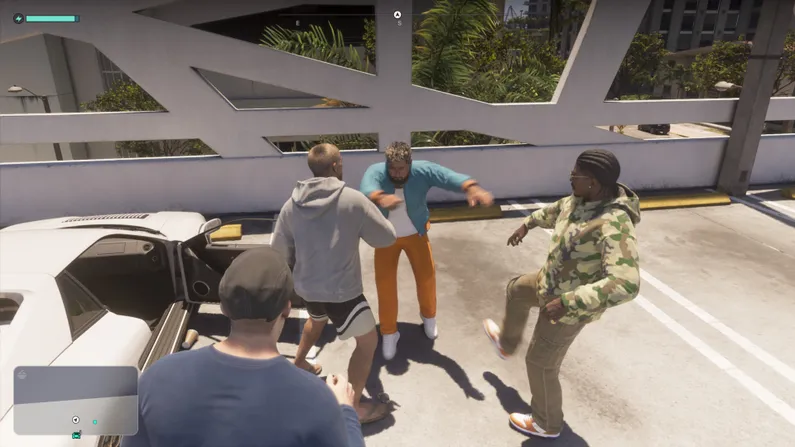
The clothes matter because the meeting matters. GTA 6 Watch It follows Jason and Dre’Quan through an argument over a watch, a violent confrontation and a wardrobe change before they reach nightclub owner Royce Jones. The sequence treats appearance as part of the work required to gain a hearing in Vice City.
It is a compact premise with a sharp social observation inside it. Dre’Quan wants to look established before he is fully established. Jason helps with the practical consequences. The resulting mission measures ambition through the awkward distance between a polished image and the disorder needed to maintain it.
A meeting with several entrance fees
Watch It is a Chapter 4 assignment for Jason, available after Making Gainz. Dre’Quan asks for help preparing to impress a nightclub proprietor. Meet him at the marked store, then accompany him to the Crowex dealer in the Cruda parking garage. Their disagreement escalates into a fight and gunfire.
After escaping, visit Nola and choose an outfit. Dre’Quan pays and wears the other selection. The pair then travel to the Doigt d’Or hotel to meet Royce, whose VYB nightclub plans are obstructed by Dante Fresh’s blackmail. The mission introduces that problem rather than resolving the entire nightclub storyline.
Three scenes, three kinds of credibility
The watch
A luxury accessory is supposed to communicate success. Its questionable authenticity turns that signal against its owner. The dispute gives Dre’Quan a recognisable vulnerability: the desire to be taken seriously can make someone easier to exploit.
The clothes
The shopping stop restores an appearance of control after the garage encounter. Choosing between the mannequins makes the change something the player participates in. Presentation becomes a task with a concrete, visible result.
The introduction
Royce’s meeting reveals another barrier beyond looking right. Access depends on the problems of the person granting it. A convincing outfit can secure attention, yet the conversation still leads to somebody else’s unfinished business.
Together, these scenes give the mission more coherence than a simple shopping detour would have. Each concerns the same question: what convinces another person to let you advance? Money, force, style and usefulness all enter the conversation. None provides a clean route through the whole encounter.
Reading the garage before it becomes crowded
The Cruda parking garage is the practical pressure point. Reach the top floor and approach the marked vehicle. Once the initial brawl is over, armed enemies arrive, including threats near the stairs. Treat the shift to gunfire as a change in priorities, and keep the return route to your car in mind.
A measured exit suits the objective better than lingering over every defeated enemy. When the immediate threat clears, regroup and leave before police complicate matters. That is straightforward advice, but the mission’s rapid change from personal argument to organised violence makes it useful.
The setting supports the escalation. A parking deck is both a meeting place and a route with entrances to monitor. Paying attention to where reinforcements appear gives the encounter a readable shape. The task becomes less confusing once the player separates the original dispute from the new threats surrounding it.
Why the shopping pause belongs
Stopping for clothes after a shootout could feel absurdly detached from the danger. Here, the absurdity serves the mission. Dre’Quan still has an appointment to prepare for. The business of looking successful continues despite what has just happened, which gives the change of pace a dry comic edge.
The outfit choice also offers a small moment of authorship. It is easy to overstate such choices as major branching decisions. Their value can be simpler: the player helps determine how Jason appears in the scene that follows. Personal preference has room to matter even when the central story remains tightly directed.
The contrast between the garage and the final appointment is especially useful for Jason’s role. He moves through the same preparations as Dre’Quan, but his contribution is mainly protection and practical help. That gives their partnership a clear shape. One man pursues the introduction; the other helps make reaching it possible. The mission can communicate that division through ordinary tasks without stopping to label their relationship for the audience.
A useful complication for Dre’Quan
The final meeting gives the earlier errands a purpose, although it also delays the larger payoff. Players hoping for a substantial resolution may find another obstacle waiting at the end. Royce still has business to settle. The mission establishes a relationship and a problem more clearly than it delivers a finished success.
Its strength is the character detail carried along the way. Dre’Quan’s ambitions emerge through purchases, embarrassment and persistence, while Jason becomes the person helping him keep the presentation intact. Watch It’s mission design makes social advancement look like work: expensive, performative and liable to turn violent before anybody reaches the front door.