
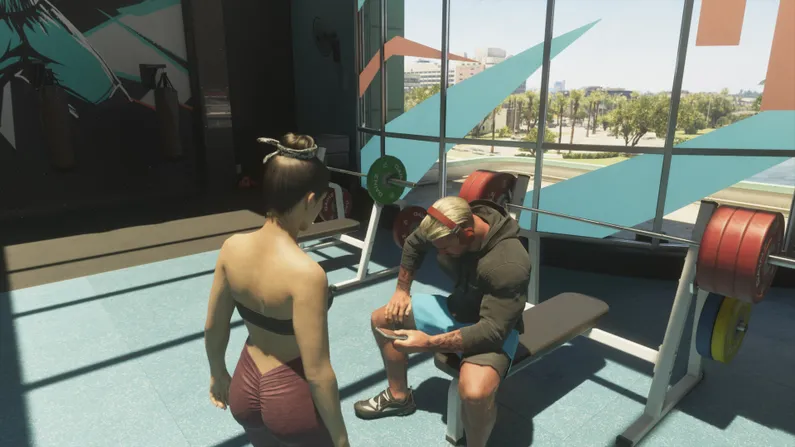
A gym membership becomes an entry pass into somebody else’s criminal circle in GTA 6 Making Gainz. Lucia’s undercover assignment depends on conversation, shared routines and the gradual performance of friendship. That gives this Chapter 4 mission an unusual centre of gravity. The important question is how much of herself she must put into the disguise.
Its strongest idea is simple: trust takes time. A montage can compress that time, but asking the player to participate in the routine gives the compression weight. Each ordinary interaction helps turn an operational plan into a relationship that looks convincing from the outside.
Hiding in plain sight
The assignment in brief
Raul sends Lucia to Ajax Gym to befriend Nate, a member of Kordell’s crew. She gets his attention, trains with him and works through a montage of repeated visits. The relationship eventually brings access to Kordell’s private workout area, the Trauma Floor. Lucia then meets Jason and returns to the planning room.
- Starting character
- Lucia begins the assignment alone.
- Immediate objective
- Become someone Nate wants around.
- Story function
- Build an opening into the crew connected to the airport heist.
Heavy Lifting precedes Raul’s approach. Allow time for his call instead of expecting the next objective immediately. When he contacts Lucia, go to the planning room with her alone and follow the briefing into her new assignment.
Repetition with a dramatic purpose
The workout sequence moves through the bench press, squats and deadlifts before Lucia reaches an exercise bike. Those activities supply a shared language. Nate can demonstrate knowledge, Lucia can respond, and the two can spend time together without either needing to explain why their acquaintance is developing.
That is a persuasive foundation for an infiltration story. A stranger who immediately demands confidential information would draw attention. Someone who keeps showing up becomes familiar. The mission makes familiarity something the player helps manufacture, which gives its quieter actions a clear dramatic purpose.
Where the montage earns its place
Compressing weeks into a playable sequence also changes the scale of the narrative. An individual errand usually measures progress through distance travelled or resistance overcome. Here, progress is accumulated time. The method suits a cover story because credibility depends on persistence, even when the player only experiences selected moments.
There is a tradeoff. Repeated workout prompts offer less room for improvisation than an open pursuit or a messy escape. Their value rests on the relationships around them. Players who approach every mission as a mechanical challenge may find the structure restrictive, while those interested in Lucia’s performance have more to examine.
The parallel scenes of Jason helping Dre’Quan prevent the montage from feeling entirely sealed off from the rest of the campaign. They suggest that time is passing for both protagonists, even when their days no longer resemble each other. The separation therefore has a narrative form as well as a practical effect on the couple’s usual shared activities.
Small choices inside a larger deception
Nate’s steroid offer is the most conspicuous decision during the training montage. The choice to accept or decline deserves a moment of attention because it concerns Lucia’s body within the fiction. It also gives the player a visible opportunity to set a boundary while she is trying to fit into somebody else’s world.
Read that moment as characterisation before treating it as an optimisation problem. The useful question is what version of Lucia the player wants to inhabit. An undercover identity can demand cooperation without making every invitation feel equally comfortable. That tension is more interesting than reducing the scene to a supposedly perfect answer.
The relationship outside the gym
The cover operation also limits Jason and Lucia’s ability to spend time together in public during this stretch of the story. Private time at the Y Hotel remains important. That restriction gives the infiltration a cost beyond completing another set of exercises: the couple’s ordinary freedom becomes part of the assignment.
It is a useful dramatic pressure because the player has something tangible to surrender. The mission asks for access to another group while narrowing the protagonists’ own social space. A successful cover can therefore feel productive and uncomfortable at once, which is precisely the contradiction this part of their story needs.
Making Gainz works best as a study of that contradiction. Its mechanical routine is modest, and the montage cannot make every interaction feel spontaneous. Yet the underlying design connects routine, ambition and intimacy with unusual clarity. By the time Lucia reaches the inner circle, belonging has become an expense she is already paying.