
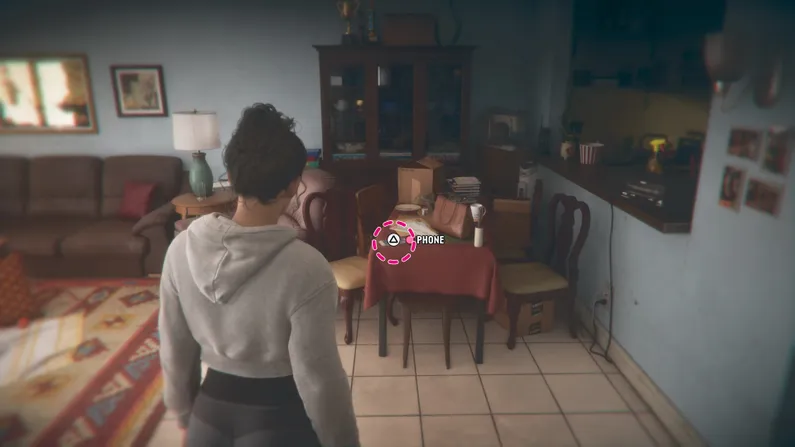
Picking up a child requires a different kind of attention from picking up a weapon. Another Life builds its most effective contrast around that difference. Lucia’s immediate responsibility is to comfort Tomás, and the scale of the action makes room for a part of her life that criminal assignments cannot explain alone.
In GTA 6 that ordinary morning gives Lucia’s story a personal scale. The flashback lets care, impatience and financial pressure occupy the same space, complicating the picture of her before prison.
A morning before the arrest
Following Ocean Beach, the game moves into Lucia’s recollection of her last morning with Tomás and the hours leading toward her arrest. The playable domestic sequence asks her to collect her phone, check on him in his crib and carry him into the living room.
She tries to settle him using the objects around her, turns up the radio and dances with him. Those actions provide the mission’s central rhythm. Understanding what happened matters more here than completing a difficult sequence of inputs.
A room built around another person
The domestic space changes the purpose of interaction. Objects matter because they might help the child. The player’s attention moves outward from Lucia’s own progress toward someone whose needs she must interpret.
That is a useful way to establish care. The scene does not rely solely on calling her a mother and expecting the description to supply emotional weight. It gives the player a few ordinary responsibilities associated with that role.
The radio is particularly useful here. Music accompanies an act of care rather than a getaway, giving a familiar feature of the series a different purpose. The same world can make room for another kind of attention.
The limits of the instructions
There is also an obvious restriction. Prompts can identify the next action, but they cannot create a full relationship through a handful of button presses. The sequence works best as a specific memory, not as a comprehensive simulation of parenthood.
Keeping that scale in mind makes its restraint easier to appreciate. A short scene can reveal something meaningful without pretending to contain an entire life.
Small pressures explain the larger strain
The surrounding dialogue adds practical difficulty to the tenderness. Lucia faces a threatened electricity cutoff and needs to get to work. Her attempt to arrange help with Tomás does not provide an easy solution.
Those details matter because they make pressure concrete. Bills, working hours and childcare compete for attention. The problem cannot be reduced to a single bad mood or a convenient explanation delivered after the fact.
The flashback also includes hostility from passengers while Tomás cries. That scene puts Lucia’s private strain into a public setting where other people treat the child as an inconvenience.
The point is not that these circumstances excuse every later act. Context and absolution are different judgments. The mission is more persuasive when it makes the circumstances visible and leaves the audience to consider the choices that follow.
Sympathy needs room for judgment
A character can be under real pressure and still remain accountable. Another Life benefits from that possibility. Reducing Lucia either to a victim or to her criminal record would discard the tension the flashback introduces.
The domestic affection and the wider strain belong to the same person. Holding both in view gives the campaign a more substantial emotional basis than treating family as a convenient motivation attached to a succession of jobs.
Why the memory follows the hotel
Ocean Beach offers a new suite and the visible rewards of a successful robbery. Another Life immediately turns attention toward an earlier home and a relationship that better accommodation cannot replace.
That placement invites a clear interpretation: the protagonists’ improved circumstances do not settle the meaning of their success. A new address may change the present while leaving the past unresolved.
The contrast also challenges the usual momentum of a reward sequence. The story has just given the couple more comfort, then asks the player to remember what comfort cannot purchase. It is an effective reason to interrupt forward movement.
For players moving through the mission, the useful advice is to follow the household objectives and give the dialogue space. There is little value in treating the room as a route to be optimized. The changing tasks direct attention toward Lucia’s responsibilities.
The guided memory leaves little room to redirect events. Its narrow participation places weight on the writing and the circumstances around Lucia, since the player can observe her past but cannot decide how it should unfold.
Another Life earns that attention through the ordinary details of care and the pressures surrounding them. Its defining image is a mother dancing with her child. The scene gives the campaign something specific to lose, and something more personal than money to pursue.