
Grand Theft Auto VI · Story spoilers
The Cartel Heist puts several earlier lessons in the same room and starts the clock. Equipment, explosives, vault practice and crew coordination now have to support an actual robbery. The mission’s central appeal lies in that convergence: preparation stops being a promise and becomes a set of working conditions.
GTA 6 earns much of that payoff by dividing the work between Jason and Lucia. Neither can manage every problem alone. Their separate responsibilities give the robbery more substance than a larger pile of cash or a longer line of enemies could provide by itself.
Act one: taking control of the bank
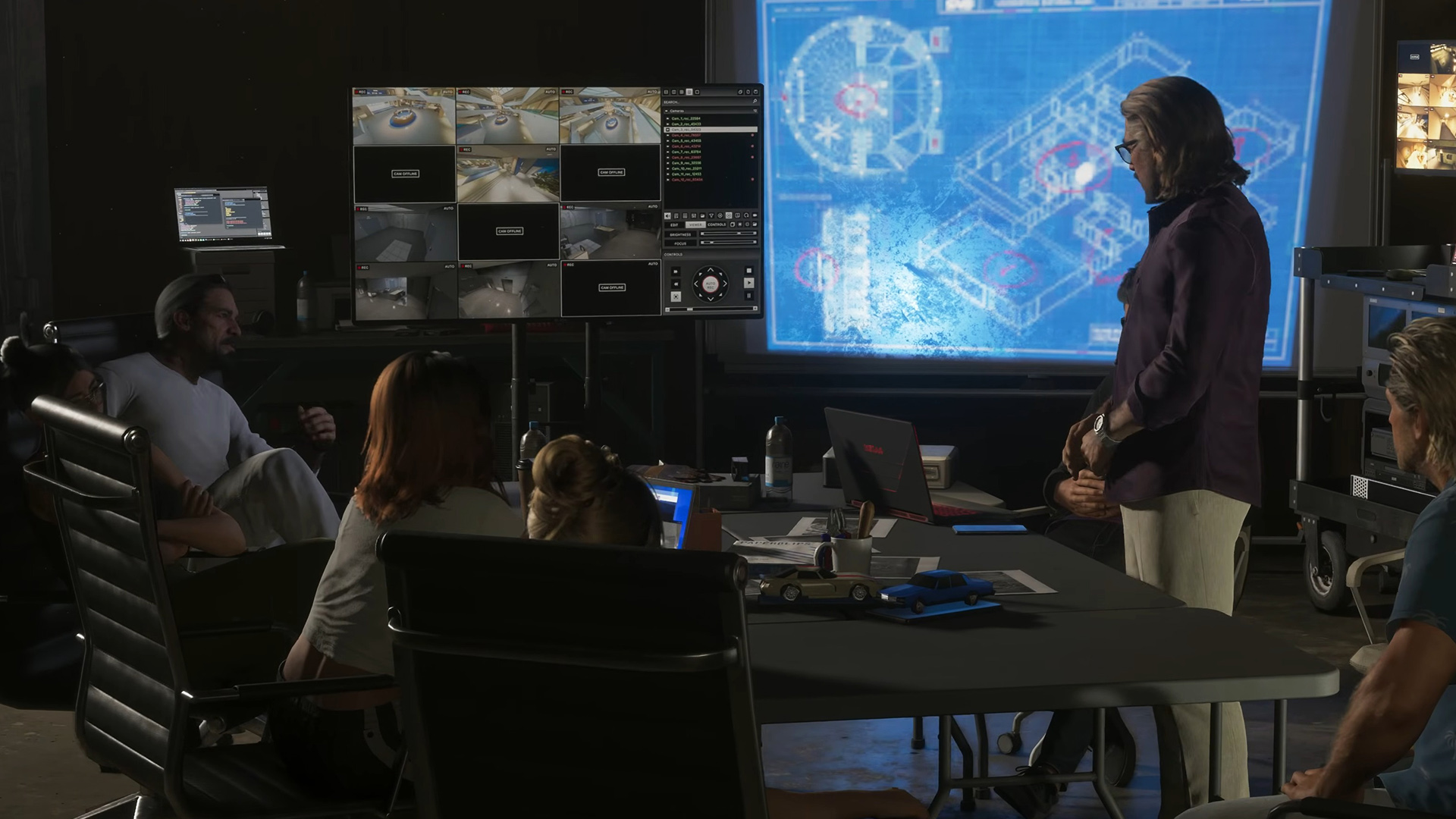
Raul brings the crew together in Stockyard once the Chapter 3 preparations are complete. The target is Sinfrontera National Bank. Detonating the previously planted tower charges creates a distraction, after which the team enters the building and begins its takeover.
The basic mission is clear: control the bank, open the vault, collect the money and leave. However, each verb conceals a different demand. Managing people in the lobby is not the same task as operating equipment below ground.
The opening asks for restraint
Karim’s signal begins the takeover. Paying attention to his warnings about people heading for the exits matters, as does avoiding unnecessary killing when aiming to preserve a Professional rating.
That restraint improves the premise. A robbery becomes more interesting when every armed confrontation cannot be solved through indiscriminate fire. The player must distinguish between asserting control and creating another complication.
The countdown reinforces the value of the earlier tower work. It represents a temporary opportunity, not safety. Preparation buys the crew space in which to act; the mission still demands attention inside that space.
Act two: the vault divides the labor
Lucia works with Nicole on the vault while Jason handles security resistance elsewhere in the building, including the roof. Switching between them makes the bank feel like several simultaneous problems rather than a corridor leading toward a single prize.
Lucia’s task develops the techniques introduced during Safe Word. Drilling and using the inspection camera now happen in the context of a live robbery. Familiar actions acquire pressure because their purpose has changed from rehearsal to execution.
Small movements, large consequences
The camera work asks for precision while the surrounding operation demands speed. That contrast is productive. A player can understand the broad plan perfectly and still lose time through a clumsy interaction.
It also exposes the mission’s most persistent weakness. Repeated precision prompts risk feeling like obstacles inserted between the player and the payoff. Their success depends on whether the tension comes from learning the tool or merely struggling to complete a familiar motion quickly.
Inside the vault, prioritize the substantial cash stacks over loose bills. More broadly, arrive with the safe practice understood. The mission works better as a test of retained knowledge than as the first encounter with an essential mechanic.
Act three: what happens when the plan stretches
The operation can produce different escape circumstances. Its extended combat route sends the crew into a much larger emergency, moving from the bank’s interior to vehicles on the street and then a freeway pursuit.
Within that route, Jason helps Nicole out while Lucia joins the bus escape. The sequence alternates between defending the bus and catching up in an armored vehicle before the characters reunite.
This escalation has a clear structural purpose. The bank began as a controlled space with assigned roles. The escape forces those roles to adapt while the same people remain dependent on each other.
The contrast between a clean operation and an extended escape also complicates the idea of a perfect playthrough in a crime story. Efficiency can shorten the ordeal, while a disrupted plan exposes more of the crew under pressure. That is an interesting dramatic trade: the most controlled result need not contain the most revealing action.
There is a cost to the spectacle. Each additional confrontation can pull attention away from the robbery’s human stakes toward the machinery of the chase. The strongest moments are therefore the ones where movement still serves someone, such as reaching a stranded colleague or bringing separated members back together.