What should Nvidia users expect from a future GTA 6 PC version? This article breaks down performance hopes, visual priorities, and player psychology.
A question growing long before release
The remarkable thing about GTA 6 is how early it creates technical expectations. Players do not wait for official PC details before building a wishlist. They start imagining hardware targets almost immediately. For owners of Nvidia graphics cards, that habit is especially strong. Many assume that if a blockbuster open-world game arrives on PC, their system should have a credible way to deliver both visual spectacle and playable performance.
That assumption is not unreasonable. Grand Theft Auto has always invited players to look closely at the world. They notice road surfaces, skyline depth, moving crowds, and how weather transforms the tone of a street. On PC, that kind of attention turns settings menus into part of the anticipation. People are not only waiting for missions or story beats. They are waiting to see how far their machine can push the city.
As a result, the phrase Nvidia and GTA 6 keeps surfacing because it captures a straightforward question: what will a premium PC audience actually expect when this game finally arrives? The answer is broader than a frame-rate target.
Visual quality will matter, but so will clarity
The first expectation is obvious. Nvidia users will want strong image quality. That means crisp detail, convincing lighting, stable motion, and a sense that the city remains rich even during fast traversal. However, pure sharpness is not enough. Modern players are deeply sensitive to clarity in motion. Driving through a dense environment can expose weak image reconstruction, inconsistent frame delivery, or unstable reflections almost immediately.
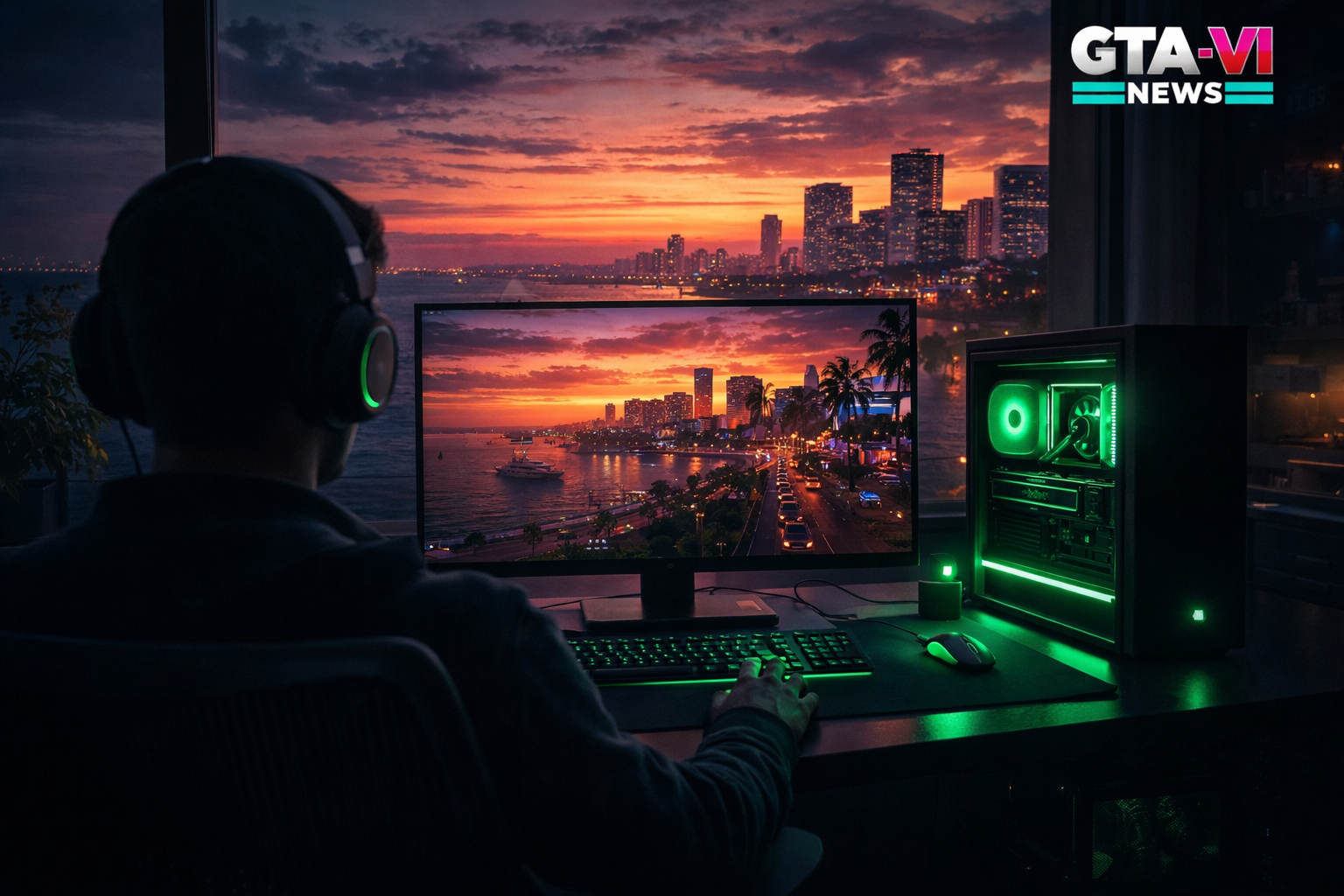
This matters because GTA 6 on PC will likely be experienced as both a spectacle and a systems test. Players will cruise slowly to admire the world, then switch instantly to chaotic action. A technically satisfying version must handle both moods without feeling like two different games stitched together. That is where expectations rise for Nvidia users in particular. They will not simply want a beautiful screenshot machine. They will want something that holds together under pressure.
Moreover, players with midrange hardware will be watching as closely as enthusiasts with premium builds. A blockbuster succeeds on PC when it scales well, not only when it dazzles at the top end.
Settings flexibility will be part of the judgment
One of the most important expectations is flexibility. PC players do not all approach games the same way. Some want maximum visual depth. Others prefer a smoother, more responsive feel. Many sit in between. A future GTA 6 PC release will need to respect those differences through smart presets, transparent settings, and options that do not feel like guesswork.
That is why Nvidia users are likely to care as much about implementation as about headline features. People want settings that make sense. They want clear trade-offs. They want the freedom to tune the experience without breaking the game’s look. In contrast, a messy or confusing setup can sour first impressions even when the underlying visuals are strong.
Fans may be surprised how much goodwill can be won through a competent options menu. It sounds mundane, but for a game of this scale, technical trust matters. If players feel they understand how to shape performance on their machine, they become more patient and more positive. If everything feels opaque, frustration grows fast.
The emotional side of the hardware discussion
There is also an emotional layer here that should not be ignored. Owners of powerful Nvidia GPUs often treat major releases as moments of validation. They want the next giant game to make their hardware investment feel worthwhile. That does not mean they expect miracles. It means they expect a visible difference, a version of the game that feels especially polished, fluid, and rich on PC.
In that sense, GTA 6 is almost uniquely positioned. It is not just another release on a crowded calendar. It is the sort of game people imagine upgrading for. Even those who never say it directly are often thinking the same thing: if any title should reward premium PC hardware, surely it is this one.
However, expectation cuts both ways. The more people project onto a game, the harder the landing can be if technical decisions feel conservative or underdeveloped. That is why Rockstar’s eventual PC strategy will matter so much. A strong launch could build lasting trust. A weak one would dominate the conversation for entirely different reasons.
What Nvidia users are really asking for
At bottom, most Nvidia users are asking for something fairly simple from a future GTA 6 PC version: let the world breathe. Let the city feel dense without becoming heavy. Let motion remain clean when speed increases. Let visual upgrades feel meaningful, not cosmetic. And let players across several hardware tiers find a configuration that feels right.
That is a practical wish, not an extravagant one. It reflects how PC players now think about technical quality. They care about immersion, but they also care about control. They want the freedom to choose how the game looks and responds on their own system.
If Rockstar delivers that balance, the conversation around Nvidia and GTA 6 will become less about speculation and more about satisfaction. That would be the best outcome. A game this important should not merely arrive on PC. It should feel at home there.