
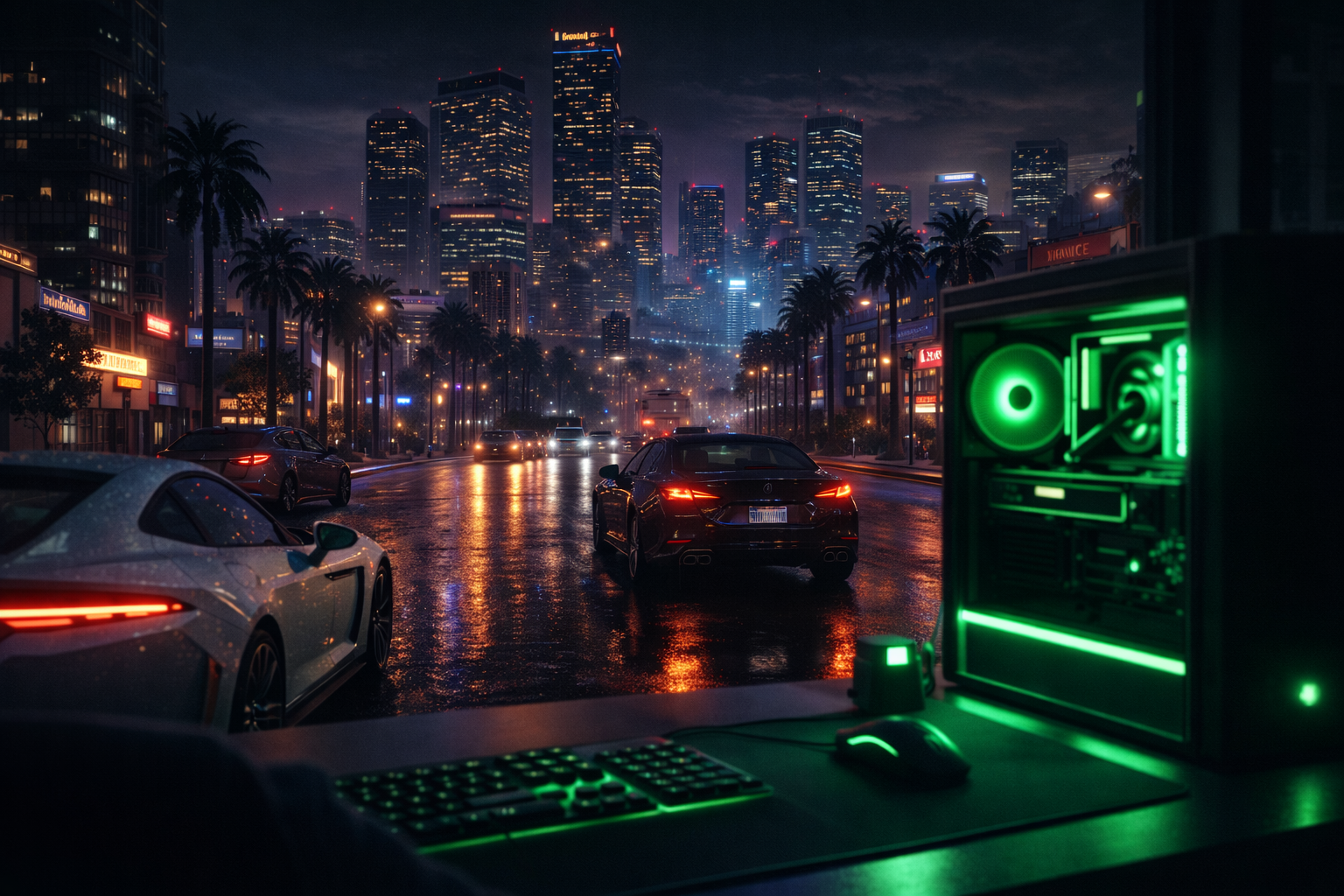
Nvidia, GTA 6, and the premium graphics race: why open-world blockbusters now compete on density, atmosphere, and technical smoothness.
The new graphics race looks different now
There was a time when graphics competition revolved around obvious leaps. More polygons. Sharper textures. Cleaner edges. Those gains still matter, but the premium graphics race now looks more complex. Players judge worlds by density, atmosphere, responsiveness, and consistency as much as by raw detail. That shift is exactly why Nvidia and GTA 6 belong in the same conversation.
A modern open-world game is not evaluated through one hero scene. It is evaluated through hours of movement and observation. How alive does the city feel at speed? How stable is the image when weather changes? Do nighttime streets preserve detail without turning muddy? Can a crowded district still feel smooth? Those questions define premium graphics now.
For a franchise like GTA 6, the pressure is even higher. Grand Theft Auto does not compete only with other open-world games. It competes with the memory of what players imagined the future would look like. That is a difficult standard, and it makes the hardware discussion more than a side note.
Why Nvidia is central to this debate
Nvidia appears so often in these discussions because it has become symbolic of premium PC graphics expectations. To many players, it represents not just top-tier hardware but also the idea that demanding games should be able to scale intelligently across different performance targets. That expectation fits naturally with the challenge a game like GTA 6 presents.
A huge city creates countless simultaneous demands. Geometry, lighting, reflections, streaming, particle effects, traffic, and crowd behavior all add up. In an environment like that, premium graphics are not about one isolated visual trick. They are about sustaining overall quality. That is harder to do, and it explains why a game such as GTA 6 could become a key talking point in the next stage of the PC graphics race.
Moreover, large releases influence perception beyond their own audience. When a cultural giant looks stunning on PC, it raises the standard for what people expect from other blockbuster games. That ripple effect is part of what makes the subject important.
Why open-world quality is harder to fake
Open-world graphics expose weakness quickly because players control the rhythm. They can stand still and inspect distant buildings, then accelerate into traffic, then spin the camera toward reflective surfaces and dense intersections. That freedom makes it much harder for a game to rely on selective polish.
This is one reason GTA 6 and Nvidia feels like a meaningful combination. If the game becomes a premium PC showcase, it will need to succeed under conditions that players themselves create. That means visual ambition must survive unpredictability. Strong lighting in one district is not enough. A convincing city needs continuity across neighborhoods, times of day, and driving speeds.
In contrast, tightly directed games can sometimes hide their compromises more easily. Grand Theft Auto has fewer places to hide. That is part of its appeal. It asks the player to believe in the whole world, not merely in curated slices of it. The premium graphics race becomes more honest in that setting.
Why smoothness is now part of visual luxury
One of the most important changes in modern gaming is that smoothness itself now feels luxurious. Players no longer separate graphics from fluidity as neatly as they once did. A game that looks spectacular but feels uneven can leave a weaker impression than one that is slightly less ambitious yet more stable in motion.
That matters enormously for a future GTA 6 PC version. Driving is central to the experience, and fast traversal exposes technical problems immediately. If Nvidia-powered systems can help preserve clean motion in demanding scenes, that will be part of the premium appeal. It is not a bonus. It is the experience.
Fans may be surprised how little patience the modern audience has for technical inconsistency in flagship games. Expectations have hardened. The market now treats blockbuster PC releases as complete packages. Strong lighting without control is not enough. Strong density without stability is not enough either.
The real prize in this race
The prize in the new open-world graphics race is not merely the most expensive screenshot. It is credibility. The game that convinces players that its world can hold together under real use earns something more valuable than temporary hype. It earns trust.
That is why Nvidia, GTA 6, and premium graphics continue to be discussed together. The pairing captures a credible possibility: one of gaming’s biggest franchises arriving as a major test for what premium PC visuals now mean. If Rockstar eventually delivers a technically polished PC version, the result could shape expectations far beyond one title.
And that is what makes the topic worth following. It is not only about hardware enthusiasts admiring specifications. It is about where visual standards are heading. In the next era of open-world gaming, luxury will be measured not by excess alone, but by how seamlessly ambition becomes believable. That is the real race now.