
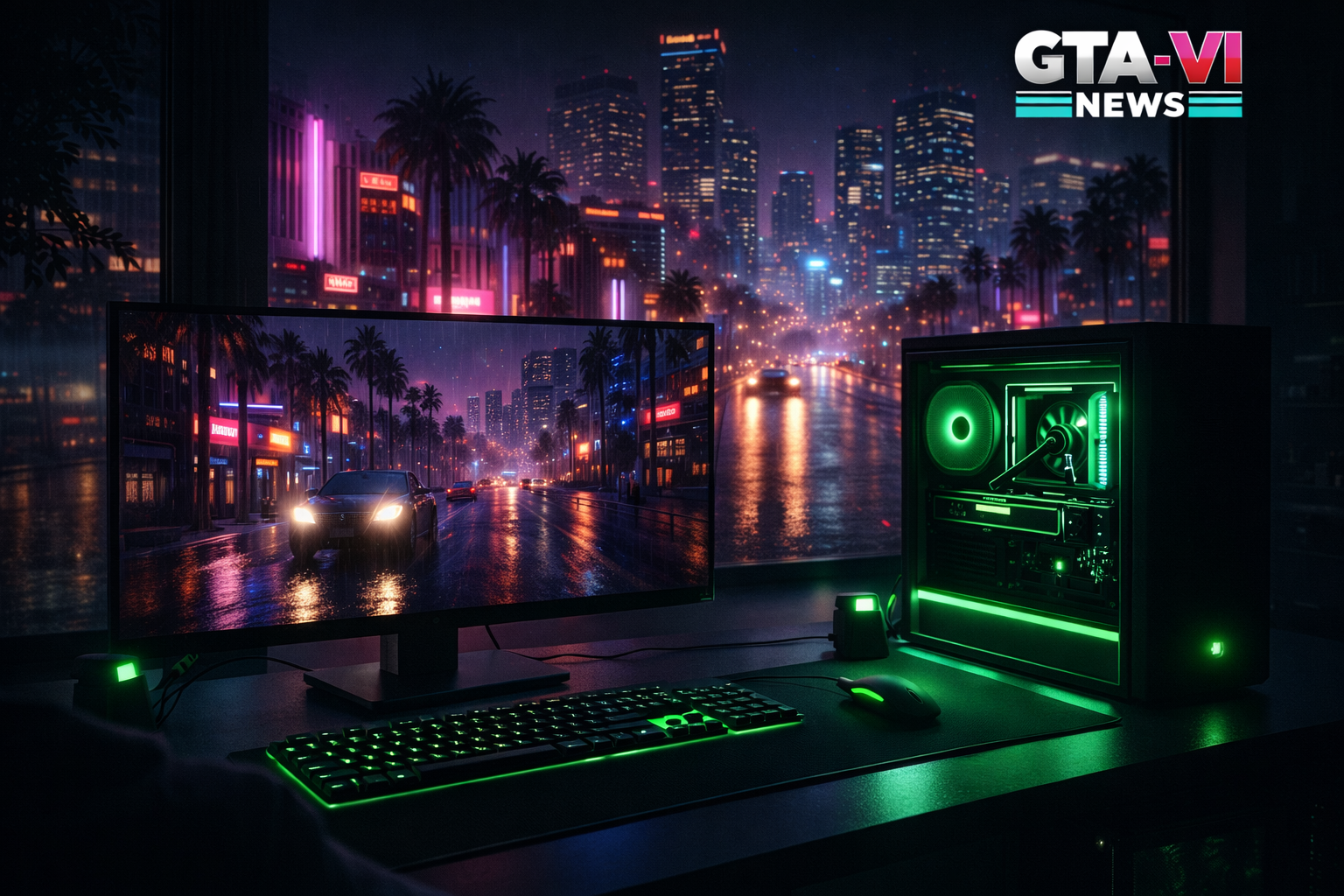
Can Nvidia-focused PC features help GTA 6 feel more cinematic? A closer look at lighting, motion, and the art of believable spectacle.
Cinematic games are not built by resolution alone
When players describe a game as cinematic, they rarely mean only that it looks sharp. They are talking about mood, movement, depth, and timing. They mean the way headlights bloom across wet roads, how shadows shape a street corner, how motion feels during a fast camera pan, and whether the world keeps its atmosphere under pressure. In that sense, the question of whether Nvidia can make GTA 6 feel more cinematic on PC is more interesting than it first appears.
A Grand Theft Auto game lives between chaos and observation. One moment, the player is staring at a skyline in the evening light. The next, they are escaping a collision-heavy pursuit through crowded roads. For the experience to feel cinematic, visual quality cannot collapse when the pace changes. That is the challenge.
This is why Nvidia and GTA 6 has become such a compelling pairing in speculation. Nvidia is often associated with the sort of graphical support that can help preserve mood without forcing players to accept constant instability. Whether Rockstar eventually uses those tools in a meaningful way remains to be seen. The broader point still holds: cinematic quality on PC now depends on more than raw pixel count.
Lighting may be the real star
If GTA 6 becomes visually memorable on PC, lighting may play the biggest role. Open-world games live or die by how believable they feel across different times of day and weather conditions. A city that looks impressive at sunset but flat at noon is not truly cohesive. Players notice those inconsistencies even when they cannot explain them in technical terms.
That is where Nvidia-related expectations often become more specific. PC players imagine richer reflections, more convincing shadow detail, cleaner night scenes, and stronger contrast between interior and exterior spaces. Those elements do not merely enhance screenshots. They shape emotional tone. A quiet neighborhood at dawn should feel different from a rain-soaked nightclub district after midnight.
Moreover, lighting affects how expensive a world feels. It can make surfaces feel tangible, cars feel grounded, and urban spaces feel inhabited. If Rockstar leans into atmosphere, Nvidia could become part of the conversation because players may associate its hardware ecosystem with the tools needed to make that atmosphere hold together.
Motion and camera feel matter just as much
Cinematic presentation is also about motion. A game can have gorgeous lighting and still feel oddly flat if fast movement becomes messy or unstable. That issue is particularly relevant for GTA 6, where driving is central to the experience. Players do not simply stand still and admire scenery. They move through it quickly, often unpredictably.
For that reason, Nvidia on PC may matter as much for perceived smoothness as for visual complexity. Clean motion can make a world feel expensive. It helps preserve a sense of realism during pursuits, gunfights, and quick turns through dense environments. When motion quality holds up, the player stays inside the scene. When it breaks down, the illusion weakens.
In contrast, many cinematic discussions ignore this point and focus only on static beauty. That misses the heart of the issue. Grand Theft Auto is a game of transitions. Street to beach. Day to night. Calm to chaos. A truly cinematic PC version must make those transitions feel natural, not jarring.
Why atmosphere could matter more than technical bragging rights
There is always a temptation to turn graphics discourse into a list of bragging rights. Bigger resolution. More effects. Higher settings. Yet the most memorable visual experiences are often defined by atmosphere rather than by obvious excess. A believable city with consistent tone can feel more cinematic than a technically louder one.
That is why the Nvidia and GTA 6 topic stays interesting. It is not only about maximum output. It is about whether PC technology can preserve a certain mood. Players want nighttime streets that feel humid and alive, coastal horizons that stretch convincingly, and interior scenes that do not look detached from the world outside. Those are atmospheric goals.
Fans may be surprised that subtlety may matter more here than spectacle. Rockstar’s worlds usually gain strength from texture, rhythm, and environmental credibility. If Nvidia-related features help support those qualities, their value will be artistic as much as technical.
The answer is probably yes, but with a condition
So, can Nvidia make GTA 6 feel more cinematic on PC? Probably yes, but only if the underlying port is designed with care. Hardware features can elevate a game. They cannot rescue a careless one. If Rockstar provides a strong technical foundation, Nvidia-supported rendering and performance tools could help deliver the richer lighting, cleaner motion, and steadier immersion that players associate with cinematic quality.
That condition matters. The most successful PC experiences are never built from one feature alone. They emerge from smart design choices layered on top of capable hardware. If GTA 6 eventually reaches that balance, the cinematic conversation will feel justified rather than inflated.
And that is really the goal. Not empty spectacle. Not a settings arms race. Just a city that feels alive, expressive, and believable when the player steps into it. If PC technology helps achieve that, people will notice immediately.