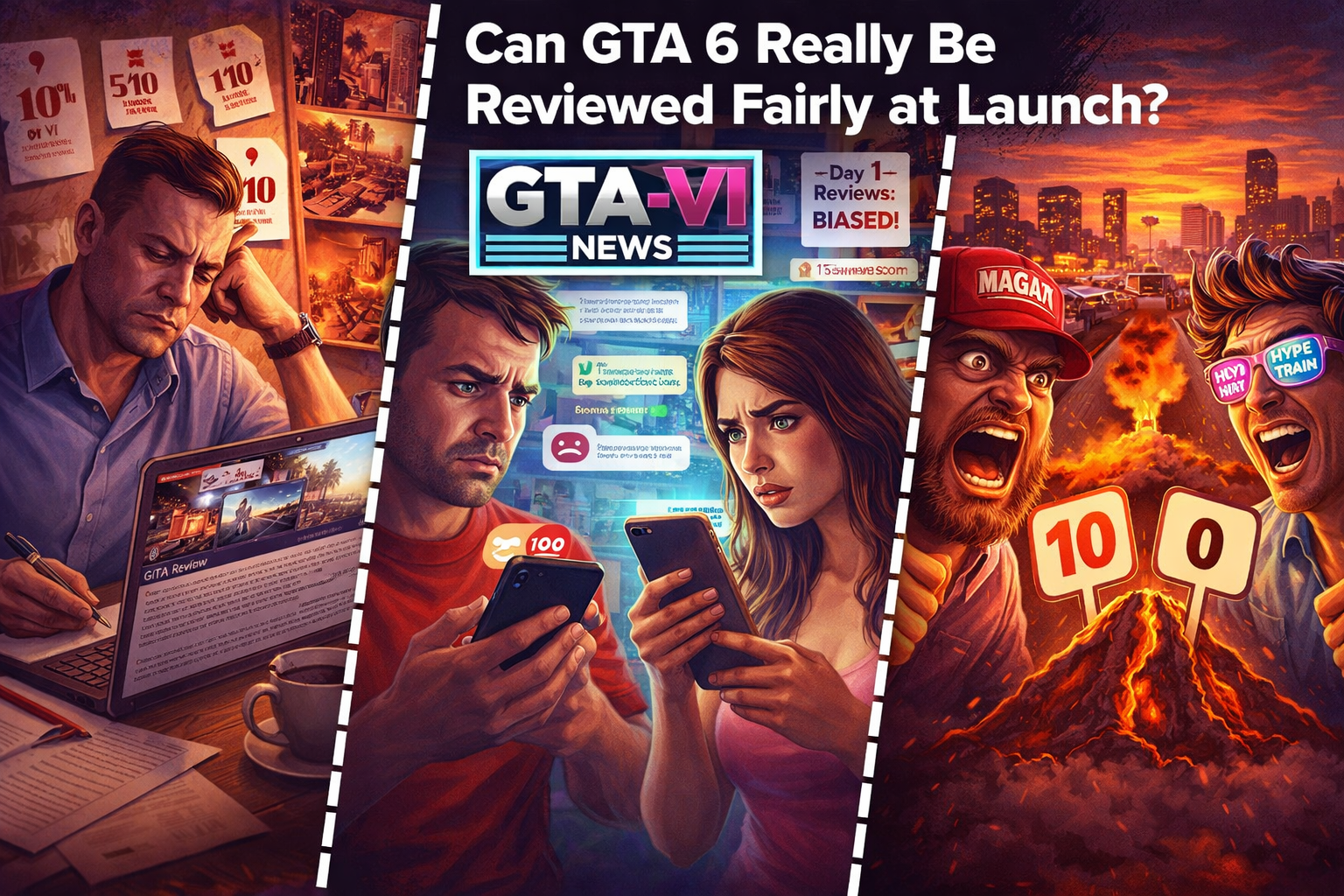
Few games arrive under as much expectation as a new Grand Theft Auto, which raises a difficult question before GTA 6 is even in players’ hands: can a game of this scale be reviewed fairly at launch? The issue is not whether critics are capable of judging it. It is whether the conditions of modern blockbuster release allow a full assessment of something that will likely contain a vast single player campaign, a heavily discussed technical profile, and perhaps an evolving online dimension that may change substantially after the first wave of verdicts.
Large open world games already challenge the idea of a definitive day one review. They unfold slowly, reveal systems over dozens of hours, and often become clearer only after the initial spectacle wears off. GTA intensifies this problem because its cultural weight can distort both praise and criticism. Reviewers are not only responding to a game. They are responding to years of expectation, public mythology, and the knowledge that their assessment will be absorbed into a much larger conversation.
That environment can create two opposite errors. One is overgenerosity, treating scale and ambition as achievements that excuse every rough edge. The other is performative severity, where critics overcorrect against hype by magnifying flaws in order to appear resistant to consensus. Neither response is especially useful to readers who want to know what the game actually does well and where it fails.
Launch reviews are snapshots, not final judgments
The fairest way to think about launch criticism is as an informed snapshot rather than a final ruling. A strong review should evaluate the writing, mission design, world building, technical condition, and thematic coherence visible within the time available. But it should also acknowledge where the experience is likely to evolve. Technical patches may improve performance. Community discoveries may reshape how the map is understood. Online systems, if included, may look very different a month later.
That does not make early criticism worthless. On the contrary, launch reviews remain essential because they document the game as it first exists in public. Players deserve to know whether performance is stable, whether the story holds together, and whether the mission structure sustains momentum. But readers should resist treating those first scores as the complete story of a game designed to dominate attention for months or years.
Rockstar’s games often benefit from time because they are built with layers that are easy to miss in a compressed review window. A district’s social texture, the rhythm of ambient systems, or the cumulative effect of the writing may only fully register after extended play. At the same time, time can also expose weaknesses that launch enthusiasm hides, such as repetitive mission logic or systems that look impressive but remain mechanically shallow.
The cultural event complicates the criticism
GTA 6 will not be reviewed in a calm environment. It will be reviewed during a media event, and that changes the tone of coverage. Every article, video, and social post will exist inside a wave of reaction that rewards speed and certainty. But the strongest criticism often requires the opposite. Patience. Precision. Willingness to separate technical spectacle from design quality.
A review that says GTA 6 is enormous or polished may tell readers something true, but not enough. The better questions are more specific. Does the story earn its scale? Does the open world support the narrative or distract from it? Do the characters feel sharply written or merely well performed? Does the game observe contemporary life with intelligence, or does it repeat familiar Rockstar gestures without fresh insight?
Those are the questions that will matter once the launch frenzy cools. They are also the questions least suited to instant consensus. So yes, GTA 6 can be reviewed fairly at launch, but only if readers understand what a launch review is and what it is not. It is the beginning of the critical conversation, not the endpoint.
That distinction is worth preserving because a game of this size deserves scrutiny that lasts longer than a score attached to release week. GTA 6 will likely be discussed as an event on day one. The more interesting question is what it looks like once the event becomes a work to be judged on its own terms.