
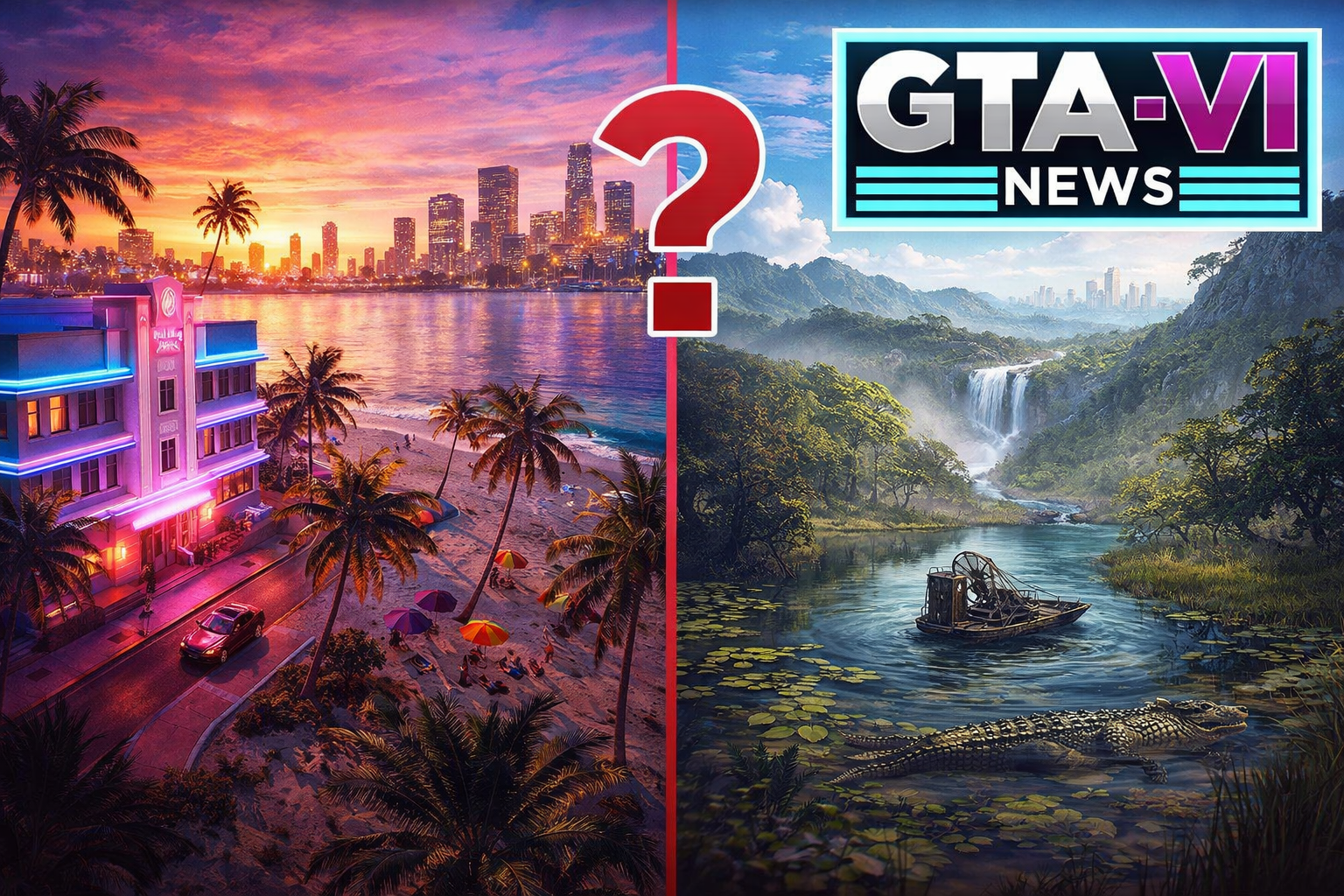
Vice City may be the name most closely associated with Grand Theft Auto 6, but it is unlikely to define the game’s geography on its own. Rockstar understands the symbolic value of a famous city, especially one with such strong series history, yet nostalgia alone is not enough to sustain a modern open world. If GTA 6 wants to feel like a true generational step, the surrounding regions may prove just as important as the city that attracts the headlines.
That broader geography matters because a contemporary GTA world is expected to offer contrast. Players want glamour and decay, tight urban density and exposed outskirts, crowded nightlife and quiet roads where tension can build slowly. A city without a convincing periphery risks feeling staged. A larger region allows Rockstar to create different kinds of stories and rhythms without breaking the overall identity of the map.
The most effective approach would be to treat Vice City as the gravitational center rather than the entire proposition. That means a dense urban core supported by coastal routes, satellite towns, industrial belts, wetlands, highways, and neglected zones that reveal how the wider region functions. In design terms, those areas are not filler. They are the spaces that make a city feel connected to an economy, a class structure, and a broader social landscape.
Rockstar has learned the value of regional storytelling
One of the lessons from Rockstar’s later work is that regions can carry narrative weight. In Red Dead Redemption 2, the world was memorable not only because it was large, but because its different territories suggested different political and cultural conditions. GTA 6 could benefit from a similar philosophy, translated into a modern setting. A wealthy waterfront district says one thing about the city. A storm battered outlying town says something else entirely.
These contrasts matter because GTA stories often revolve around mobility. Characters cross boundaries between wealth and poverty, legality and criminality, glamour and desperation. A broader map supports those transitions in a visual and spatial way. It makes movement itself part of the narrative rather than a logistical function between mission markers.
There is also a gameplay argument. Different regions allow Rockstar to diversify mission design without constant tonal strain. Chases, surveillance, smuggling, evasion, and quieter character scenes all gain more texture when they occur in spaces built for different moods. A swamp road at dusk does different emotional work from a bright downtown boulevard at midday.
The danger of over romanticizing Vice City
Players often talk about returning to Vice City as though the location itself is enough to guarantee excitement. But Rockstar is unlikely to succeed by merely recreating a familiar skyline with sharper graphics. The more interesting challenge is reinterpreting the city within a larger contemporary world. That means asking what modern Vice City represents now, not what it represented in a stylized earlier era.
If Rockstar uses the city as part of a wider regional ecosystem, GTA 6 could avoid the trap of nostalgia becoming a design limit. Vice City would still carry the brand power, but it would be enriched by the places around it. The result could be a map that feels both iconic and less predictable.
That is probably the smartest direction. Players want the city they remember, but they also want a world that justifies current generation ambition. Rockstar can satisfy both by making Vice City the anchor rather than the boundary. A great GTA map is not just a famous urban name. It is the set of relationships between center and edge, aspiration and neglect, order and improvisation.
If GTA 6 captures that balance, the conversation around the map may shift quickly. People will start by asking whether Vice City is back. They may end up talking about everything around it that makes the return feel larger, stranger, and more convincing than expected.