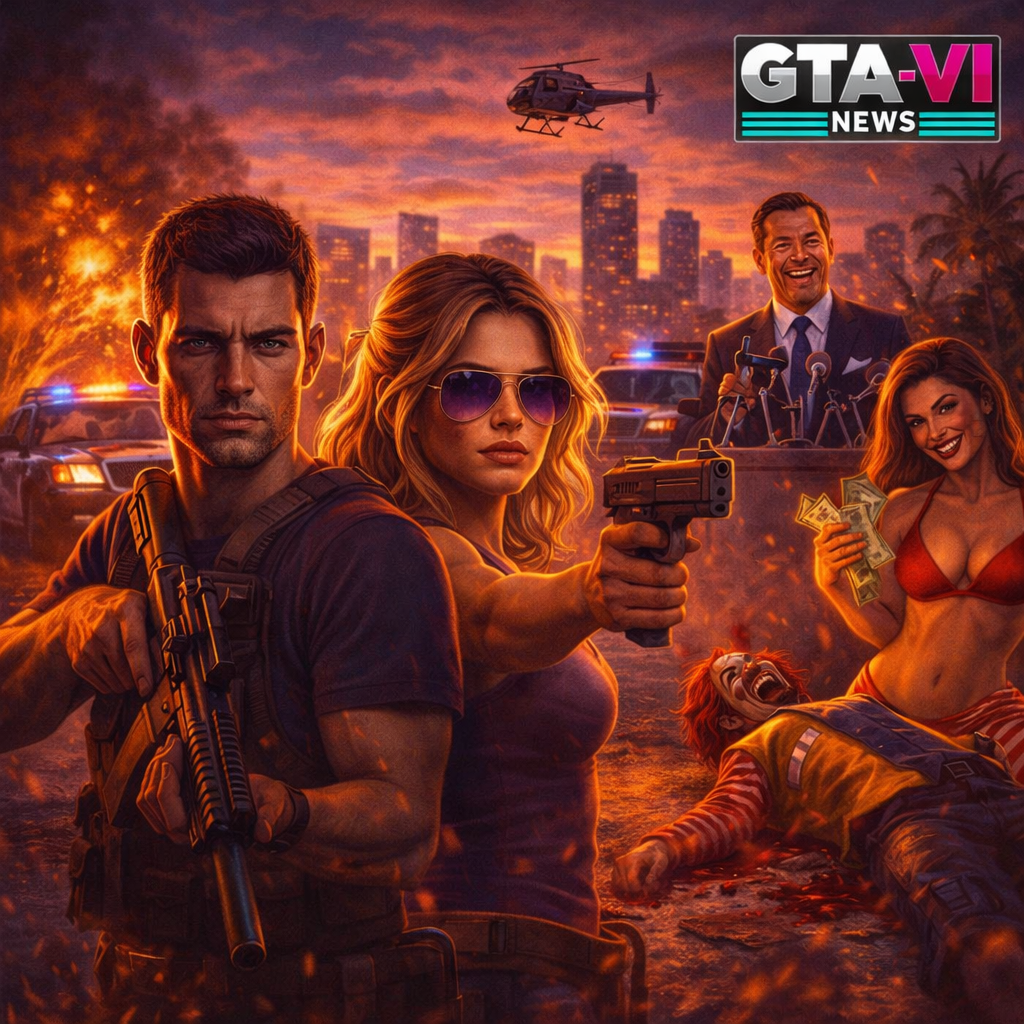
Grand Theft Auto has always lived in tension. It is a crime fantasy, a social parody, a technical spectacle, and a series fascinated by the emotional aftershocks of violence without ever wanting to be pinned down as solemn. That tension is part of its appeal, but it is also one of the hardest things for Rockstar to manage. GTA 6 will likely be judged in part on whether it can finally balance story, satire, and violence with greater precision than some earlier entries achieved.
The challenge is not whether violent action can coexist with humor or critique. It obviously can. The challenge is whether the game knows what each mode is doing in a given moment. Rockstar sometimes undercuts its own dramatic scenes with a reflexive joke, or turns social observation into noise by satirizing everything at once. The result can be entertaining but tonally diffuse, as though the game is unwilling to let any element settle long enough to develop real force.
GTA 6 has an opportunity to improve on this by treating violence less as automatic escalation and more as narrative pressure. Crime stories become more interesting when action changes relationships, social standing, and psychological state rather than simply increasing spectacle. If missions and cutscenes acknowledge the social consequences of violence without becoming preachy, the world will feel more coherent.
Satire works best when it has targets, not just volume
Rockstar’s writing is often funniest when it is specific. A carefully observed parody of local politics, fake luxury culture, or media performance can reveal the world sharply. The weaker moments tend to come when satire becomes generalized noise, a constant sneer without enough hierarchy or focus. GTA 6 should resist the temptation to mock everything equally.
That matters because a modern setting offers plenty to work with. Platform culture, speculative wealth, digital self branding, soft corruption, and visible inequality all fit the series naturally. But the writing will need to know which observations are worth lingering on and which are merely familiar. Precision will make the world feel smarter. Excess will make it feel repetitive.
Violence and satire can support each other when the game understands the relationship between them. A mission can be funny in setup, brutal in execution, and revealing in aftermath. That layered tone is difficult to achieve, but Rockstar is one of the few studios with the resources and writing ambition to attempt it.
The story must decide when to stop joking
Perhaps the most important discipline GTA 6 needs is knowing when not to retreat into irony. Characters can still be flawed, funny, and contradictory, but some key scenes should be allowed to stand without immediate tonal escape. That is how narrative weight accumulates. A game earns seriousness not by rejecting humor, but by refusing to let humor flatten every emotional contour.
If GTA 6 can hold its nerve in those moments, the broader story will benefit. The satire will feel sharper because it is not constant. The violence will feel more consequential because it is not only a vehicle for set pieces. The characters will feel more legible because their reactions are not always filtered through performance.
This kind of balance is difficult, especially in a series with such a strong public identity. Players expect irreverence from GTA. Rockstar will be wary of appearing too controlled or self serious. But maturity does not require dullness. It requires judgment.
That may be the deeper test GTA 6 faces. Not whether it can be bigger or louder than before, but whether it can finally shape its own contradictions into something more deliberate. If it can, the story may leave a stronger impression than any single mission or visual set piece. If it cannot, the game may still succeed hugely while feeling narratively less focused than its ambition deserves.