
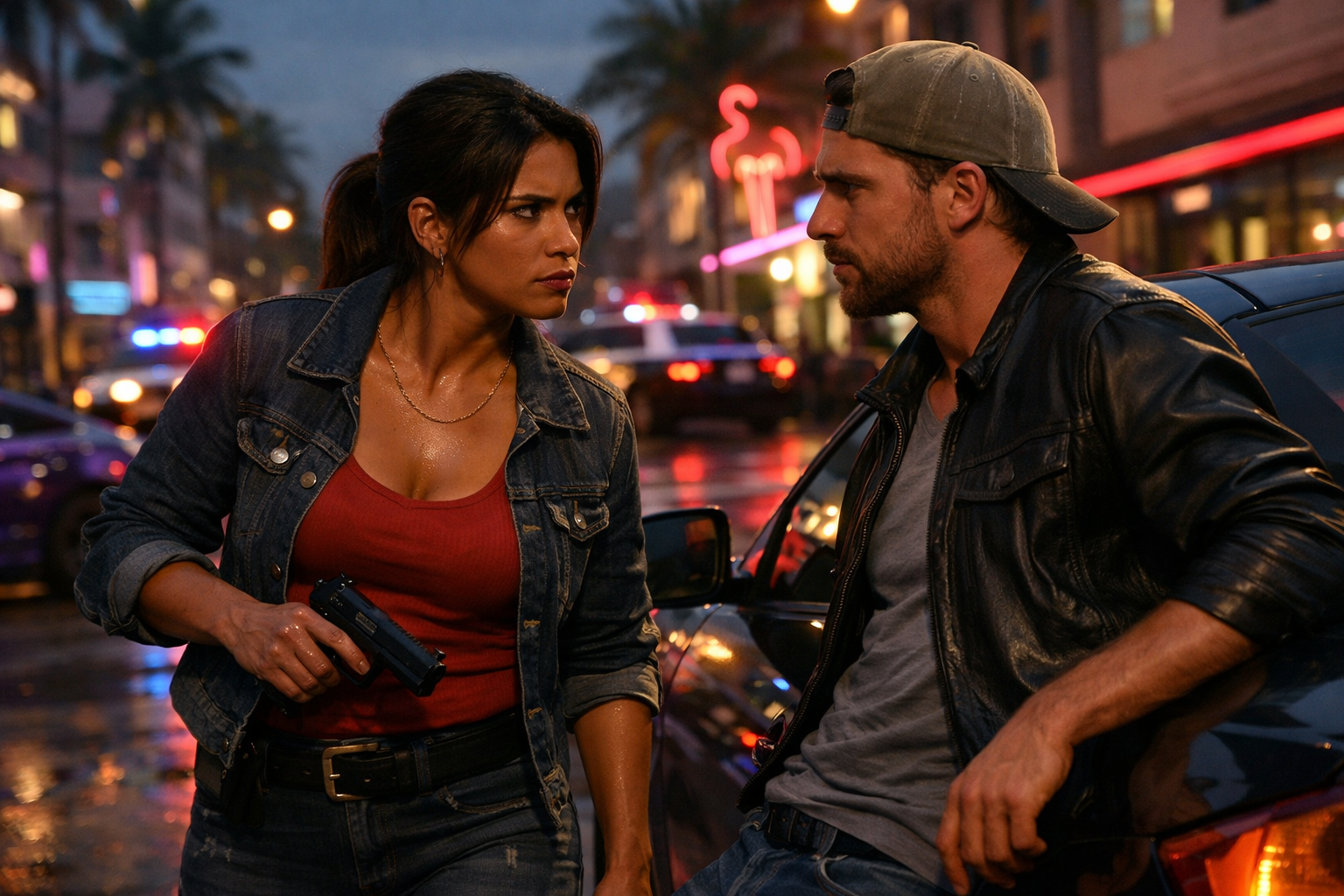
Few upcoming games are being analyzed as intensely as Grand Theft Auto VI. Rockstar has formally shown Vice City, the wider state of Leonida, and its main duo, Lucia and Jason. Those details alone raise a larger question. What kind of crime story does a modern Grand Theft Auto need to tell if it wants to feel sharp rather than inflated? Rockstar’s official site currently lists Grand Theft Auto VI for PlayStation 5 and Xbox Series X|S with a release date of November 19, 2026, while its trailers position the game in Vice City and the broader state of Leonida. Those are the stable facts. Everything else in this piece is analysis built around those confirmed elements rather than leaked claims or recycled rumor. That distinction matters, especially when online coverage tends to blur what is known with what is merely popular. A good GTA 6 article should do better.
The angle here is simple. Why Restraint Could Make the Plot Hit Harder That may sound narrow, but narrow is often where stronger criticism begins. Earlier Rockstar games sometimes stretched themselves between social commentary, excess, and sentiment. At their best, they turned that mix into texture. At their worst, they treated momentum as a substitute for precision. Fans may be surprised that the safest way for Grand Theft Auto VI to feel bigger is not to say more. It is to say the right things at the right time.
Why the Premise Matters
A strong first act should not rush into fireworks. It should establish who these people are when the job is not working. In practice, that means the game must trust players to read tone and pattern. The most effective scenes in a crime drama are often built on withheld information, delayed reaction, or a line that lands harder because it is not explained twice. For a modern Rockstar release, that kind of discipline would feel refreshing. It would also make the official setting of Leonida feel more than decorative, because place starts to influence how people speak, move, and choose under pressure.
Mission structure needs to echo emotional movement. When tension rises in the relationship, mission friction should rise too. This is where design and writing meet. A mission, district, or conversation becomes memorable when it reflects the larger point of the campaign rather than simply filling time. That applies whether the subject is the GTA 6 map, the core characters, or the overall story arc. Players do not always describe this in critical language, but they feel it instantly. They notice when a game is carrying its own weight.
Where Structure Can Improve
Players usually accept crime escalation more readily when the early motivations are specific. Money alone is rarely enough. Moreover, specificity creates credibility. A world like Vice City should not be reduced to postcard imagery or nostalgia cues. It should have social gradations, local habits, and different kinds of risk depending on where the player is and who they are with. The same principle applies to people. Lucia and Jason will only feel convincing if their choices reveal priorities, fears, and limits, not just cool poses inside polished cinematics.
Satire is still part of the brand, yet satire works better when it grows from the world rather than interrupting it. In contrast, a bloated approach would flatten everything into the same dramatic register. Every mission cannot be the most important mission. Every ally cannot sound equally eccentric. Every zone cannot compete for the same kind of attention. Restraint is what allows standout moments to stand out. This changes everything when it is done well, because the game starts to breathe instead of shout.
How Character Stakes Raise the Tension
There is also a structural reason to care about this topic. Grand Theft Auto VI arrives after an unusually long period of player anticipation. That means expectations are not only high, they are fragmented. Some players want a denser open world. Others want better satire, deeper character writing, or a more cohesive campaign. Rockstar cannot satisfy every imagined version of the game. What it can do is choose a clear philosophy and execute it with confidence. That is usually what separates landmark games from overbuilt ones.
My own view is that Grand Theft Auto VI will benefit most if it treats cohesion as a feature. The official trailers suggest a glamorous world, but glamour alone never sustains a long campaign. The enduring appeal comes from relationships, routes, neighborhoods, habits, and the sense that the world notices what the player is doing. Whether one is analyzing the GTA 6 story, the GTA 6 map, or the major characters, the strongest answer is often the same. Make the details pull in the same direction.
What This Could Mean for the Full Campaign
That is why this topic deserves more than speculative countdown coverage. It deserves close reading. Rockstar has already given players enough official material to discuss tone, structure, and possibility without pretending to know the full script. A mature conversation around Grand Theft Auto VI should begin there. It should start with the confirmed facts, examine the implications, and resist the urge to turn every theory into certainty. Good criticism is useful precisely because it leaves room for the finished work to surprise us.
Grand Theft Auto VI does not need the noisiest plot Rockstar has ever written. It needs the most controlled one. With Vice City, Leonida, Lucia, and Jason officially in place, the opportunity is obvious. A sharper GTA 6 story could make every robbery, escape, and quiet aftermath feel more valuable. That would not only suit the material. It would show growth.