
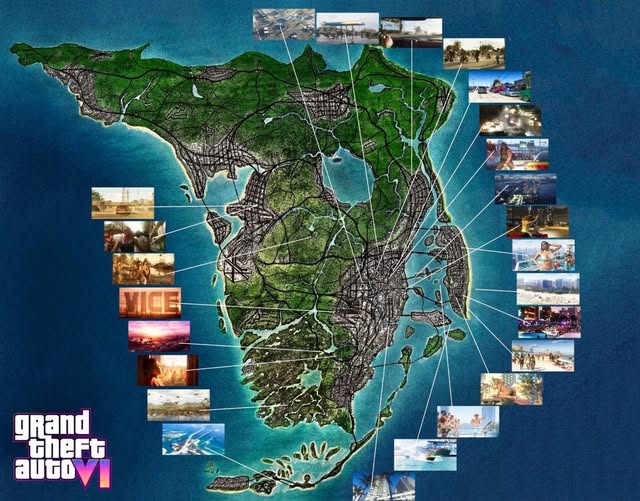
GTA 6 is bringing players back to familiar territory, but the scale is expanding far beyond nostalgia. Rockstar has officially confirmed that Grand Theft Auto 6 takes place in the fictional state of Leonida, a modern reimagining inspired by Florida. Within that setting, several major cities and regions have already been revealed.
The return to Vice City headlines the list. However, it is only the beginning.
Vice City Returns in GTA 6
The most recognizable location in Grand Theft Auto 6 is undoubtedly Vice City. First introduced in earlier entries, the neon-soaked metropolis has been rebuilt for a contemporary setting.
This is not a nostalgic copy. It is a modern urban landscape shaped by social media culture, influencer spectacle, and economic contrast. Skyscrapers dominate the skyline. High-end beachfront properties sit beside crowded districts pulsing with nightlife.
Rockstar’s depiction appears broader than previous iterations. In contrast to the more compact Vice City of the early 2000s, this version stretches outward with layered neighborhoods and distinct architectural zones.
Fans may be surprised by how central Vice City remains to the narrative. Yet early footage suggests it anchors the state of Leonida both geographically and culturally.
Port Gellhorn: Industrial Edge of Leonida
Beyond Vice City, Rockstar has confirmed additional urban areas. One of them is Port Gellhorn, a coastal city that appears more industrial and economically strained.
Where Vice City emphasizes glamour and excess, Port Gellhorn introduces grit. Dockyards, highways, and aging commercial districts dominate the skyline. The tonal contrast suggests narrative range.
This changes everything about how players may navigate the map. Instead of a single metropolitan focus, GTA 6 offers economic and social diversity across regions.
Moreover, varied city design supports mission variety. Industrial zones create opportunities for smuggling, corporate intrigue, and maritime operations.
Leonida Keys: Coastal Escape and Criminal Opportunity
The Leonida Keys represent another confirmed region. Inspired by the Florida Keys, this area blends tourism and isolation. Shallow waters, wooden docks, and sparse communities define the atmosphere.
In contrast to dense urban districts, the Keys introduce openness. Water-based traversal appears central to exploration. Boats and coastal hideouts may play significant roles.
Rockstar has historically leveraged environmental shifts to influence gameplay pacing. The Keys could serve as narrative breathing space between city-driven missions.
However, isolation can also conceal criminal enterprise. Remote locations often host clandestine operations in the Grand Theft Auto universe.
Grassrivers and the Wetlands
The state of Leonida includes expansive wetlands known as Grassrivers. This swamp-like region evokes real-world Everglades terrain.
Dense vegetation, wildlife, and rural settlements differentiate this zone from urban environments. The inclusion of wetlands signals Rockstar’s commitment to ecological variety.
Moreover, environmental storytelling may extend beyond city streets. Rural communities often carry distinct social dynamics. Side missions in these areas could explore themes separate from metropolitan satire.
In prior Rockstar titles, wilderness regions provided contrast to urban chaos. GTA 6 appears poised to continue that tradition.
Ambrosia and Suburban Leonida
Another confirmed location is Ambrosia, a smaller town within Leonida. Early details suggest suburban layouts and agricultural surroundings.
Suburban spaces often function as narrative bridges between extremes. They are neither as glamorous as Vice City nor as isolated as the wetlands.
However, Rockstar rarely treats smaller towns as background decoration. Local culture, regional politics, and hidden economies tend to surface through side missions and ambient dialogue.
This layered approach reinforces the sense that GTA 6 is constructing an entire state rather than a single focal point.
Why Multiple Cities Matter
Expanding beyond a single metropolitan area enhances scale. Grand Theft Auto 6 appears designed to encourage long-distance traversal across Leonida.
In contrast to earlier entries where transitions between regions felt constrained, current-generation hardware enables seamless streaming. Faster SSDs allow continuous movement without visible loading interruptions.
Moreover, varied cities support narrative complexity. Protagonists may shift between urban nightlife, industrial docks, rural communities, and coastal hideouts. Each location introduces distinct social hierarchies and criminal ecosystems.
Rockstar’s decision to frame the map as a state rather than a city reflects ambition. It suggests broader thematic exploration.
The Cultural Dimension of Leonida
The fictional state of Leonida draws clear inspiration from Florida’s contrasts. Tourism and wealth coexist with environmental fragility and economic disparity.
That duality fits the tone of GTA 6. The franchise thrives on satire grounded in recognizable social realities. By constructing multiple cities within a single state, Rockstar can explore varied cultural pockets.
Vice City may represent spectacle. Port Gellhorn signals industry. The Keys evoke isolation. Grassrivers introduce wilderness. Ambrosia reflects suburban nuance.
Together, they form a mosaic.
A State Built for Modern Storytelling
The confirmed locations in GTA 6 indicate that Rockstar aims to surpass previous geographic scope. Vice City anchors the narrative, but Leonida expands outward into industrial ports, wetlands, coastal chains, and rural towns.
Fans may focus on the return of familiar skylines. However, the broader state design suggests evolution rather than repetition.
This is not simply a revisited city. It is a reimagined region.
As further details emerge, additional districts may surface. For now, the confirmed cities already signal scale and diversity.
Grand Theft Auto 6 is not shrinking its world. It is redefining it.