
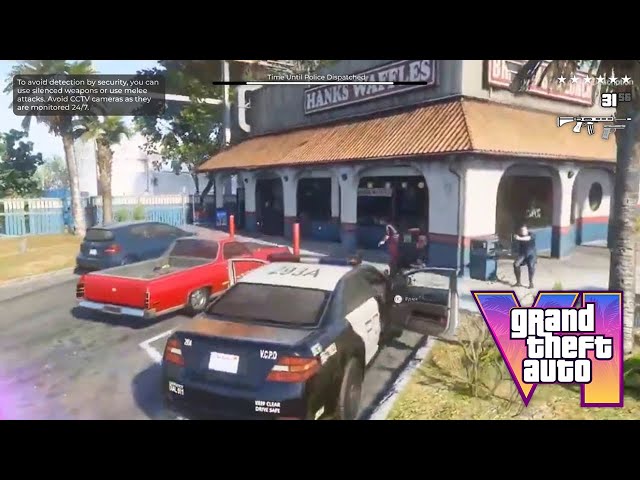
For years, the GTA wanted system has been one of the defining mechanics of the series. Cause trouble, attract attention, escape the radius, and reset. It works. It is also predictable. That predictability is exactly why many players believe GTA 6 is preparing a more layered approach to police response.
Recent discussion around Grand Theft Auto VI suggests that Rockstar Games may be redesigning how law enforcement tracks, searches, and pressures the player. Not just faster cars and bigger roadblocks, but systemic changes. Smarter detection. More persistent investigations. Less arcade logic.
If accurate, it would mark one of the most meaningful mechanical shifts in the series since GTA 4 introduced modern police AI behavior. Fans may be surprised how much this one system influences the entire feel of free roam play.
Why the Classic GTA Wanted Loop Feels Dated
In GTA 5, police escalation follows a clear structure. Each wanted star increases force, vehicles, and aggression. Escape depends on distance and line of sight. Break visual contact, leave the search circle, and wait. The system is readable and fair, but also gameable.
Veteran players know the tricks. Duck into a tunnel. Swap cars. Hide behind a building edge. The rules rarely change. That consistency helped accessibility, yet it also reduced tension over time. Once you understood the logic, the mystery disappeared.
Modern open world design has moved toward simulation rather than fixed loops. Rockstar already tested this direction in Red Dead Redemption 2, where witnesses, reporting delays, and regional law awareness created more organic consequences. Many expect GTA 6 police AI to follow that philosophy.
From Radius Search to Intelligence Driven Response
Instead of a simple circular search zone, the next iteration could rely more on information flow. Who saw the crime. Whether they reported it. What description they gave. Where the suspect vehicle was last detected. These are small variables individually. Together, they change everything.
A system built on partial knowledge forces different player decisions. Do you silence a witness. Do you flee immediately. Do you blend into traffic before the alert spreads. That kind of design creates tension without increasing raw difficulty.
Evidence From Early GTA 6 Footage and Reports
Clips and development material that circulated earlier in the project’s life cycle pointed toward more detailed police behavior in GTA 6. Observers noted scene containment, directional searches, and dialogue that suggested officers were coordinating rather than simply converging.
Of course, early builds do not guarantee final mechanics. Features shift during production. Some are simplified for pacing. Others are expanded when they prove fun. Still, the direction matches Rockstar’s broader design trend toward systemic realism over scripted reaction.
Moreover, hardware advances give the studio more room to simulate layered responses without sacrificing performance. That matters in dense urban spaces like the rumored new version of Vice City.
Smarter Cops Change Player Behavior
An improved GTA 6 wanted system would not only affect chases. It would change how players approach crime itself. Quick smash and grab jobs become riskier if identification persists. Vehicle choice matters more if plates or descriptions are tracked. Clothing changes might reduce suspicion. Timing becomes a factor.
This pushes the game slightly closer to a stealth sandbox without forcing stealth. The option space grows. Loud escapes remain possible, but quiet exits gain value. That balance tends to produce better emergent stories, which is where Rockstar games often shine.
Heat That Lingers Beyond the Scene
One widely discussed possibility is residual heat. Instead of a full reset after each escape, certain areas or factions might remain alert. Commit repeated crimes in the same district and response times drop. Patrol density rises. Undercover units appear more often.
That approach mirrors systems seen in some immersive sims and strategy titles. It rewards movement and planning. It also discourages repetitive grinding in one safe corner of the map. Not everyone will like that pressure, but it would make the world feel more reactive.
Balancing Realism With GTA’s Signature Chaos
There is a line Rockstar cannot cross. Grand Theft Auto VI still needs to support chaos driven play. If law enforcement becomes too persistent or too realistic, spontaneous fun suffers. Long pursuits are exciting. Endless surveillance is not.
The likely solution is layered logic. Low level crimes trigger local response with smarter search patterns. Major crimes escalate into traditional multi unit chases. Military style lockdown remains reserved for extreme wanted levels. In contrast to past games, the escalation would feel contextual rather than purely star based.
That hybrid model preserves the series identity while modernizing the underlying rules.
Technology Finally Supports the Design Ambition
Earlier GTA entries were limited by memory and CPU budgets. Simpler police logic kept the world stable. Today’s consoles and PCs allow more background simulation. More agents can run decision trees. More events can be tracked across time.
This technical headroom gives Rockstar Games the opportunity to connect systems that were once isolated. Traffic cameras, patrol routes, civilian reports, and vehicle databases can feed into one response network. The player may never see the math, but they will feel the difference.
That is often Rockstar’s preferred method. Hide the complexity. Show the result.
What This Means for GTA 6’s Open World
If the rumored changes land, the open world of GTA 6 will feel less like a stage and more like a city that reacts. Crimes will echo. Mistakes will compound. Clean escapes will feel earned rather than automatic.
It also aligns with the dual protagonist structure. Different characters could attract different scrutiny based on history, style, or known associations. One may be flagged faster. The other slips through longer. That adds mechanical identity to narrative roles.
Nothing is confirmed yet. Rockstar remains quiet about specific systems. Still, the direction of travel is clear. More simulation. More consequence. More texture in everyday interactions with the law.
For a franchise built on evasion, that is a meaningful evolution.