
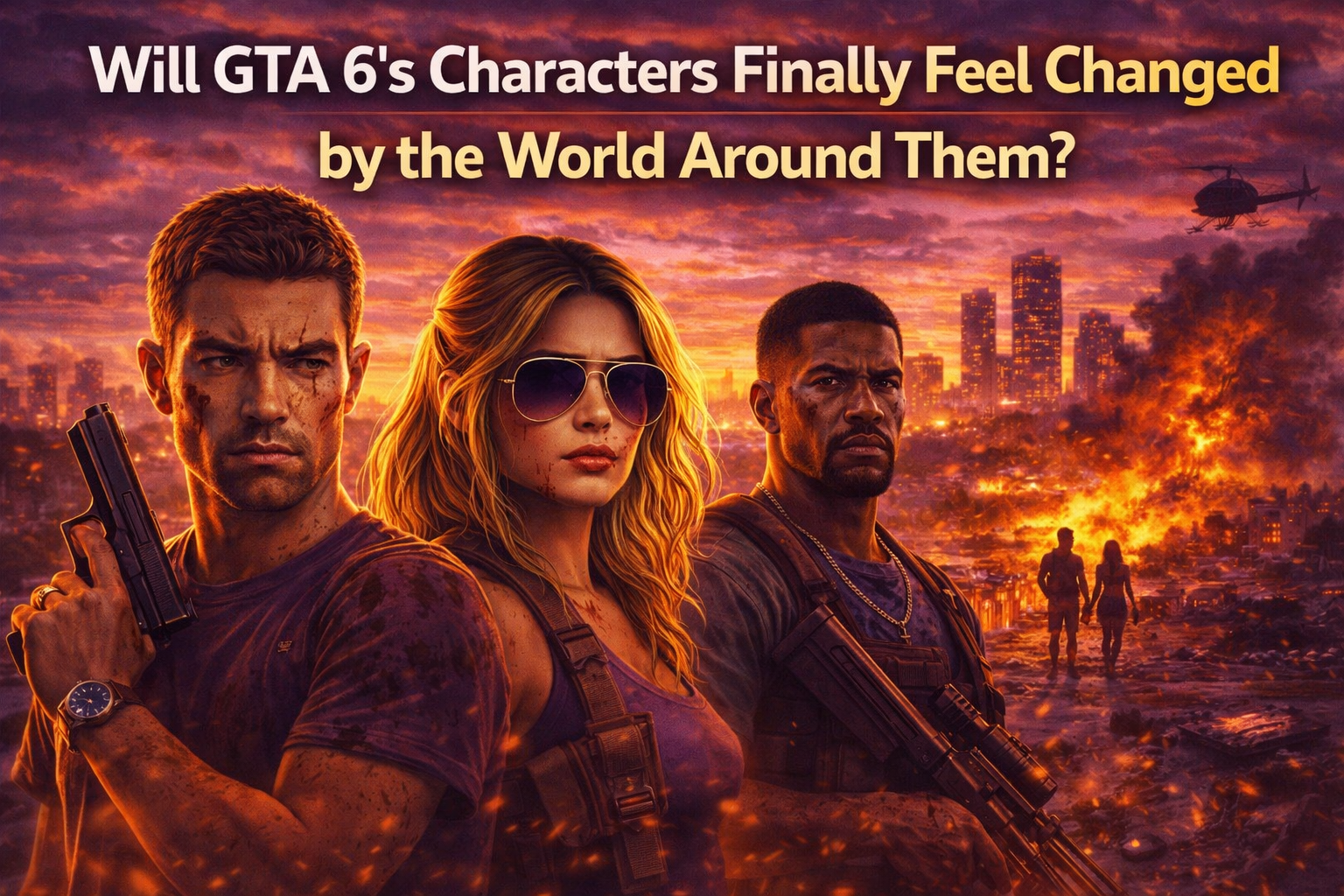
One of Rockstar’s persistent strengths is environmental storytelling. Its worlds feel rich with social clues, material detail, and implied systems of power. One of its persistent weaknesses is that characters do not always seem transformed by living in those worlds. They move through them, comment on them, exploit them, and sometimes mock them, but they are not always shaped by them in ways that feel deep or lasting. GTA 6 has a chance to change that.
This matters because a contemporary crime story is not only about what characters do. It is about what the world teaches them to desire, fear, imitate, or escape. In a setting likely defined by performance culture, visible wealth, unstable loyalty, and constant pressure to project identity, character development should emerge from social environment, not merely plot events.
If Lucia and Jason, or whatever central figures Rockstar ultimately uses, feel changed by the city’s specific logic, the story will gain force immediately. Their relationship to money, risk, attention, and self invention should evolve not because a cutscene says so, but because the world around them makes certain choices easier and others harder. That is how settings become dramatic rather than decorative.
Rockstar has already shown it can do this
Red Dead Redemption 2 offered a strong example of a Rockstar protagonist genuinely shaped by historical and social conditions. Arthur Morgan’s development was inseparable from the changing world around him. GTA 6 does not need to imitate that exact model, but it can borrow the principle. A modern city should leave marks on the characters who survive inside it.
That could appear in small ways. The way characters talk about opportunity. The spaces where they feel confident or exposed. The kinds of people they imitate. The compromises they start treating as normal. A well written character arc often depends on accumulation rather than a few dramatic turns. Rockstar’s open world scale could support that brilliantly if the writing is disciplined enough to track those subtle shifts.
Supporting characters can help here as well. The people the protagonists meet should not merely hand out jobs or jokes. They should embody possible futures, warnings, temptations, and forms of social pressure. A city becomes morally legible when the cast around the leads reflects different survival strategies.
Change must be visible in behavior, not only dialogue
One trap in big narrative games is announcing character growth through exposition while leaving behavior largely unchanged. GTA 6 should avoid that. If characters are altered by the world, players should see it in decisions, tone, hesitation, routine, and even the types of missions they are willing to pursue. Growth and corrosion can both be meaningful if they are dramatized rather than declared.
This is also where the dual protagonist structure, if present, could help. Characters often become clearer when another lead reflects or resists their changes. Differences in ambition, caution, or self perception can make development visible in ways that solitary protagonists sometimes struggle to achieve.
The payoff would be significant. Rockstar already knows how to build a city people want to study. If it also builds characters who seem marked by living there, GTA 6 could feel more integrated than any previous game in the series. The world would no longer be merely the stage for character drama. It would be one of the forces producing it.
That kind of writing would make GTA 6 feel newly confident. Not only bigger or more polished, but more aware of how people are formed by the worlds they inhabit. For a series that has always been fascinated by social surfaces, that deeper transformation could be one of its most important evolutions.