
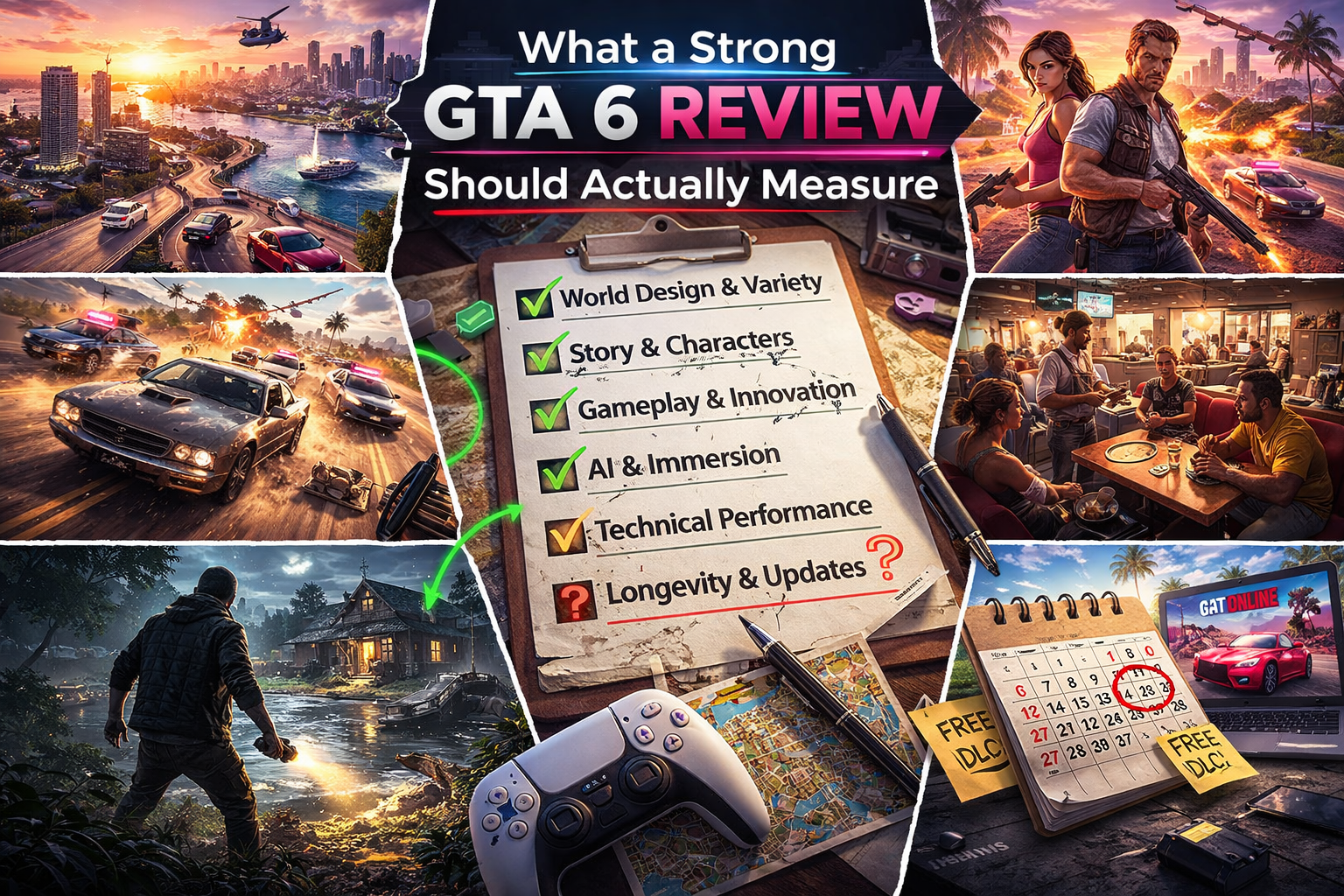
When Grand Theft Auto 6 arrives, many reviews will naturally focus on size, production values, and technical polish. Those are important considerations, but they are not enough. A meaningful review of a Rockstar game should measure more than spectacle. It should ask what the game is trying to say, how effectively its systems support that ambition, and whether its open world does more than simply exist at impressive scale.
Rockstar’s reputation can make this difficult. The studio is so closely associated with expensive craftsmanship that reviewers sometimes treat presentation as argument, as though the magnitude of the production settles deeper questions about design and writing. It does not. A giant map, lavish animation, and cinematic performances are achievements, but they are not a substitute for critical clarity.
The first thing a strong review should measure is coherence. Does GTA 6’s story fit the world it builds, or are they pulling in different directions? Rockstar games often balance satire with seriousness, irony with emotional investment. When that balance works, the result can feel distinctive. When it does not, characters risk becoming trapped between caricature and drama without fully convincing as either.
World design should be judged as lived space, not only visual space
Another essential measure is whether the world feels inhabited in a meaningful way. Visual detail is the easiest part to admire. The harder question is whether districts, interiors, roads, and ambient systems create the sense of a functioning social landscape. Do neighborhoods feel distinct beyond art direction? Does the city change with time, weather, and activity in ways that matter? Are side encounters interesting because they reveal something about the setting, or only because they add volume?
This matters because Rockstar’s worlds are often treated as self evidently great if they are dense enough. But density without interpretive clarity can become noise. A truly strong open world gives the player reasons to understand it, not merely reasons to stare at it.
Reviews should also look closely at mission design, an area where Rockstar has been both influential and vulnerable to criticism. The studio is excellent at staging and atmosphere, yet sometimes relies on rigid scripting that limits player expression. GTA 6 should be judged on whether it has evolved here. Does it trust the player more? Does it allow flexibility without losing narrative control? Or does it still funnel every dramatic situation through narrow fail states and tightly managed choreography?
Technical polish is necessary, but not sufficient
Technical performance will matter enormously, particularly given the likely scale of the game. Stable frame pacing, fast loading, clean streaming, and consistent controls are all legitimate review concerns. But criticism should resist collapsing into pure performance reporting. A flawless technical state cannot rescue weak writing or repetitive systems. Likewise, minor technical flaws do not necessarily invalidate more substantial artistic success.
The review question is always one of relation. How do the technical choices support or compromise the larger experience? Does visual ambition deepen immersion, or does it crowd out responsiveness? Do simulation systems enrich the world, or do they mostly serve as expensive background dressing?
A strong GTA 6 review should finally pay attention to tone. Rockstar’s satire has often been both sharp and uneven. Sometimes it captures the absurdity of contemporary culture with precision. Sometimes it mistakes noise for insight. Critics should be willing to separate the game’s observational strengths from its habits, especially if the writing leans on familiar targets without much new perspective.
That is what mature criticism can provide at a moment when the launch conversation will otherwise be flooded with scale and excitement. The question is not whether GTA 6 is big, expensive, or technically ambitious. It almost certainly will be. The question is whether those qualities serve a work that is thoughtful, coherent, and genuinely worth examining beyond its commercial inevitability.