
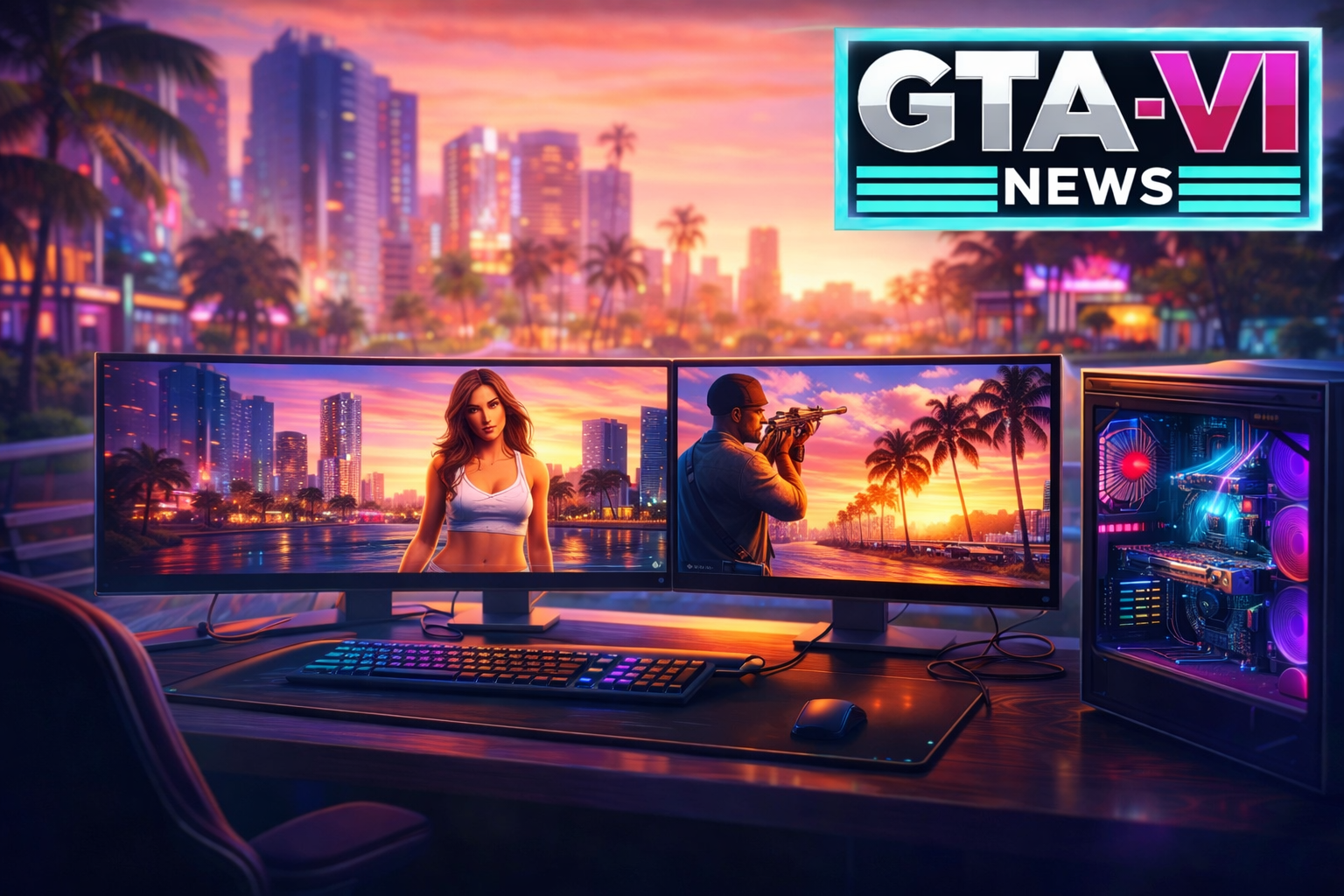
Even before Rockstar has published official PC specifications, one conclusion already feels safe: Grand Theft Auto 6 will not be a casual hardware release. This is expected to be the studio’s most ambitious open world yet, built for current generation consoles and likely designed around much faster storage, larger memory budgets, more advanced rendering, and denser environmental simulation than Grand Theft Auto V ever attempted.
That matters because GTA has never been demanding in only one direction. These games do not merely stress the graphics card. They also put sustained pressure on the CPU, storage pipeline, and system memory. In a title where cars, pedestrians, weather, police logic, interior streaming, and mission scripting all interact at once, raw graphical horsepower tells only part of the story.
A reasonable starting assumption is that GTA 6 on PC will expect solid state storage as a baseline rather than a luxury. Streaming a large city with quick traversal, heavy traffic, and likely far more interior detail than past games makes older hard drives increasingly hard to justify. Rockstar may not want long loading interruptions or texture pop in to define the first impression of its biggest release.
CPU may matter more than players expect
In many blockbuster PC releases, the conversation quickly narrows to ray tracing and GPU benchmarks. With GTA 6, the processor could prove just as important. Rockstar’s worlds rely on layers of simulation. Civilian behavior, vehicle flow, law enforcement response, environmental reactions, and mission triggers all sit on top of rendering demands. If the game expands those systems significantly, weaker processors may struggle even when paired with a capable graphics card.
That means mid range systems with older CPUs could face an uncomfortable bottleneck. A player may have enough GPU power to target 1080p or 1440p, yet still run into inconsistent frame times in crowded districts or during large action sequences. Rockstar’s track record suggests that city density and world logic are never cosmetic additions. They affect how alive the game feels, and that makes the processor central to the experience.
Likely targets for performance tiers
For 1080p with balanced settings, players will probably need a system that sits firmly in the modern mid range rather than the entry level. For 1440p at high settings, expectations rise sharply, especially if advanced lighting or upscaling features are part of the package. A 4K native target, meanwhile, may remain unrealistic for many users without high end GPUs and some help from reconstruction technologies.
Memory is another area where Rockstar may move the bar higher. A game of this scope could make 16 GB feel like the practical floor rather than the comfortable standard, with 32 GB becoming the safer recommendation for players who want smoother multitasking, fewer streaming hitches, and headroom for background applications.
Then there is VRAM, the quiet pressure point in modern PC gaming. Large textures, wide draw distances, detailed vehicle models, and complex city lighting all compete for space. If GTA 6 leans heavily into visual density, cards with limited VRAM may need noticeably reduced texture settings even at modest resolutions.
The likely shape of Rockstar’s PC strategy
When Rockstar eventually ships GTA 6 on PC, it will face an audience that expects flexibility. That means broad settings menus, scaling options, resolution choices, and modern technologies such as upscaling and frame generation where appropriate. The company may also treat the PC edition as the place where the game’s visual ceiling is fully exposed, much as it did with previous releases.
For players planning ahead, the safest strategy is not chasing one exact part list before official information exists. It is building a balanced machine. Fast storage, a strong multi core CPU, a modern GPU with enough VRAM, and at least 16 GB of memory should matter more than buying one expensive component and ignoring the rest of the system.
GTA 6 will almost certainly be benchmarked obsessively once the PC version appears. Until then, the best guess is also the simplest one: if your machine already struggles with recent large scale open world games, it is unlikely to handle Rockstar’s next flagship comfortably. The studio is not building for the past. It is building for the hardware generation that is shaping the next decade of blockbusters.