
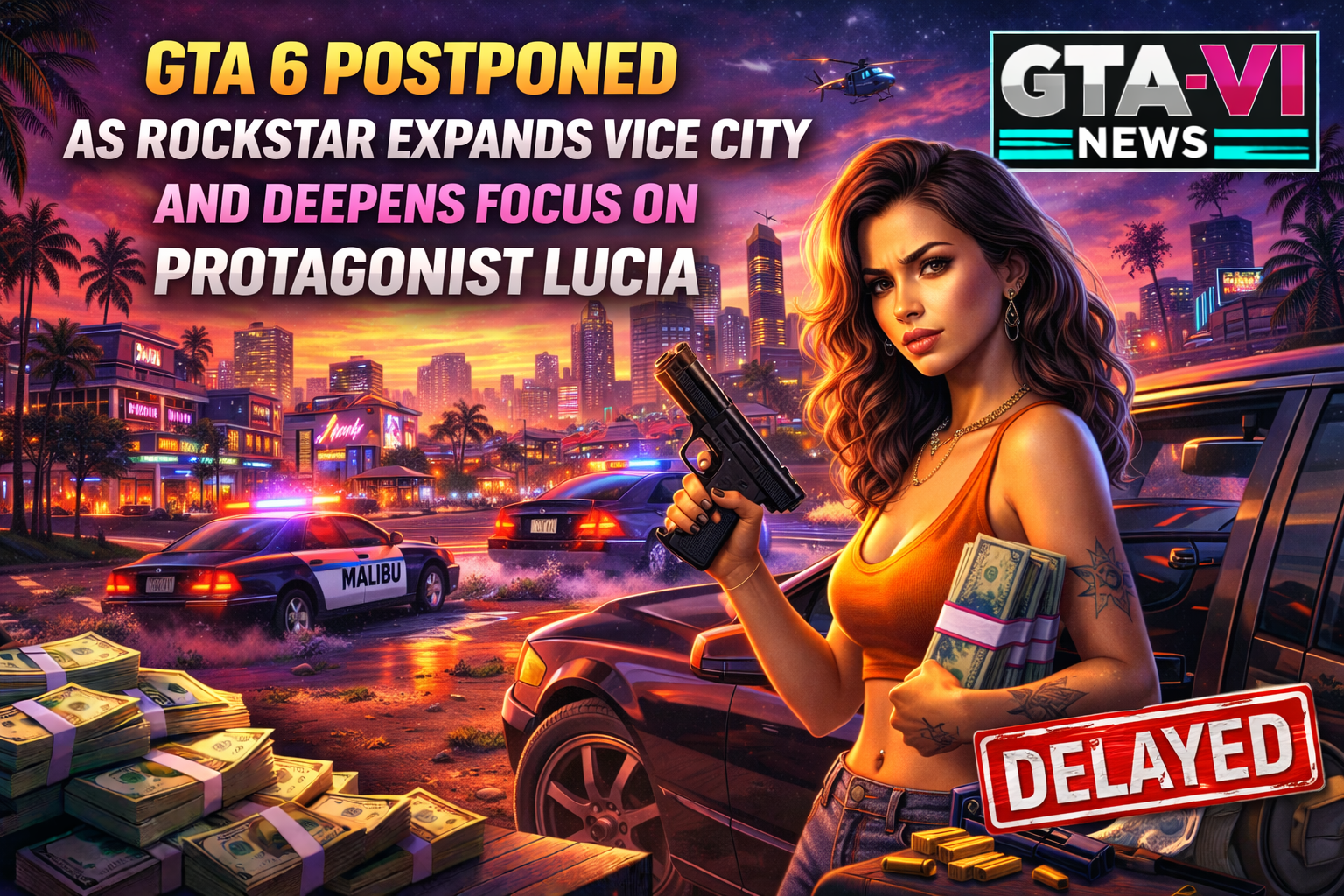
The release schedule for GTA 6 has shifted again, with Rockstar Games confirming a postponement tied to broader design upgrades and narrative refinement. Alongside the delay, new details have emerged about a reworked Vice City and the growing importance of protagonist Lucia in the game’s story structure.
While delays often trigger concern, the context here tells a different story. Rockstar is not trimming scope. It is increasing it. The studio is using additional development time to expand the world, strengthen character arcs, and refine systemic gameplay layers across the map.
For a franchise known for setting industry benchmarks, that decision carries weight.

Why Rockstar Moved the GTA 6 Release Window
According to updated publisher guidance, the postponed launch is directly linked to quality targets and world-building goals. Rockstar has reportedly extended production to allow more iteration across mission design, environmental behavior, and narrative pacing.
This is consistent with the company’s historical approach. Several past Rockstar titles arrived later than first announced but launched with strong technical stability and narrative cohesion. The studio tends to protect final delivery standards, even when that means absorbing short-term criticism.
Fans may be surprised how often that patience has paid off. The pattern is familiar. Delay now, dominate later.
A Reimagined Vice City, Built for Modern Hardware
The new Vice City is not framed as a nostalgic remake. It is positioned as a ground-up reinterpretation designed for current-generation hardware. Reports tied to the project describe a larger urban footprint, expanded outskirts, and a more seamless regional layout that stretches beyond the city center.
Instead of a tightly bounded metro zone, players can expect layered districts connected by highways, waterways, and transitional environments. That broader structure changes how players approach exploration and mission routing.
Density also appears to be a priority. Interior spaces, side activities, and ambient events are said to be more frequent and more reactive. In practical terms, the map should feel less static and more conversational.
Environmental Detail and Systemic Behavior
Rockstar is reportedly investing heavily in background systems that shape everyday activity across the map. Traffic patterns, pedestrian reactions, and law enforcement responses are being tuned to respond more precisely to player behavior.
Small systemic changes can produce large experiential differences. A city that reacts feels alive. A city that repeats feels artificial.
This design philosophy suggests Rockstar is pushing simulation depth alongside cinematic storytelling rather than choosing one over the other.
Lucia’s Expanding Role in the Story
New character information highlights Lucia as a central figure in GTA 6, not merely a co-lead. Trailer footage and early character descriptions present her as controlled, strategic, and situationally aware. Her presence signals a shift toward more grounded character motivation.
Rather than leaning entirely on satire and spectacle, the narrative appears to emphasize partnership, risk calculation, and consequence. Lucia’s portrayal supports that direction. Her dialogue and on-screen choices suggest planning over impulse.
That tonal adjustment could influence how missions unfold and how players interpret key decisions throughout the campaign.
Dual Protagonists, Dual Perspectives
GTA 6 is expected to follow a dual-protagonist structure, pairing Lucia with a male counterpart. This framework allows narrative contrast and mission variety. It also gives writers room to show the same criminal landscape through different emotional filters.
When perspective shifts, stakes shift. The same job can feel reckless in one viewpoint and necessary in another. That narrative device adds texture without adding confusion.
This changes everything for story pacing.
Development Time Versus Map Scale
Open world games face a recurring problem. The larger the map, the greater the risk of repetition. Additional development time helps teams diversify mission triggers, side events, and interactive locations. Rockstar’s delay suggests the studio is addressing that risk directly rather than scaling content back.
Iteration matters more than raw size. A smaller map with varied systems outperforms a large empty one. Rockstar appears determined to deliver the former, even if it means waiting longer.
That decision aligns with current player expectations. Recent high-profile launches across the industry have shown what happens when scope outruns polish. Reception suffers quickly and publicly.
Market Pressure and Franchise Legacy
The commercial expectations surrounding Grand Theft Auto VI are exceptional. The previous installment continues to generate revenue and player activity years after release. That longevity raises the performance bar for the next entry.
From a publisher standpoint, protecting long-term brand value outweighs meeting an earlier quarter target. A delayed but stable launch preserves trust. A rushed release risks reputational damage that can last longer than any schedule slip.
Investors understand this calculus. Most veteran players do as well.
What This Means for Players
The postponed GTA 6 launch is tied to a broader Vice City, more reactive systems, and stronger character emphasis centered on Lucia. That combination points toward a title built for depth rather than speed to market.
Rockstar remains selective with official reveals. That restraint is deliberate. When the next major showcase appears, it will likely highlight tangible improvements tied to the extended timeline.
Expectation remains high. So does scrutiny. Rockstar seems prepared for both.