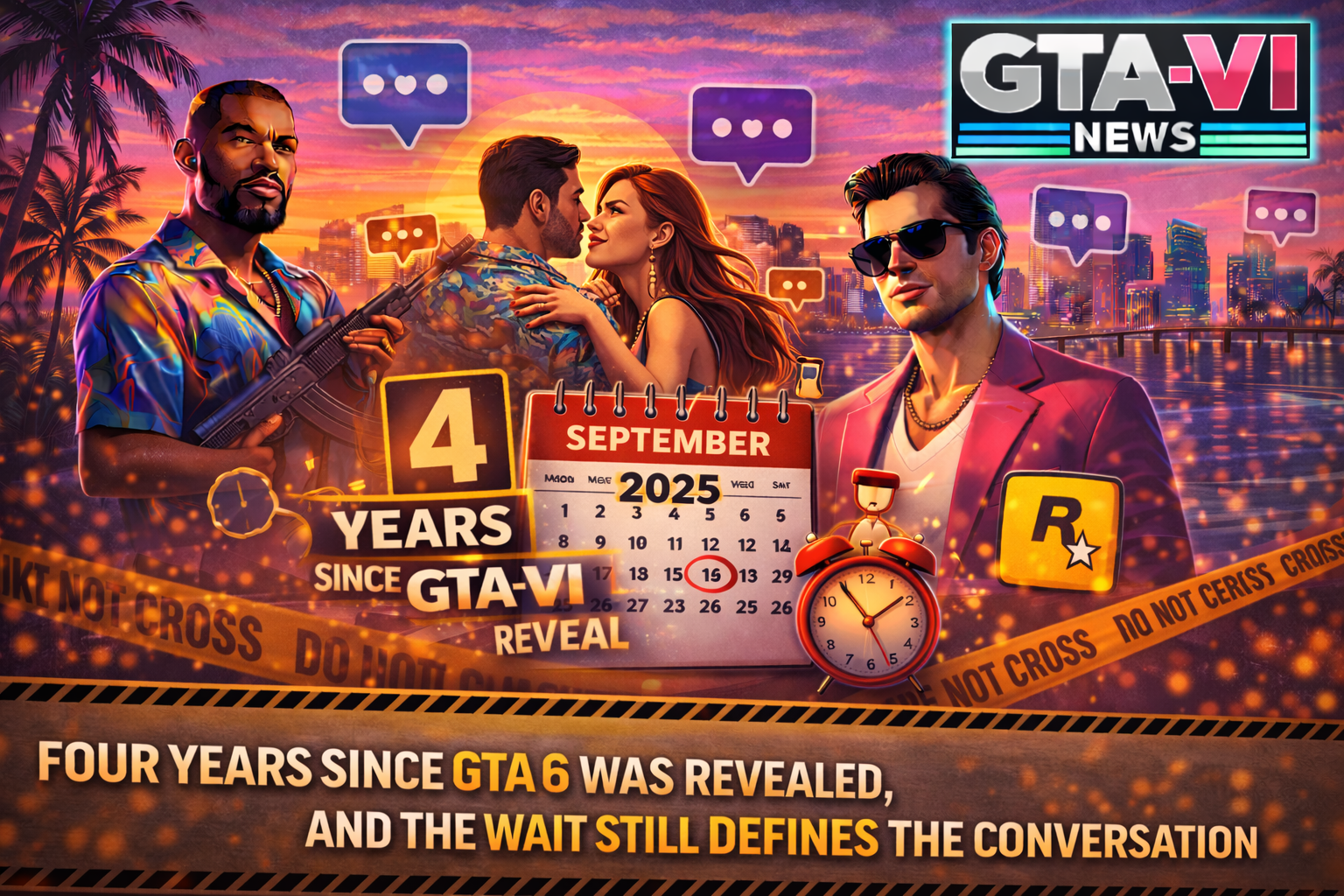
Time moves differently around certain games. Grand Theft Auto VI is one of them. It has now been four years since Rockstar first confirmed that the next GTA was in development, a short statement that triggered one of the longest hype cycles in modern gaming.
What followed was not a steady flow of updates, but something more unusual. Silence, broken by rare official signals, surrounded by constant speculation.
Fans may be surprised how much has changed since that first confirmation. Hardware generations shifted. Industry priorities moved. Yet the demand for GTA 6 has only intensified.
This changes how the reveal is remembered. It was not the start of a marketing campaign. It was the start of a cultural countdown.
A minimal reveal that created maximum impact
Rockstar did not introduce GTA 6 with a full trailer or gameplay showcase at first. The original confirmation was brief and controlled. It acknowledged active development and little more.
In contrast to publishers who unveil projects with cinematic presentations, Rockstar chose restraint. That restraint worked. The announcement dominated discussion without showing a single mission or mechanic.
Moreover, the studio’s reputation carried the message. Players understood that when Rockstar confirms a GTA project, it is real and it is significant.
Why Rockstar reveals differently from everyone else
Most studios follow a familiar promotional rhythm. Teaser. Trailer. Developer diary. Preview cycle. Rockstar rarely follows that template.
Instead, it builds distance between announcements and details. The company prefers concentrated bursts of information rather than continuous exposure.
However, that strategy has side effects. Long quiet periods encourage rumour cycles. Communities begin analysing investor calls, job listings, and release calendars for hidden meaning.
Four years on, the GTA 6 news ecosystem is almost self sustaining, even when Rockstar says nothing at all.
The gap between reveal and release has grown across the industry
GTA 6 is not alone in having a long runway between confirmation and launch. Big budget games increasingly require extended development cycles. Teams are larger. Worlds are denser. Technical expectations are higher.
In contrast to earlier console generations, where sequels arrived more frequently, modern flagship titles often take many years to complete.
Moreover, Rockstar has historically accepted delays when needed. The studio prioritises polish and cohesion over speed. That pattern shapes fan expectations now.
The four year mark feels long, but in AAA terms, it is no longer unusual.
How the GTA 6 wait changed fan behaviour
The extended gap between reveal and release has transformed how fans engage with the project. Waiting is no longer passive. It is participatory.
Players track every executive quote. They debate release windows. They dissect trailer frames and patent filings. Entire channels and forums exist purely to analyse GTA 6 release date theories.
Fans may be surprised how organised this speculation has become. It resembles financial forecasting more than casual fandom.
This changes the nature of hype. It becomes a continuous activity rather than a short pre launch spike.
The industry has been planning around GTA 6 for years
The long visibility of GTA 6 has also affected publishers. Competitors are already positioning their biggest releases away from Rockstar’s expected launch window.
That behaviour is rare. Most games respond to confirmed dates, not distant expectations. GTA changes that equation.
In contrast to normal competition, where several blockbusters can share a season, Rockstar’s next title is widely expected to dominate attention alone.
The reveal did not just alert players. It alerted the market.
Technology shifted during the wait
Four years is enough time for technology to evolve. Since the original GTA 6 confirmation, current generation consoles have matured, engine capabilities have expanded, and player expectations around performance have risen.
Moreover, conversations about AI, procedural systems, and development tools have accelerated. Notably, Take Two leadership has stated that generative AI is not part of GTA 6’s creative production, reinforcing Rockstar’s emphasis on authored design.
That detail matters. It positions the game as a product of deliberate craft, not automated assembly.
What still remains unknown
Despite the time that has passed, many core details remain officially unconfirmed. Rockstar has shared only limited information about setting, systems, and structure.
The GTA 6 trailer offered tone and direction, but not full mechanical clarity. Questions about scale, online integration, and post launch plans remain open.
However, that uncertainty also fuels engagement. The unknown keeps the conversation alive.
The next phase will feel very different
Once Rockstar begins its full marketing cycle, the tone will shift quickly. Trailer releases, gameplay showcases, and edition announcements will replace abstract speculation.
In contrast to the slow burn of the past four years, the final months before launch will move fast. Information density will spike. Analysis will turn from theory to detail.
This changes everything about how the wait feels. Long anticipation will convert into short term countdown.
Four years later, the anticipation is still growing
Very few games can sustain momentum across four years with minimal official detail. GTA 6 has done exactly that.
The original reveal did not satisfy curiosity. It amplified it. The silence that followed did not weaken interest. It strengthened it.
Rockstar’s next major update will reset the conversation again. Until then, the anniversary marks something unusual: a reveal that never stopped echoing.