
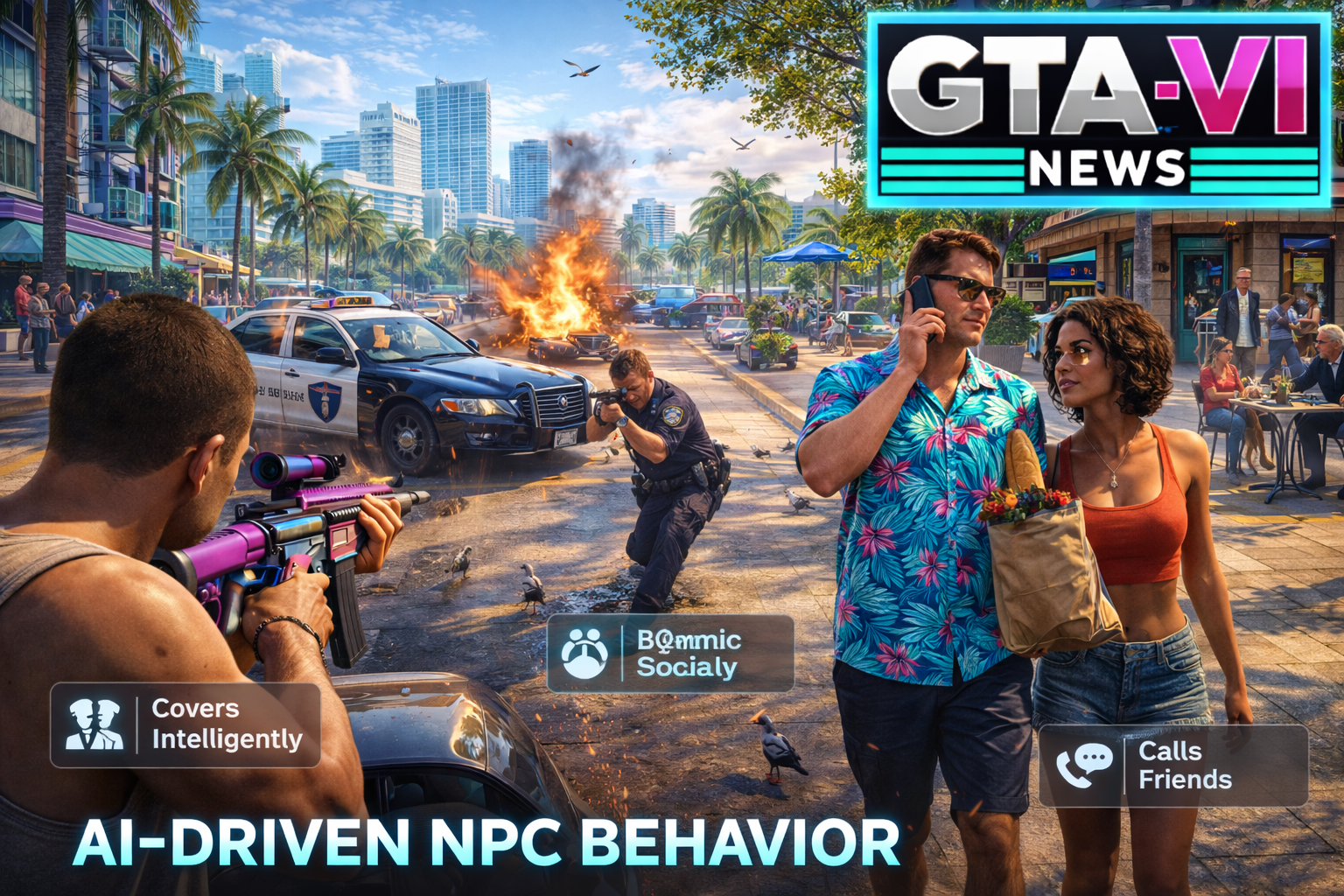
Few elements shape immersion as powerfully as non-playable characters. They populate streets, react to chaos, and define whether a world feels alive or artificial. With GTA 6, attention has increasingly shifted toward one question. Will the game feature advanced AI-driven NPC behavior?
Rockstar has not officially confirmed the use of next-generation AI systems. However, multiple sources point toward significantly improved NPC interaction, drawing clear inspiration from systems introduced in Red Dead Redemption 2.
The direction seems deliberate rather than experimental.
Why NPC Behavior Matters More Than Ever
In older open-world games, NPCs existed to fill space.
They walked predefined paths, repeated dialogue, and reacted predictably to disruption. That approach no longer satisfies modern players.
GTA 6 is arriving in a landscape where responsiveness defines quality. NPCs are expected to notice, remember, and react in context.
Fans may be surprised how much this changes the feel of the city.
This changes everything.
The RDR2 Blueprint
Red Dead Redemption 2 set a new benchmark for NPC interaction.
Players could greet strangers, antagonize them, or escalate encounters organically. NPCs responded with personality rather than scripted hostility. Some backed down. Others fought back. A few remembered you.
These systems were not random. They followed logic and social rules.
Evidence suggests GTA 6 adapts this framework for a modern urban environment.
What “AI NPC Behavior” Actually Means
The phrase “AI-driven NPCs” is often misunderstood.
This does not imply self-learning characters or unscripted intelligence. Instead, it refers to layered behavior systems that respond dynamically to player actions.
NPCs assess tone. Context. History.
A casual interaction can escalate into confrontation. A hostile move can trigger group responses. Behavior emerges from systems rather than triggers.
Greeting and Antagonizing Returns
Sources indicate that player-driven interaction will return.
Greeting NPCs may lead to neutral or friendly exchanges. Antagonizing them could provoke arguments, threats, or violence.
The key difference lies in variability.
Not every NPC responds the same way. Social status, location, and circumstance influence reactions.
The city develops a social texture.
Urban Behavior Is More Complex Than the Frontier
Translating RDR2’s systems to a modern city presents new challenges.
Cities are denser. Social dynamics are faster. Law enforcement response is immediate.
GTA 6 must balance realism with pace.
An insult in a quiet street may provoke a fight. The same action downtown could draw attention from bystanders, cameras, or police.
This complexity enhances tension.
NPC Memory and Consequence
One of the most intriguing aspects of modern NPC design is memory.
In Red Dead Redemption 2, certain NPCs remembered past encounters.
GTA 6 may expand on this idea subtly. Shopkeepers may react differently after repeated trouble. Neighborhoods may feel less welcoming.
Consequences do not need to be permanent to feel meaningful.
Short-term memory alone can change player behavior.
From Scripted Crowds to Social Systems
Earlier GTA games relied heavily on scripted reactions.
Chaos triggered panic. Violence triggered aggression. Calm restored normality.
GTA 6 appears to move toward social systems instead.
NPCs assess risk. They choose whether to intervene, flee, or ignore events.
This creates scenes that feel unscripted, even when governed by logic.
Why Rockstar Avoids the “AI” Label
Rockstar rarely uses technical buzzwords in public messaging.
The studio prefers to demonstrate systems rather than describe them.
Calling NPC behavior “AI-driven” raises expectations of autonomy that few games can meet.
Instead, Rockstar focuses on behavior, interaction, and consequence.
The technology serves the experience.
Technical Foundations Behind Smarter NPCs
Improved NPC behavior depends on several factors.
Better pathfinding. Faster decision-making. More detailed state tracking.
Modern hardware allows Rockstar to simulate more variables at once. NPCs can react to sound, movement, and proximity with greater nuance.
These improvements are incremental, not magical.
They add up.
Balancing Realism and Chaos
Too much realism can undermine fun.
Rockstar understands this balance. NPCs must feel believable without slowing the pace.
GTA 6 is unlikely to punish minor interactions excessively.
The goal is tension, not frustration.
Multiplayer Implications
If GTA 6 includes an evolved online mode, NPC behavior becomes even more important.
Smarter NPCs create shared context. Players influence environments together.
Role-play communities benefit. Emergent scenarios multiply.
NPCs become part of the social fabric rather than background noise.
Why This Evolution Feels Inevitable
Rockstar has already invested heavily in behavioral systems.
Abandoning that progress would contradict its design trajectory.
GTA 6 is positioned as a generational leap. NPC intelligence is a natural frontier.
The question is not whether NPCs will be smarter.
It is how subtle that intelligence will feel.
Managing Expectations Carefully
NPCs will not behave like real humans.
They will still follow rules. Patterns. Constraints.
The improvement lies in believability, not unpredictability.
Rockstar excels at this middle ground.
The Most Likely Outcome
So, will GTA 6 use AI NPC behavior?
While not officially confirmed, all signs point to significantly enhanced NPC systems inspired by Red Dead Redemption 2.
Greeting, antagonizing, and contextual reactions are expected to return, refined for a modern city.
NPCs will not think for themselves.
They will react convincingly.
In a game built around chaos, that distinction matters.
If Rockstar succeeds, Grand Theft Auto 6 will feel less like a stage and more like a society.
And that may be its most important evolution yet.