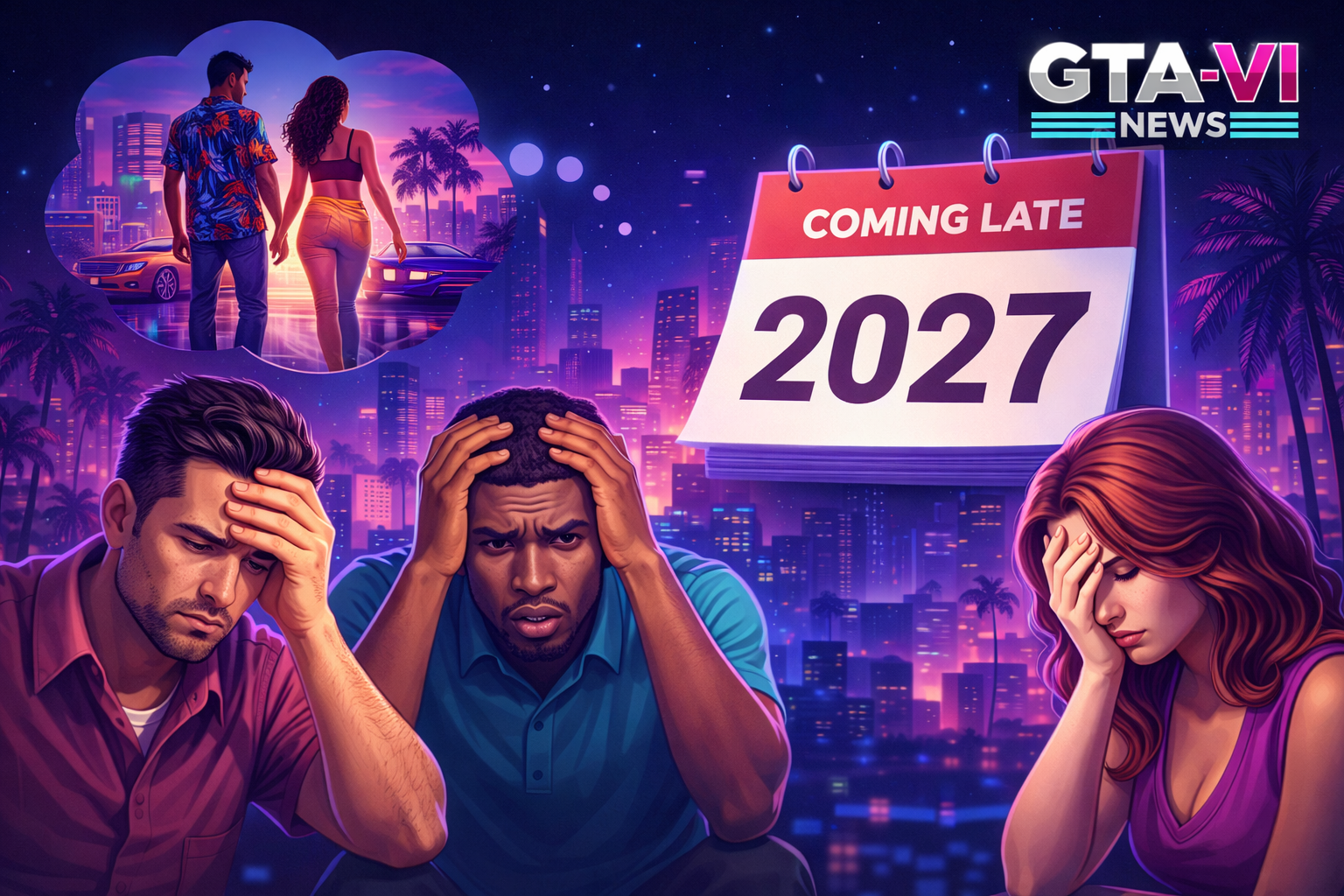
Even with Rockstar Games targeting 2026 for the launch of Grand Theft Auto VI, there is now a growing belief among some fans and industry watchers that the release could slip even further. A small but vocal group insists the open-world giant will not reach players until 2027. The argument may sound extreme, but it reflects a real shift in mood around the project one shaped by silence, delays, and rising expectations.
It is a curious development. For years, GTA 6 has represented certainty. Now, even its release window feels negotiable.
A Changing Mood Around GTA 6
Officially, Rockstar maintains its plan to launch in 2026. Nothing concrete contradicts that. Yet a noticeable portion of the fan base especially the most dedicated has started revisiting the timeline. Some speak from caution after seeing the game delayed more than once. Others do not trust the industry’s shifting development schedules. Many are simply responding to what long-running AAA production looks like today: unpredictable, expensive, and structurally fragile.
As speculative as it may be, the 2027 narrative reflects fatigue. It tells its own story.
Delayed Games Are Becoming Standard Practice
The idea that GTA 6 might drift beyond 2026 does not exist in a vacuum. In recent years, numerous high-profile projects have slipped — sometimes dramatically. The Witcher 4, Starfield, Skull and Bones, and multiple Ubisoft and EA franchises spent years in delay cycles. Budgets and production timelines have ballooned. Post-pandemic restructuring and studio turnover have made forecasting far more complicated.
Against that backdrop, another delay at Rockstar does not feel impossible. But is it likely?
Confidence vs. Doubt
Most analysts still think 2026 is secure. Rockstar has a track record: the company does not announce release targets recklessly. When it does, the studio typically knows how to hit them. The internal expectation from parent company Take-Two Interactive remains focused on the same window. Investors have not been warned otherwise. There is no obvious evidence of risk.
However, some fans see signals in the silence. Trailer gaps. Limited media presence. A lack of marketing rhythm. Even tiny details have become fuel for speculation.
This is how uncertainty spreads not through facts, but through atmosphere.
The Social Media Effect
Online communities magnify uncertainty. Posts speculating about a 2027 delay, once fringe, travel quickly. One person floats the idea; another amplifies it; eventually it becomes something larger than intended. In gaming culture, rumours often gain more traction than official statements.
It is not unusual to see fans preparing “just in case,” even without clear reasons to do so.
The Difference Between Release and Accessibility
Another factor complicates the conversation. For some players, the idea of “release date” has changed meaning. Launch day no longer guarantees full stability, complete features, or polished performance. Patches, early access phases, and staggered content drops stretch the timeline. What counts as a finished game? When is it truly ready?
For a project of GTA 6’s size, that question resonates. Perhaps 2026 is the technical launch and 2027 is the year the game feels fully formed.
Why Some Expect the Timeline to Extend
Several reasons fuel the theory:
- The game’s scale is unprecedented and resource-heavy
- Past development leaks exposed technical challenges
- Rockstar and Take-Two face intense scrutiny and pressure
- Previous titles from the studio experienced delays
- The industry landscape is in upheaval
When combined, these elements create a convincing narrative. Whether true or not, they sound plausible.
The Emotional Weight Behind the Speculation
For many, predicting a 2027 delay is not rooted in cynicism, but self-protection. After years of anticipation, some fans would rather expect the worst than risk disappointment. The arrival of GTA 6 represents a cultural moment bigger than a standard release. It carries enormous emotional gravity.
That alone invites doubt.
Rockstar Remains Silent And Intentional
Despite the noise, Rockstar shows no sign of alarm. The studio appears unmoved by speculation and resistant to distraction. In that sense, silence is strategic. Public stillness creates space to finish the work. When the company speaks next, it will likely be with purpose a shift in marketing, a milestone announcement, or final confirmation.
The timeline will not be decided by chatter. It will be decided by readiness.
Looking Toward 2026 With Measured Confidence
Players have every reason to expect the game to arrive as scheduled. Internal planning, shareholder guidance, and industry structure all support 2026. Betting on 2027 may be dramatic, but it is not the prevailing view. The majority still trust the date on the horizon.
Still, the conversation itself is meaningful. It reflects how drastically expectations have changed in modern game development. Today, nothing feels guaranteed.
And that uncertainty as much as the game itself defines the moment.
The Story Behind the Story
The discussion around Grand Theft Auto VI is no longer just about release timing. It is about trust, patience, scale, and the shifting shape of the industry. It is about how long players are willing to wait and how much studios can deliver under pressure. It is about belief belief in a date, in a company, and in a future that fans have imagined for a decade.
If the game arrives in 2026, the wait will end. If it slips to 2027, the story continues. Either way, the cultural impact remains enormous.