
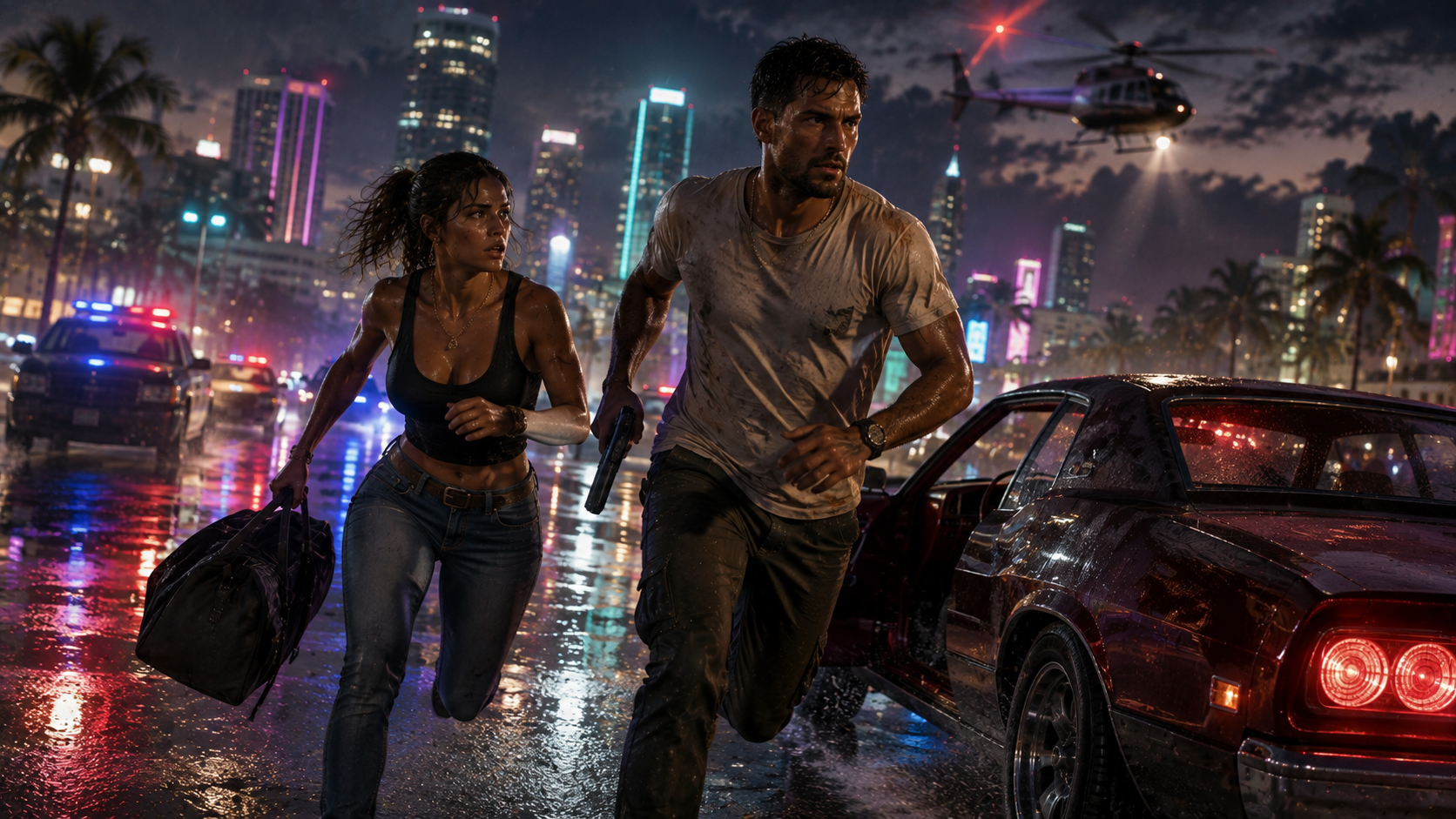
The extended showcase offers a clearer view of how familiar Grand Theft Auto systems may evolve.
Familiar chaos, a different rhythm
The first sustained looks at GTA 6 gameplay show a recognizable crime sandbox. Cars, guns, robberies and crowded streets remain part of the formula. The noteworthy differences are found in how those elements connect, especially when Jason and Lucia operate together rather than behaving like separate heroes who happen to share a story.
The practical implications
The two-character setup may be especially significant during unscripted moments. A companion who can follow, react and participate naturally gives the player another way to read a situation. If the game allows broad freedom, the AI must cope with unexpected paths, vehicles and timing. That is a demanding task, and a successful scripted mission alone cannot demonstrate that the system works everywhere.
Police behavior presents a related challenge. Pursuits need rules that remain understandable at different speeds and across varied environments. A search in a crowded block and a chase on an open highway should produce distinct tactical opportunities. That difference would make escape more strategic than simply driving in a straight line. It remains a promising possibility rather than a guaranteed feature until more extensive play is available.
The wider perspective
A smarter pursuit system could change how players plan crimes. Witnesses, escape routes and the visibility of an individual character may become as important as raw driving speed. That potential is exciting, but it remains a point for verification rather than an established universal rule.
Another question is how forgiving these systems are. Realism can add tension, yet a crime sandbox also needs room for playful mistakes. A pursuit that feels too unpredictable or a companion who gets stuck at a doorway would undermine the freedom Rockstar is trying to preserve.
A polished montage can hide awkward transitions. Longer demonstrations are more informative because they reveal movement between dialogue, exploration and action. The showcase provides indications of that continuity, though it cannot settle how every situation behaves in unrestricted play.
A partnership built into encounters
In the footage, Jason and Lucia move through dangerous interiors and support one another during an escalating confrontation. That creates the impression of a pair whose relationship matters during play, not solely in cutscenes. It also raises useful mechanical questions. Does the second character respond independently? Can players issue instructions? How often is switching control available?
The answers will determine whether the partnership feels flexible or heavily scripted. Strong companion behavior can make a mission feel more believable. Poorly managed assistance can turn the same feature into another source of frustration.
The wanted system has work to do
Police responses are among Grand Theft Auto’s most recognizable rules. A new entry must preserve the thrill of pursuit while making searches and escapes feel consistent. Preview coverage describes an overhaul of the GTA 6 wanted system, but individual demonstrations still leave questions about detection, witness behavior and the ability to lose attention.
Players will notice whether police arrive for understandable reasons, how roadblocks emerge and whether escape strategies remain viable. These details matter more than simply making opponents tougher. A convincing pursuit system is one that the player can read and react to.
Small interactions change the pace
A pettable dog, a shift into a tense indoor confrontation or a seamless camera transition might appear minor beside a chase. Yet these moments can soften the boundary between cinematic storytelling and player control. They invite players to notice their surroundings instead of sprinting between markers.
The danger is that interactions become isolated demonstrations. A game feels coherent when the same rules appear across many locations and continue working after the presentation ends. Repetition will reveal whether the new touches are systems or set pieces.
What footage cannot prove
Frame pacing, animation responsiveness, enemy behavior and general stability require longer hands-on sessions. Promotional showcases are typically chosen to demonstrate the game at its best. That is reasonable marketing, but it limits what an observer can responsibly conclude.
The clearest early assessment is that Grand Theft Auto VI mechanics look evolutionary rather than disconnected from the series. The unusual opportunity lies in how a two-character narrative, a more reactive police system and numerous smaller interactions may affect familiar decisions from one minute to the next.
Another factor is how understandable new mechanics are to returning players. The game cannot assume everyone has followed months of previews or technical interviews. Changes to police rules, partner controls or equipment need clear in-game communication. When they are intuitive, complexity creates interesting choices. When they are opaque, it creates confusion at exactly the moment the player expects freedom.