
Editorial note: Rockstar’s official website currently lists Grand Theft Auto VI for PlayStation 5 and Xbox Series X|S with a release date of November 19, 2026. This article is based on official trailers and screenshot material, not unverified leaks.
The most interesting thing about the official GTA 6 footage is not one flashy effect. It is the consistency of the world.
Rockstar has officially confirmed Grand Theft Auto VI for PlayStation 5 and Xbox Series X|S, and its current official release date is November 19, 2026. The company has also published trailer footage and a large set of official screenshots, which gives analysts more visual evidence than is usually available this far ahead of launch. That does not mean every technical conclusion is settled. It does, however, allow a careful reading of what Rockstar appears to be prioritizing in its presentation of Vice City and the wider state of Leonida.
Why the Visual Direction Matters
Every visual gain carries a performance cost. That is especially true in a Rockstar game, where scale is part of the appeal rather than a background statistic. The question is not whether GTA 6 looks impressive. It clearly does. The real question is how Rockstar chooses to allocate rendering budget across such a broad world.
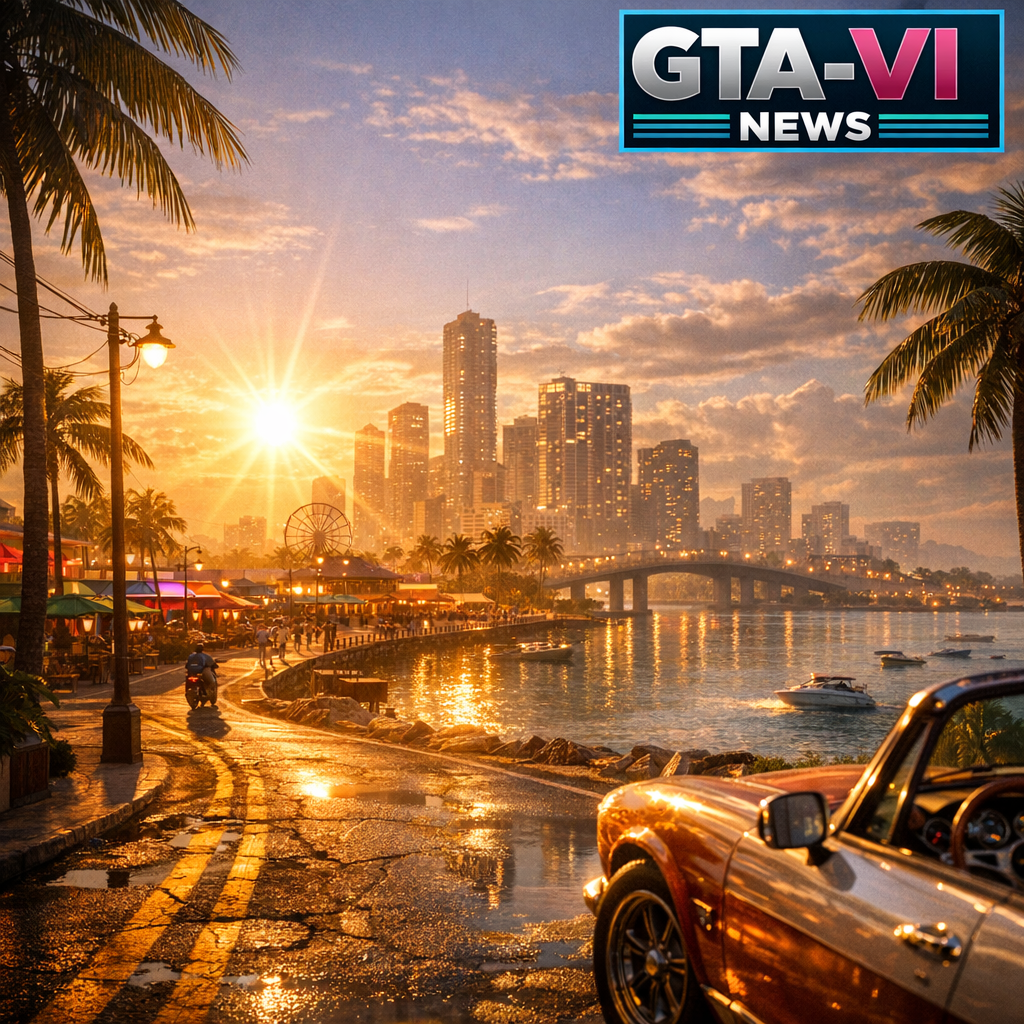
For a highend open world, credibility often comes from small signals. The way sunlight fades across a hood. The way humidity softens the horizon. The way headlights interact with damp asphalt. The way a crowd scene keeps background motion alive. Those signals appear to be a major part of Rockstar’s current presentation.
What This Could Mean for Players
Official media suggests a deliberate balance. Instead of chasing one exaggerated visual gimmick, the presentation leans on many mediumtohigh quality systems working together. That may be the smarter route for consoles. Stable lighting, credible materials, careful density, and good streaming often age better than one headline feature.
There is also a storytelling benefit. Visual systems shape tone before dialogue arrives. A harsher noon scene can create tension. Softer coastal haze can imply distance and drift. Dense neon with reflective pavement can turn ordinary movement into spectacle. In that sense, graphics are not decoration. They are narrative support.
Players will inevitably compare GTA 6 to the biggest current openworld releases, but Rockstar’s challenge is slightly different. The studio is not just making a large map. It is making a culturally recognizable one. The engine needs to sell place, climate, ambition, satire, and momentum all at once.
What the Official Footage Actually Shows
In practical terms, that could allow the game to maintain atmosphere across city centers, highways, interiors, wetlands, and beachfront areas without making any one zone feel technologically detached from the rest of the map.
Another interesting point is restraint. Rockstar does not seem to be presenting Vice City as a glossy fantasy surface with every effect pushed to extremes. The image has style, certainly, but it also has weight. Materials react with believable variation, and the environment often looks lived in rather than showroomclean.
That is why the discussion around the GTA 6 graphics engine has become so intense. Fans are not only asking whether the game will be technically advanced. They are asking whether Rockstar can make Leonida feel socially and physically alive. The footage so far suggests that is the real target.
Editorial View
My reading is that Rockstar is treating scale versus performance pressure as part of a broader visual language rather than as a standalone showcase feature. That is the right decision. A sandbox this large does not win by looking expensive in one screenshot. It wins by making motion, travel, and routine exploration feel convincing hour after hour. If the final game preserves that quality, the GTA 6 graphics engine will matter not because it is flashy, but because it keeps the illusion intact.
This is where subtle interpretation matters. Rockstar has not released a public technical specification for the rendering stack, so any precise claim about internal systems would be guesswork. Even so, the official trailers and screenshot set strongly suggest an engine focused on atmosphere, material response, and stable visual identity across very different environments.
There is still room for caution. Prerelease media is always selective, and Rockstar has not published a full technical breakdown of its rendering systems. Still, the official trailers and screenshot gallery provide enough evidence to say this much with confidence: the studio is aiming for a world where lighting, density, materials, and atmosphere operate as one integrated visual system. For a game of this scale, that may be the real breakthrough.