
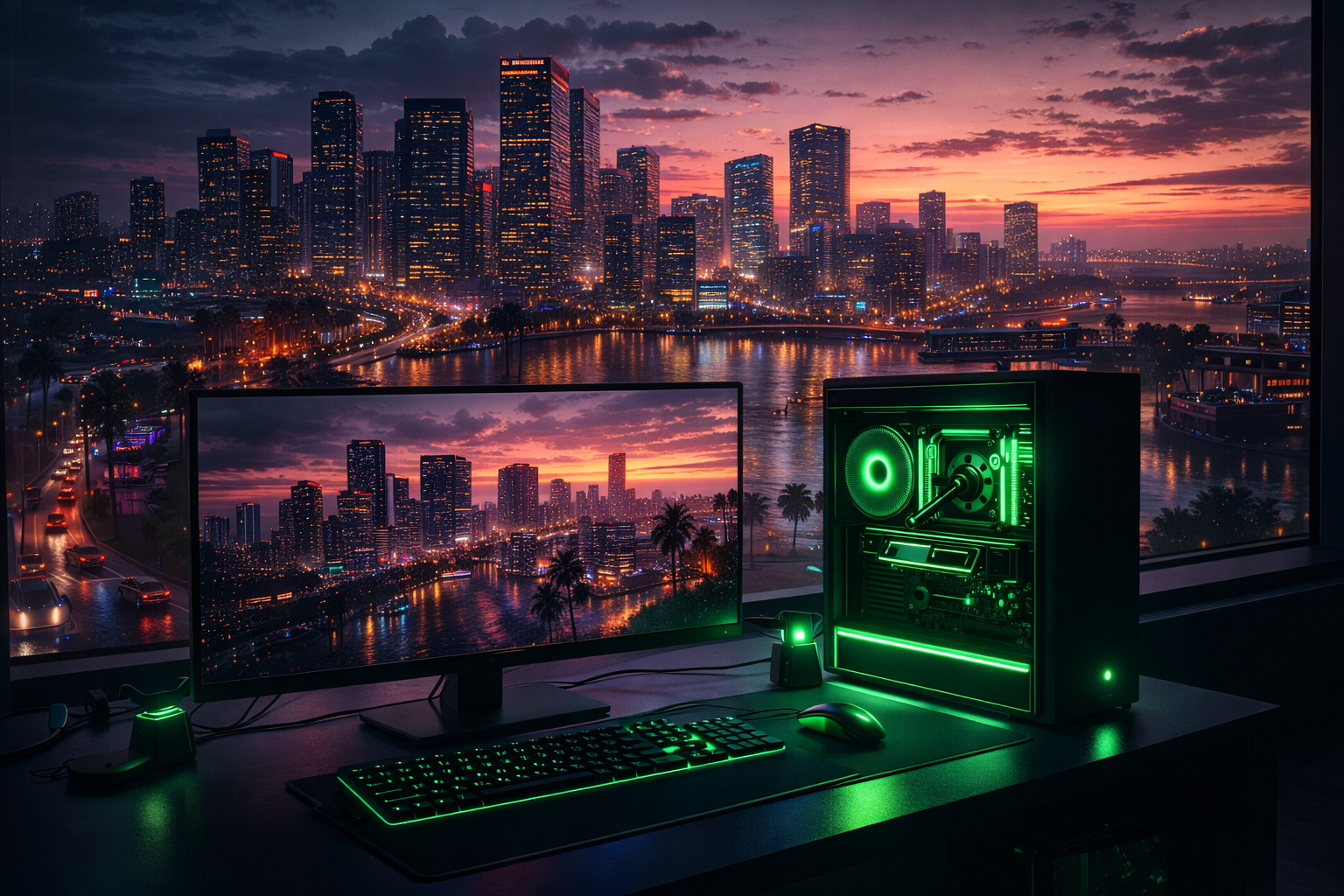
From visual density to GPU pressure, this article examines why GTA 6 could become one of the clearest showcases for Nvidia hardware on PC.
A franchise built for hardware conversations
Every generation gets a handful of games that become shorthand for technical ambition. GTA 6 looks set to be one of them. Even before the PC version becomes concrete, the idea of pairing the game with powerful Nvidia hardware already feels inevitable. That is not because of branding alone. It is because Grand Theft Auto has a habit of turning scale into spectacle.
Rockstar does not build games that live only in cutscenes. Its worlds are meant to be inhabited, observed, and tested. Players drive into crowded intersections, start chaos on purpose, chase sunsets across coastlines, and then stop to examine small background details that many studios would barely attempt. That design philosophy tends to expose hardware limits very quickly, especially on PC.
As a result, Nvidia and GTA 6 has become more than a search phrase. It reflects a wider expectation that the game could act as a hardware reference point, the kind of title people use when they want to know what their system can really do. That sort of role does not happen by accident. It happens when a game combines technical ambition with cultural weight. GTA 6 clearly has both.
What makes a game a true GPU showcase
A real graphics showcase does more than produce one striking trailer scene. It delivers complexity in motion. Players want lighting that survives at speed, reflections that hold up across changing angles, rich city detail, long-distance visibility, and an image that remains stable during fast driving or combat. Those demands are where Nvidia GPUs often enter the discussion.
High-end graphics hardware matters most when a game keeps asking more of the screen. A big city, dynamic weather, dense traffic, and interior-exterior transitions can all add pressure. If Rockstar leans heavily into realism and environmental variety, GTA 6 on PC could end up being one of those releases people immediately use to test new systems.
Moreover, the modern PC audience now expects advanced options rather than brute force alone. Upscaling, latency reduction, and smarter frame delivery are discussed almost as often as raw resolution. That is a major change from older hardware cycles. Today, the best showcase games are not only visually rich. They are also technically flexible.
Why open worlds make hardware feel personal
There is something unusually personal about performance in an open-world game. A tightly scripted action title can be evaluated scene by scene. Grand Theft Auto does not work that way. Players create their own chaos. They decide where to go, what to trigger, and how long to linger. That unpredictability means technical quality feels less like a fixed score and more like a lived experience.
This is one reason Nvidia and GTA 6 feels like a meaningful topic rather than empty speculation. Enthusiast players are already imagining their own use cases. One wants 4K at high settings for cinematic driving. Another wants a smoother experience for chaotic missions and rapid movement across the map. Someone else wants the balance point where visual fidelity still feels rich but performance remains controlled.
However, hardware conversations become useful only when they stay grounded. The smartest question is not whether a GPU can produce the biggest number on a chart. It is whether the game still feels cohesive when the city becomes busiest. That is the moment a showcase title proves itself.
Why Rockstar’s reputation adds pressure
Rockstar carries a particular technical reputation. Players expect polish, density, and atmosphere. They also expect worlds that remain believable even when systems stack on top of each other. That reputation raises the bar for any future GTA 6 PC version. People will not judge it like an ordinary release. They will judge it like an event.
In contrast, many visually ambitious games can still escape criticism if they offer one or two standout effects. Grand Theft Auto does not get that luxury. Its appeal is holistic. The city, the traffic, the pedestrian behavior, the weather, the lighting, and the sense of seamlessness all matter together. A weakness in one area can stand out more sharply because the surrounding ambition is so high.
That is where Nvidia hardware enters the public imagination again. For many players, it represents the most likely path toward experiencing the full version of what Rockstar is trying to build on PC. Whether that expectation proves justified is another matter. Still, the association makes sense. Big release, big world, big GPU conversation.
The likely result of all this anticipation
If GTA 6 lands on PC with strong technical support, it could become one of the most discussed graphics showcases of its era. Not because it will necessarily be the most experimental game ever made, but because almost everyone will be looking at it. Visibility matters. A niche technical marvel impresses enthusiasts. A Grand Theft Auto release shapes the wider market conversation.
Fans may be surprised that this level of anticipation can help and hurt at the same time. It raises excitement, but it also leaves very little room for technical compromise. Players expect major releases to justify premium hardware. When the game in question is GTA 6 and the hardware brand in question is Nvidia, that pressure becomes even sharper.
Still, there is a reason the topic keeps growing. It captures a believable future. A massive open-world game, a huge PC audience, and a hardware ecosystem eager for the next showcase title. That combination almost writes its own narrative. If Rockstar delivers the port carefully, Nvidia and GTA 6 could become one of the defining PC performance stories of the generation.