
An inside look at Rockstar North reveals the scale, creative pressure and workplace questions surrounding GTA 6 before its November launch.
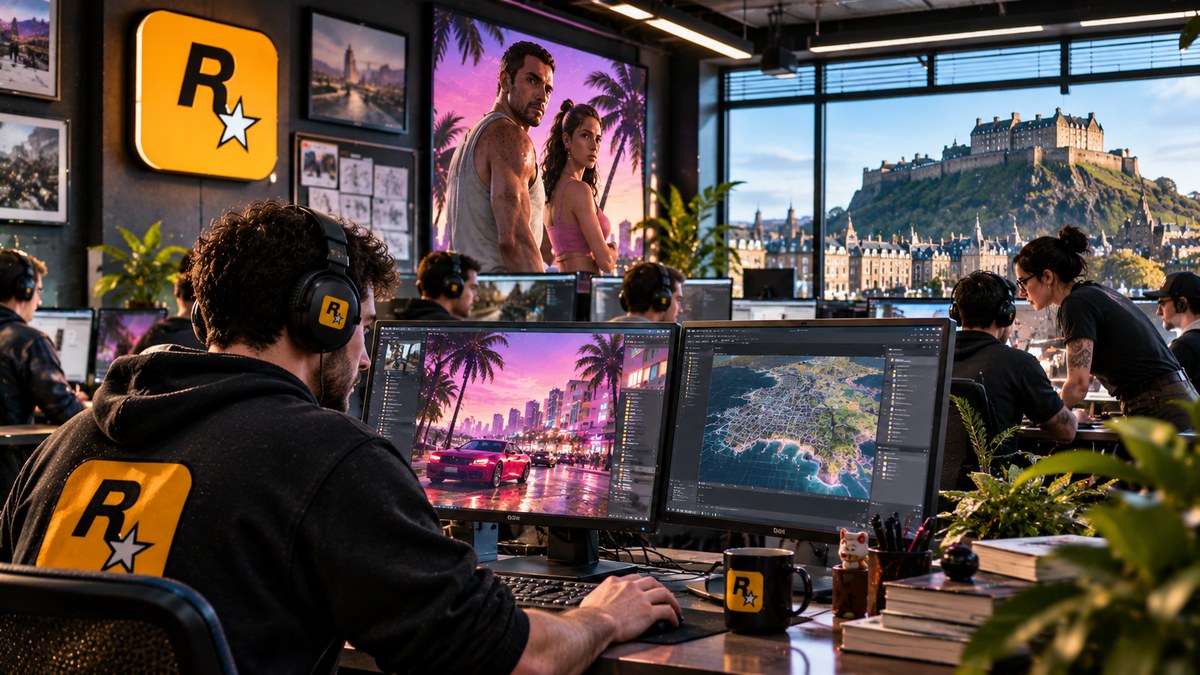
Visitors arriving in Edinburgh might not immediately connect the city with the fictional heat of Vice City. Yet Scotland remains central to the making of Grand Theft Auto VI. A new Guardian report from inside Rockstar North captures a studio confronting an unusual moment: years of production are ending, while the rest of the world is preparing to examine every detail.
Edinburgh remains at the heart of GTA
Rockstar’s production network now spans several countries, with thousands of people contributing to the franchise. The Guardian describes a workforce approaching 5,000 across the wider operation. Even at that scale, the Scottish headquarters remains an important creative centre. That continuity stretches back to the series’ early history in Dundee and its growth into a globally recognized property.
The setting could hardly be farther away. Leonida, the fictional state surrounding Vice City, draws on Florida’s beaches, highways, nightlife and contradictions. The appeal does not rest simply on visual realism. Grand Theft Auto has traditionally used exaggerated commercial culture, media and crime to build a satire that players can inhabit. The challenge for the new entry is making those elements feel contemporary without becoming a collection of internet jokes.
What a decade of development buys
Long production schedules make ambitious work possible, but they also raise expectations. Artists refine environments, writers revise dialogue, engineers rebuild systems and producers coordinate thousands of dependencies. A seemingly small feature can influence animation, sound, mission design and performance. That helps explain why blockbuster games take years even after their basic concept is established.
Rockstar has not supplied a verified final budget corresponding to every large figure circulating online. Reports of spending around or above a billion dollars require care, because different estimates may combine production, staffing, marketing and other costs. The more defensible observation is that the project involves enormous resources and unusual commercial risk.
Pressure reaches beyond the game itself
The Guardian also examines a workplace dispute involving former Rockstar North employees. The reported tribunal concerns dismissals and allegations connected to union organizing. Those allegations are contested and should be treated separately from conclusions about the finished game. A successful commercial launch would not, by itself, resolve questions about working conditions, just as an employment dispute does not determine whether the game will be enjoyable.
That distinction matters because the gaming industry has endured layoffs and closures even while its biggest franchises attract record attention. More money flowing to a handful of giant products does not guarantee stable careers throughout the sector. Smaller studios face different financing conditions, while employees across large teams can experience intense pressure around release deadlines.
The story Rockstar wants to tell
Official material positions Jason and Lucia as partners navigating a criminal conspiracy in Leonida. Their relationship is more prominent in promotional footage than the lone antihero formula familiar from several earlier entries. Whether the final narrative gives both characters substantial emotional depth remains a question for players and reviewers. Yet the focus already suggests Rockstar wants the audience to care about more than the next vehicle or spectacular chase.
There is also the city itself. Rockstar’s worlds work best when ordinary places carry a sense of life outside the main missions: traffic patterns, local businesses, overheard conversations and unexpected behavior. Those details rarely dominate trailers, but they shape how a place feels after dozens of hours. They are where a huge production budget becomes visible in quieter ways.
How ambitious worlds are assembled
From a production standpoint, a city-sized game is less like one enormous artwork and more like thousands of connected projects. Vehicle handling affects police pursuits; pedestrian behavior changes how streets feel; animation must respond to weather, clothing and movement. A revision in one system can alter work elsewhere. That web of dependencies explains why large development teams need both creative specialists and people whose work is almost invisible to the player, including testing, localization and production management. It also complicates public conversations about delays. Additional months are not necessarily evidence of a single problem. They may reflect many interlocking tasks that have to meet the same standard before release.
A rare cultural moment, with real stakes
GTA 6 is due on 19 November 2026 for PS5 and Xbox Series X|S. Its predecessor has spent more than a decade generating sales, cultural references and online stories. Many people who first encountered GTA V as teenagers are now adults with jobs and families. The audience has changed, even if the anticipation looks familiar.
The significance of the Edinburgh report lies in that contrast. From the outside, a blockbuster appears as trailers, countdowns and sales predictions. Inside the studio are years of decisions made by people whose names most players will never know. When Leonida finally opens, the world will judge the result quickly. Understanding how it came to exist requires a longer view.