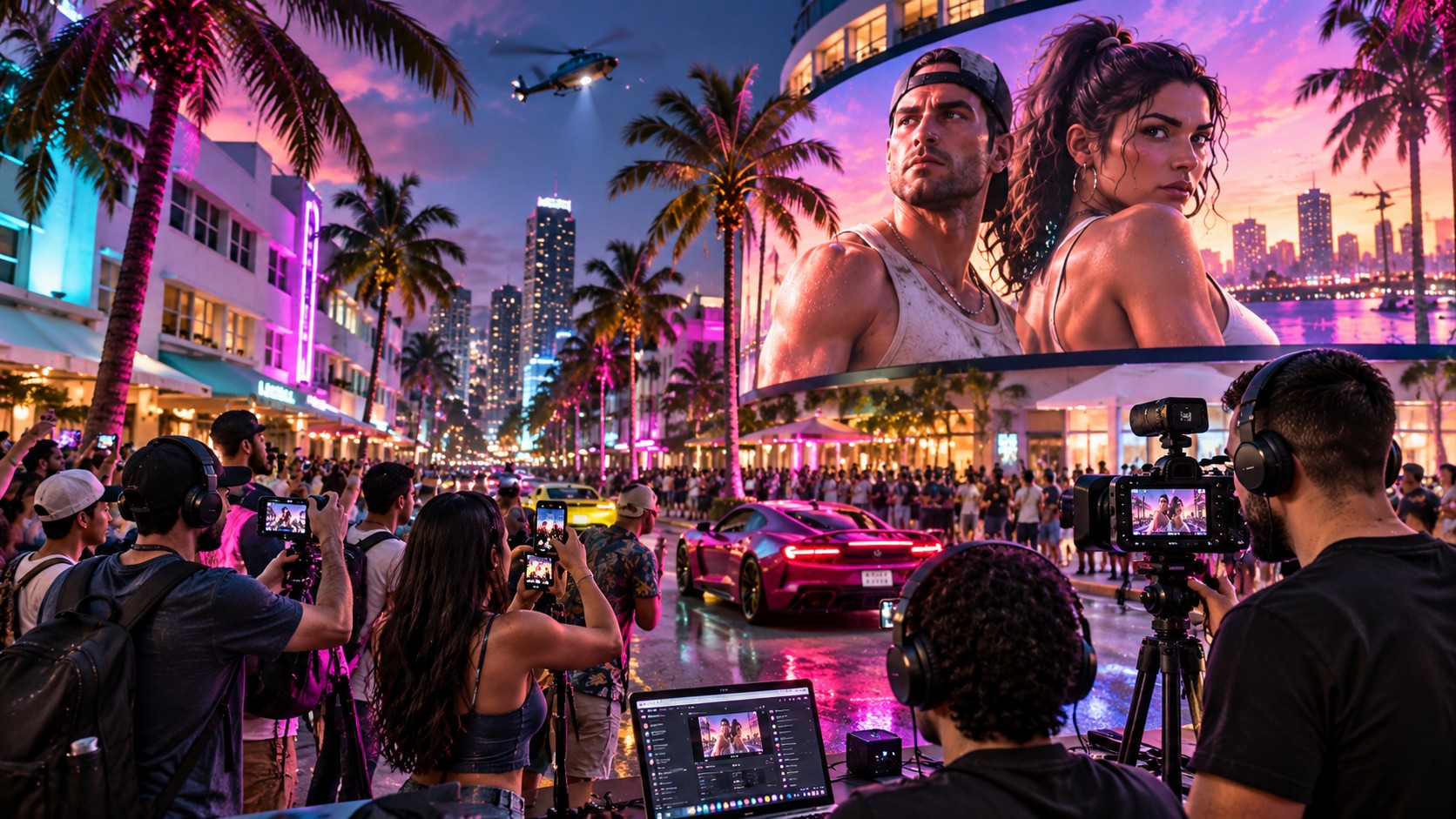
Most video games are marketed to people who already follow games. GTA 6 has escaped that boundary. Its launch campaign now appears in mainstream entertainment, local business promotions and conversations about what millions of people might do on November 19.
Rockstar’s crime saga returns after thirteen years, with Jason and Lucia navigating the fictional state of Leonida. The setting offers a familiar mix of sunshine, celebrity, ambition and disorder. It also provides brands with visual and musical references that work outside a controller screen.
The launch has become a shared calendar event
There are several reasons this release feels different from a conventional sequel. GTA V remained commercially relevant across multiple console generations. Its online component helped keep the wider franchise in view, while the long development gap gave audiences years to debate what a successor should contain.
Now the date is fixed. Rockstar lists November 19, 2026, for PS5 and Xbox Series X|S, and PlayStation has already opened preloading. A countdown visible on millions of consoles converts a marketing campaign into an appointment.
Entertainment companies are joining the conversation
YouTube has announced a 24-hour launch broadcast featuring creators from several countries. Netflix previously hosted an extended look at the game, presenting a long-form video reveal to an audience beyond traditional games press. Those are different platforms, but the logic is similar: a major release can draw people who might otherwise be watching something else.
The crossover works particularly well for Grand Theft Auto because music has always been part of its identity. In-game radio, licensed tracks and the cultural flavour of a fictional city have helped make earlier entries memorable long after their stories ended.
The economics of borrowed attention
Brands do not need to appear inside the game to benefit from the surrounding conversation. A launch-day livestream, a themed product or a staff gaming event can attract an audience while taking a relatively small piece of the event’s overall visibility.
Logitech, for instance, has introduced a company-wide gaming day timed to the release. YouTube is assembling an international creator broadcast. Those projects have different commercial objectives, yet both rely on the expectation that Grand Theft Auto VI will be a topic people already recognise.
Miami is part of the story without being Vice City
The game’s setting borrows heavily from South Florida. That resemblance encourages local collaborations, street-level promotions and comparisons between real neighbourhoods and fictional locations. Miami has its own identity, however, and it should not be reduced to a backdrop for a game about crime.
Recent footage shared by a Miami social account drew attention partly because viewers struggled to distinguish a supposed in-game scene from actual city streets. The reaction captured the campaign’s visual ambition. It also showed how quickly speculation spreads when official explanations are scarce.
Big forecasts come with large qualifications
Industry researchers have circulated first-week sales projections worth several billion dollars. Take-Two chief executive Strauss Zelnick has said preorders are exceeding expectations while remaining cautious about declaring success before launch.
These forecasts should be read as scenarios, not guaranteed results. Pricing, edition mix, reviews and access problems can change the outcome. Even if a record falls, it will not mean every company attached to the excitement shares equally in the revenue.
The event has also widened the range of people discussing games as an economic force. Film distributors, advertisers and music executives are watching how audience attention shifts, not only how many copies sell. That curiosity is a sign of cultural reach, although it should not be mistaken for a guaranteed commercial benefit to every participant.
Why the response matters after release day
The first morning is likely to bring screenshots, streaming highlights and comparisons between hardware versions. A week later, the conversation will turn toward the missions, characters, world design and unexpected moments players discover for themselves.
That transition is critical. Marketing can convince someone to watch a trailer. Only an engaging game can keep them returning to a fictional place. Past Grand Theft Auto titles were sustained partly by the freedom to wander, experiment and tell stories not prescribed by a mission.
The cultural moment has a short deadline
There is a reason executives are careful about celebrating before the game arrives. A blockbuster attracts scrutiny in proportion to its promises, from technical reliability to the scale of its storytelling. Anyone who has waited thirteen years will carry specific expectations into the opening hours.
The GTA 6 cultural takeover is already visible. Whether it becomes an enduring chapter in popular entertainment will depend on what happens after the billboards come down and the players finally take control.