
Meta description: Understand for gta 6, is screen size more important than oled?, GTA 6 PS5 limits and the best TV features to prioritise before the November 2026 release.
Myth Check
Editorial status: GTA 6 is officially listed for PS5 on November 19, 2026. Final PS5 resolution modes, frame-rate targets, install size and PS5 Pro enhancements were not officially detailed when this package was prepared.
The useful way to examine for GTA 6, Is Screen Size More Important Than OLED? is to separate platform capability from game-specific promises. PS5 compatibility is official. Final resolution, frame rate, ray-tracing settings, install size and PS5 Pro enhancements remain incomplete or unannounced.
The popular claim
Measure the wall and seating position before buying, then balance size with contrast, motion and gaming features. This advice remains valid even if Rockstar later announces several modes. A strong television and correctly configured signal chain can present each mode properly, while a weak display can hide contrast, add delay or block useful HDMI features.
Large screens magnify low-quality processing, unstable resolution and poor local dimming. That limitation is not a reason for pessimism. It is a reason to keep the argument precise. The PS5 has delivered large, visually ambitious games, but GTA 6 may combine more systems than a simple graphics comparison suggests.
The signal chain has three distinct layers. Rockstar chooses the software mode. The PS5 renders and outputs the signal. The television displays that signal with its own latency, contrast, brightness and processing. Most confused buying advice mixes these layers together.
The technical reality
A high price does not guarantee a perfect Game Mode. Some televisions reduce local dimming, alter tone mapping or limit ports when low latency is active. Model-specific testing matters.
Output support is not a performance target. A PS5 may send a 120 Hz signal while the game produces fewer unique frames. A 4K output can also contain an image reconstructed from a lower internal resolution.
A competent 60 Hz television remains compatible. It can present a stable 30 or 60 fps signal well. The owner mainly gives up high-refresh modes, part of VRR’s usefulness and some long-term flexibility.
The missing evidence
The television changes perception. Better black levels reveal shadow detail. Strong HDR preserves sunlight and reflections. Low latency makes steering and aiming feel more direct. These gains are real, although none increases the console’s simulation budget.
Room conditions remain decisive. Reflections can erase OLED’s contrast advantage in strong daylight, while blooming can distract from Mini LED highlights in darkness. The best panel is the one whose compromise is least visible where it will actually be used.
A useful test is to think about the most difficult scene, not the cleanest one. Dense traffic in rain, crowds near bright signs, rapid camera movement and active police behaviour create a more meaningful workload than an empty beach at sunrise.
What to verify
Before launch, update the PS5, confirm free storage and connect it to the television’s full-feature HDMI input. Enable the enhanced signal format, review VRR and 120 Hz output, then run the PS5 HDR calibration after selecting Game Mode.
Buyers should resist panic upgrades. A healthy PS5 connected to a recent low-latency 4K television is already a credible launch setup. Replacing working equipment only makes sense when the new product solves a specific weakness.
A purchase that only makes sense under one unconfirmed GTA 6 assumption is fragile. A purchase that improves contrast, latency, compatibility and screen size across the whole library is easier to justify.
A calmer conclusion
The final technical discussion should use direct capture from release software, repeatable locations and clear mode descriptions. Until those tests exist, careful wording is not indecision. It is the correct editorial standard.
The best upgrade is the one that fixes the weakest link. An old high-latency 1080p screen benefits greatly from replacement. A recent OLED owner may gain more from storage, audio or a healthier seating arrangement.
A practical note
Long sessions reward comfort. Excessive brightness, an oversized screen at short distance and aggressive sharpening can become tiring. Accurate colour and stable motion usually age better than a showroom preset.
Game Mode is more important than a cinema label. Motion interpolation, noise reduction and other processing can add delay. The best televisions preserve HDR, contrast and local dimming while lowering latency.
Keep the console in open space rather than a sealed cabinet. Clear airflow and current software matter more than decorative fan accessories. If storage is tight, a compatible M.2 SSD can run PS5 games directly.
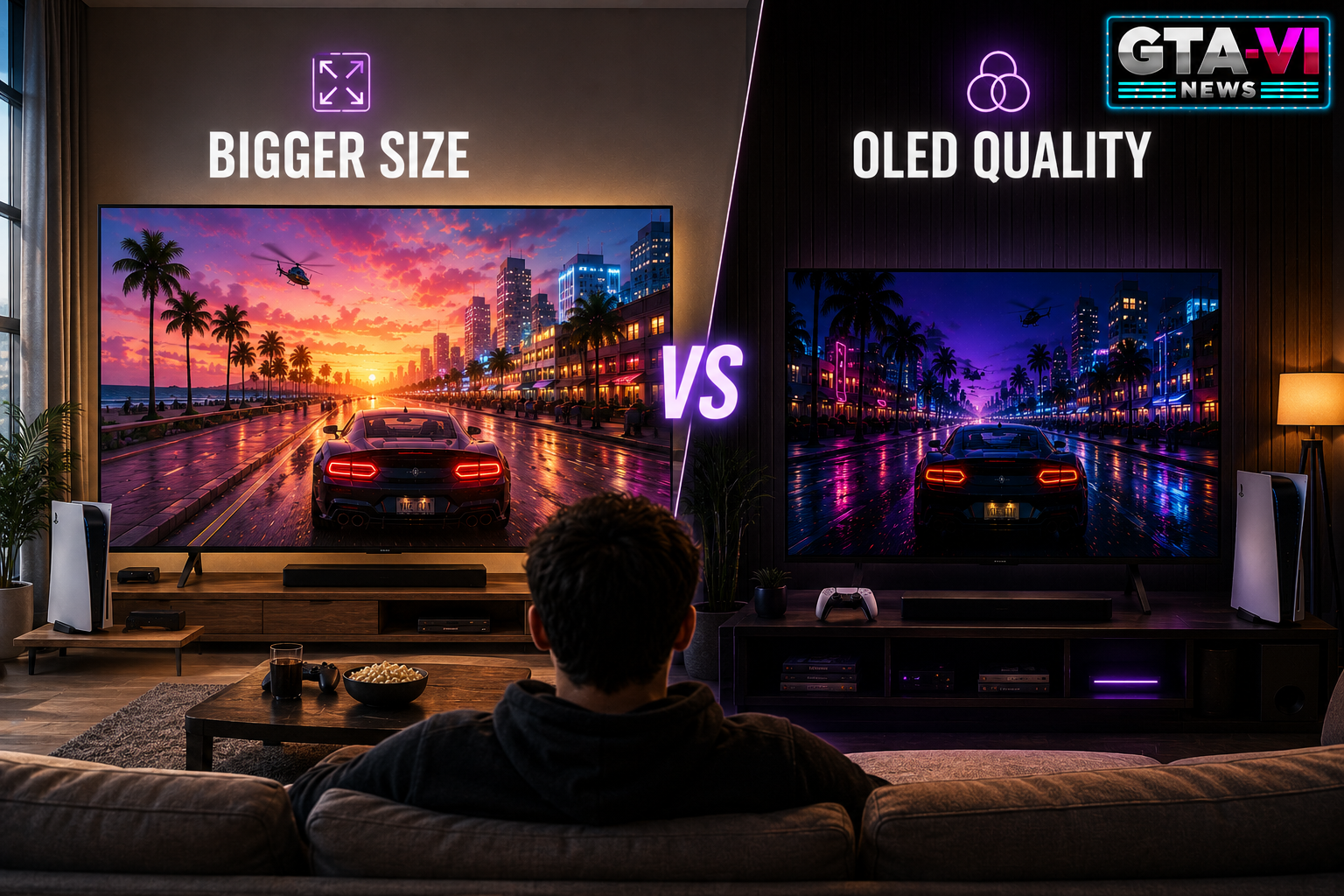
Screen size should follow distance. A 65-inch television can be immersive from a normal sofa, while a 42-inch or 48-inch OLED may be ideal at a desk or in a small room. Bigger is not automatically better when the seating position is wrong.
The title question, For GTA 6, Is Screen Size More Important Than OLED?, is useful because it forces a distinction between support and optimisation. A supported console can still face trade-offs. Developers decide whether extra processing time goes toward denser crowds, richer reflections, sharper output or faster response. The same millisecond cannot be spent twice.
An official platform listing means owners of a healthy standard PS5 are using supported hardware. The real question is presentation. Rockstar may use dynamic resolution, reconstruction, multiple graphics modes or one tightly controlled target. None should be treated as confirmed without direct information.
A calmer conclusion
The correct screen size depends on viewing distance, room lighting and budget. A larger weak panel can be less satisfying than a smaller high-quality one. In practical terms, measure the wall and seating position before buying, then balance size with contrast, motion and gaming features. Large screens magnify low-quality processing, unstable resolution and poor local dimming. The result is less dramatic than a rumour, but far more useful.